
In 2026, a vague "eco-friendly" claim is no longer a marketing asset; it's a significant regulatory liability. With the UK's Extended Producer Responsibility (EPR) framework now introducing modulated fees based on recyclability, your choice of materials directly impacts your bottom line. Having the OK compost HOME certification explained is the first step in moving beyond the confusion of generic "biodegradable" labels. It's about securing a verified, transparent path toward circularity that protects your brand from greenwashing accusations and ensures compliance with evolving standards.
We understand that managing these shifting requirements can feel complex, especially when you're trying to balance operational efficiency with environmental stewardship. This guide reveals exactly what the OK compost HOME label guarantees and why it's the definitive benchmark for sustainable packaging this year. You'll gain a clear understanding of the certification criteria, from degradation rates to chemical safety. We also preview how adopting high-quality alternatives, such as certified compostable garbage bags and food waste solutions, can streamline your ESG reporting and support a cleaner, more resilient future for your organisation.
Key Takeaways
- Understand the critical temperature distinction between home and industrial composting to ensure your chosen materials perform effectively in garden environments.
- This guide has the OK compost HOME certification explained through its four mandatory testing pillars, ensuring 90% biodegradation within 12 months without toxic residues.
- Discover how this label serves as a strategic asset for UK businesses to navigate the 2026 Extended Producer Responsibility (EPR) framework and modulated fees.
- Learn why transitioning to certified compostable garbage bags and clingfilm can eliminate greenwashing risks and strengthen your organisation's ESG reporting.
- Gain the practical insights required to align your procurement strategy with a circular economy, positioning your brand as a leader in environmental stewardship.
What is OK compost HOME Certification?
The OK compost HOME label, awarded by the international body TÜV Austria, represents the most rigorous standard for organic recovery available to UK businesses. Having the OK compost HOME certification explained is essential for procurement teams because it guarantees that a product will fully break down in a domestic compost heap. Unlike industrial standards that rely on heavy machinery and extreme heat, this certification ensures that materials return to the earth without leaving behind microplastics or harmful chemical residues.
Many organisations mistakenly use the term "biodegradable" as a catch-all for sustainability, yet this word lacks a legal timeframe or specific environmental requirement. In contrast, products carrying the OK compost HOME mark are crafted from advanced bioplastic materials that must meet four strict criteria: biodegradation, disintegration, lack of eco-toxicity, and low heavy metal content. This transparency is what makes the label a trusted shield against greenwashing in a competitive market.
To better understand how this certification functions in practice, watch this helpful video:
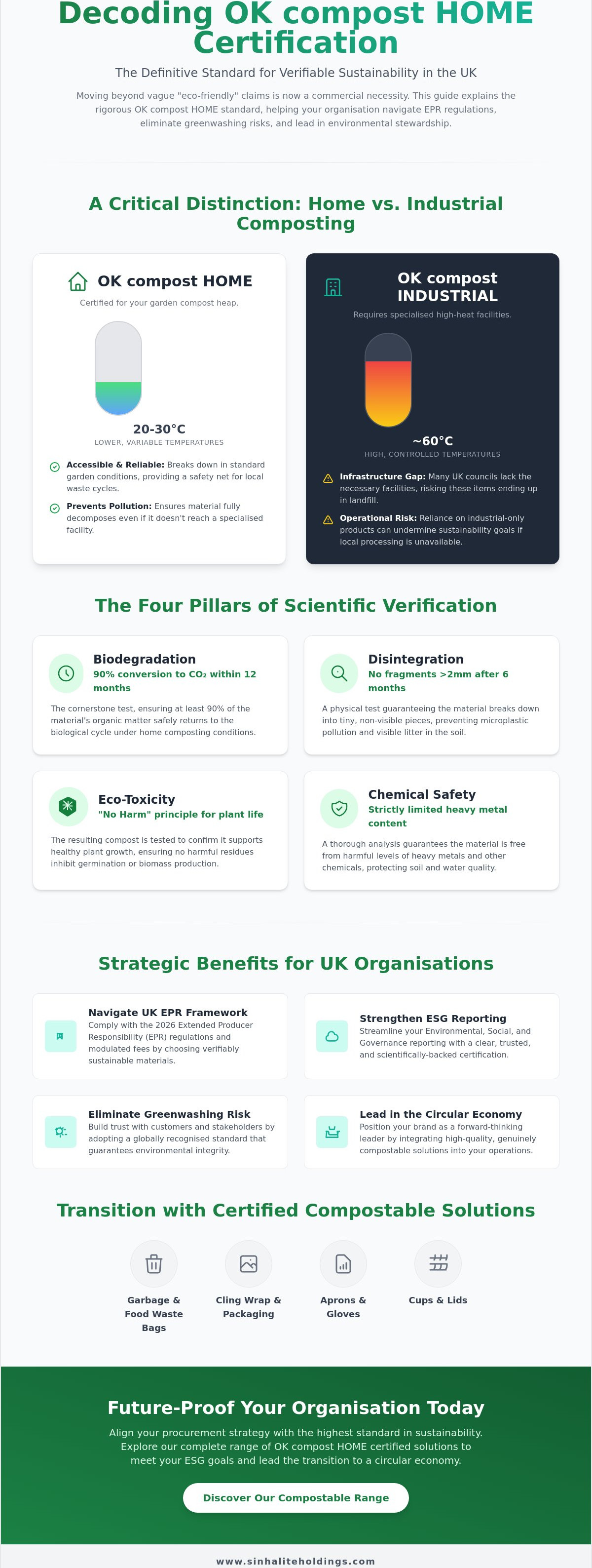
The fundamental technical distinction lies in the thermal environment. Industrial composting facilities maintain temperatures around 60°C to facilitate rapid breakdown. However, a garden compost heap typically operates between 20-30°C. Because OK compost HOME products are tested at these lower, less consistent temperatures, they provide a reliable solution for items that might bypass industrial waste streams.
Home vs. Industrial Composting: The UK Context
For UK organisations, the distinction is more than just technical; it's a matter of waste management integrity. Many "Industrial Only" compostable items end up in landfill because local councils often lack the specialised high-heat facilities required to process them. By choosing items like compostable garbage bags or caddy bags that meet home standards, businesses provide a safety net for local waste cycles. This ensures that even if a product misses the industrial bin, it won't persist in the environment for decades.
Recent innovations in bioplastic technology 2026 have enabled the production of high-performance alternatives like compostable household clingfilm and shopping bags that maintain industrial-grade strength while remaining garden-safe. This evolution allows businesses to meet their ESG targets without sacrificing the utility or durability their daily operations demand.
The Science and Testing Behind the Label
The integrity of the OK compost HOME label rests on a foundation of rigorous, multi-stage scientific validation. When we look at the OK compost HOME certification explained through a technical lens, it's clear that the process goes far beyond simple breakdown. Every product must successfully pass four mandatory testing pillars: biodegradation, disintegration, eco-toxicity, and a strict analysis of heavy metal content. These benchmarks ensure that the material doesn't just disappear from sight but integrates safely back into the biological cycle.
The 90% rule is the cornerstone of this validation. For a material to earn its certification, at least 90% of the organic matter must convert into CO2 within 12 months under home composting conditions. This is a significantly longer and more demanding timeframe than the six months required for industrial standards. It accounts for the lower, fluctuating temperatures found in a typical UK garden. Additionally, a physical disintegration test ensures that no fragments larger than 2mm remain after six months. This prevents the accumulation of visible litter in the soil, maintaining the aesthetic and functional quality of the resulting compost.
Testing also focuses on the "No Harm" principle. This ensures that the compost produced is not only free from microplastics but also supports healthy plant growth. Testing bodies conduct plant toxicity trials to confirm that the degraded material doesn't inhibit germination or biomass production. This level of scrutiny is why many organisations now explore our range of certified compostable solutions to replace conventional plastic items like shopping bags and caddy bags.
Verifying Material Safety and Non-Toxicity
Safety extends deep into the chemical composition of the product. Modern certifications ensure that materials are entirely free from harmful PFAS, often called "forever chemicals," which are frequently found in traditional grease-resistant plastics. For a deeper look into the molecular safety of these products, you can read our guide on are there chemicals in compostable plastics. Much of this performance is achieved through the use of plant-based polymers like PBAT. These materials provide the durability and strength required for commercial use while maintaining the chemical simplicity needed for safe organic degradation.
Strategic Benefits for UK Organisations and Businesses
Adopting verified standards is no longer a peripheral choice; it's a strategic necessity for brand integrity. Having the OK compost HOME certification explained within your procurement policy acts as a robust shield against greenwashing. It provides the transparent, third-party validation that modern consumers and stakeholders demand. By integrating certified compostable shopping bags and garbage bags into your operations, your organisation demonstrates a concrete commitment to environmental stewardship that goes beyond mere rhetoric.
The 2026 shift toward a circular economy has redefined waste as a resource. For UK councils, the use of certified home-compostable caddy bags by residents simplifies the logistics of organic waste collection. These liners ensure that food waste remains uncontaminated by traditional plastic, making the composting process more efficient and cost-effective. This alignment between business practices and local infrastructure creates a seamless transition away from single-use plastics, directly supporting national sustainability goals.
Meeting ESG targets requires measurable action. Switching to certified alternatives allows businesses to report precise reductions in plastic waste. Whether it's replacing plastic wrap in food service or using compostable food roller bags, these choices provide the data-driven evidence needed for modern corporate reporting. It's about building a reputation as a responsible innovator that provides tangible tools for a greener future.
Practical Implementation in Commercial Settings
Success starts with prioritising high-volume waste areas. Kitchens and delis are ideal environments to begin the transition. You can maintain high performance and ethical standards by swapping traditional plastic wrap for compostable cling film that actually clings. This simple switch ensures that food safety is never sacrificed for sustainability, providing a practical solution that scales with your business needs.
Staff training is equally vital. Ensuring your team understands how to identify the OK compost HOME label helps prevent cross-contamination. When certified bags are correctly disposed of in organic waste streams, the entire system functions as intended. This collaborative approach turns a procurement choice into a powerful driver of systemic change, reinforcing your organisation's role as a leader in the transition to a plastic-free UK.
Securing Your Organisation's Sustainable Future
The transition toward a circular economy requires more than just intent; it demands verified, high-performance solutions that protect both the environment and your brand's reputation. Having the OK compost HOME certification explained provides the clarity needed to make informed procurement decisions that align with the 2026 UK regulatory landscape. By prioritising materials that pass rigorous biodegradation and eco-toxicity tests, your organisation ensures that "compostable" remains a promise kept. Don't settle for vague eco-claims when you can rely on scientifically validated standards.
Sinhalite Holdings has been a specialist UK supplier of these solutions since 2018, helping partners navigate the shift away from single-use plastics with confidence. Our offerings maintain full compliance with TÜV Austria standards, ensuring every product meets the highest benchmarks for organic recovery. As a partner trusted by UK businesses and councils, we provide the practical tools, from compostable caddy bags to high-performance clingfilm, required to meet your ESG targets. Explore Sinhalite's range of OK compost HOME certified packaging today to secure a cleaner, more resilient future for your organisation. It's time to lead the way toward a sustainable, plastic-free legacy.
Frequently Asked Questions
Is OK compost HOME the same as EN 13432?
No, OK compost HOME is not identical to EN 13432, though it incorporates many of the same rigorous testing principles. While EN 13432 is the European standard for industrial composting requiring temperatures of 60°C, the OK compost HOME certification is specifically adapted for the lower temperatures of 20-30°C found in domestic garden heaps. This distinction ensures that products break down effectively even in the less controlled environments typical of UK households.
Can I put OK compost HOME certified products in my food waste caddy?
Yes, you can typically place these certified products in your food waste caddy. Because they meet the most stringent requirements for organic recovery, they are highly compatible with local council collection schemes across the UK. Using certified caddy bags or food roller bags helps streamline the waste management process, ensuring that organic material reaches processing facilities without the risk of traditional plastic contamination or microplastic residue.
How long does it take for a certified bag to disappear in a UK garden?
A certified bag will typically achieve 90% biodegradation within 12 months when placed in a garden compost heap. This OK compost HOME certification explained in technical terms requires the material to disintegrate into fragments smaller than 2mm within just six months. These timeframes ensure that high-quality compostable garbage bags return to the earth efficiently without disrupting the biological cycle or the quality of the resulting soil.
Does the certification guarantee that the product is GMO-free?
No, the certification does not explicitly guarantee that a product is GMO-free. Its primary focus is on the environmental impact of the product’s end-of-life, specifically its ability to biodegrade safely and completely without leaving toxic traces. Organisations seeking GMO-free status should look for additional specific declarations from their suppliers alongside the OK compost HOME mark to ensure full alignment with their internal ethical procurement policies and corporate responsibility standards.


