
With the UK producing an estimated 10.7 million tonnes of food waste annually, the transition from voluntary initiatives to strict legal mandates is a vital reality for every sector. Staying ahead of the regulations for food waste disposal uk business is essential to avoid fixed penalty notices or the risk of prosecution for persistent non-compliance. We recognize that aligning your daily operations with these systemic changes can feel like a significant undertaking, especially when you're focused on maintaining a productive workplace.
This article provides the clarity you need to master the latest legislation and ensure your business remains compliant while adopting sustainable disposal practices. You'll find a clear, actionable checklist that details the 2026 enforcement expectations and the specific requirements for different business sizes. We also examine how implementing high-performance tools, such as compostable caddy bags and garbage bags, can simplify staff training and prevent waste contamination. By following this guide, you'll gain the confidence to turn these regulatory requirements into a visionary step forward for your organization's environmental legacy.
Key Takeaways
- Learn how the 'Simpler Recycling' reforms establish a unified standard for waste separation across all UK commercial sectors.
- Navigate the essential regulations for food waste disposal uk business so you don't face penalties while upholding your statutory Duty of Care.
- Determine your compliance timeline based on employee headcount, distinguishing between the requirements for micro-firms and larger enterprises.
- Implement a practical seven-step roadmap to audit your food waste volume and establish a reliable internal bin system.
- Explore how integrating compostable caddy bags and garbage bags into your workflow simplifies waste handling and prevents bin contamination.
Understanding the UK Food Waste Landscape: The 2026 Mandate
The "Simpler Recycling" framework represents a significant shift in how the government approaches environmental stewardship within the commercial sector. This legislative structure mandates that all businesses in England must separate food waste from other waste streams, ensuring that organic materials are processed through specialized facilities rather than ending up in landfill. Adhering to the regulations for food waste disposal uk business requires a proactive approach to waste management that prioritizes separation at the source. By implementing these practices, your organization contributes directly to a systemic reduction in methane emissions. Instead of generating harmful greenhouse gases in a landfill environment, captured food waste supports anaerobic digestion, a process that creates renewable energy and nutrient-rich fertilizer.
To better understand the core components of this framework, watch this helpful video:
Effective oversight is maintained by the Department for Environment, Food & Rural Affairs (DEFRA) and the Environment Agency. These bodies ensure that the transition to a more circular economy is handled with transparency and integrity. A deeper look at Food waste in the United Kingdom reveals that millions of tonnes of organic material are produced annually, highlighting why these centralized regulations are necessary for long-term ecological health. The Environment Agency oversees these regulations for food waste disposal uk business to ensure that commercial waste does not compromise national sustainability targets.
The 2026 Regulatory Timeline
The general mandate for businesses officially came into force on 31 March 2025. While many organizations have already integrated these practices, 2026 serves as a critical year for those finalizing their operational shifts. Micro-firms with fewer than 10 full-time equivalent employees currently benefit from a transition period, with a final compliance deadline of 31 March 2027. By the start of 2026, the majority of the UK business landscape is expected to be fully compliant, as local authorities transition from providing guidance to stricter enforcement protocols and potential penalties.
Why "Business as Usual" is No Longer Legal
Mixing food waste with general residual waste is now a violation of national waste policy. This ban exists because contamination from non-organic materials, such as traditional plastic bags, prevents the efficient processing of food waste in anaerobic digestion plants. When businesses use standard plastic liners, they risk the entire batch being rejected and sent to landfill, which defeats the purpose of the separation mandate. Transitioning to specialized, high-performance tools is a requirement for operational integrity. Diverting food waste from the general stream creates a closed-loop system where organic materials return to the earth as resources rather than pollutants.
The Legal Framework: Mandatory Separation and Duty of Care
The integrity of a business's waste management system rests on the legal foundation of the Duty of Care. Under Section 34 of the Environmental Protection Act 1990, every commercial entity bears a personal responsibility for the waste they produce. This responsibility doesn't end when the bin is emptied; it extends until the material reaches its final destination for recovery or disposal. To adhere to the regulations for food waste disposal uk business, you must ensure that all food remains are handled safely and stored securely to prevent environmental pollution or the attraction of pests. This legal obligation requires the use of only licensed waste carriers who are authorized to transport organic material to anaerobic digestion or composting facilities.
The government maintains strict standards for how these materials move through the supply chain. For detailed requirements on animal by-products and former foodstuffs, businesses should consult the official government guidance. Maintaining a clear audit trail is a critical part of this process. You're required to keep records of every waste transfer for at least two years, providing proof of your commitment to lawful disposal during any potential inspection.
Defining "Food Waste" for Compliance
Achieving compliance starts with a precise understanding of what belongs in your organic recycling stream. This includes plate waste from customers, preparation scraps from kitchens, and any expired inventory that's no longer fit for consumption. It's vital to remember that liquid waste, such as fats, oils, and greases (FOG), must never be mixed with solid food waste. These substances require separate collection to prevent sewer blockages. Contamination is a primary concern for processing facilities. If plastic, glass, or metal enters the food bin, it often leads to heavy surcharges or rejected loads. Utilizing high-performance compostable caddy bags helps maintain hygiene while ensuring that the containment material itself is compatible with the organic recycling process.
The Role of Waste Transfer Notes
Every time food waste leaves your premises, it must be accompanied by a Waste Transfer Note (WTN). In 2026, the UK is moving toward mandatory digital waste tracking to increase transparency and reduce illegal dumping. A valid WTN must contain a clear description of the waste and the appropriate European Waste Catalogue (EWC) code, which is typically 20 01 08 for commercial food waste. It also needs the signatures of both the producer and the carrier, the quantity of waste, and the address of the production site. Failing to produce these documents during an audit can result in significant fines. Ultimately, mastering the regulations for food waste disposal uk business protects your organization from legal risk while supporting the national transition to renewable energy.
Business Exemptions vs. Full Compliance: Where Do You Stand?
Understanding where your organization falls within the current legislative framework is the first step toward achieving environmental integrity. While the general mandate for most workplaces came into effect on 31 March 2025, the law distinguishes between different scales of operation to allow for a smoother systemic transition. Standard commercial entities, charities, and public sector organizations are all required to adhere to the regulations for food waste disposal uk business. However, the specific requirements often depend on the nature of your output. A hospitality business producing hundreds of meals daily faces different logistical challenges compared to an office environment where waste is limited to staff lunch scraps and coffee grounds. Regardless of your sector, the core objective remains the same: ensuring that organic material is diverted from landfills to support a more sustainable future.
The Micro-Firm Grace Period
Small organizations with fewer than 10 full-time equivalent (FTE) employees are currently classified under a micro-firm exemption. This provides a temporary grace period with a final compliance deadline of 31 March 2027. We encourage these smaller entities to avoid complacency. Implementing these systems early reduces future operational shocks and spreads out the cost of staff training over a longer period. Small businesses can often find efficiency by utilizing shared collection hubs with neighboring firms, which lowers the financial burden of separate pickups. By adopting high-quality tools like compostable garbage bags today, you prepare your team for the inevitable standards of tomorrow while demonstrating immediate environmental stewardship.
Large Scale Operations and Higher Standards
For high-volume producers such as food manufacturing plants, large hotels, and major retailers, the expectations are significantly higher. These organizations must conduct regular internal waste audits to prove their ongoing compliance with the regulations for food waste disposal uk business. This data is no longer just for internal records; it's a core component of corporate social responsibility (CSR) reporting. According to the Food Waste Reduction Roadmap, tracking progress is essential for meeting national climate targets and reducing the UK's overall carbon footprint. Large-scale compliance demonstrates a commitment to transparency and ecological leadership, positioning your brand as a responsible innovator in an increasingly scrutinized market. Consistent record-keeping ensures that your business remains a steady and dependable ally in the global effort to minimize waste.
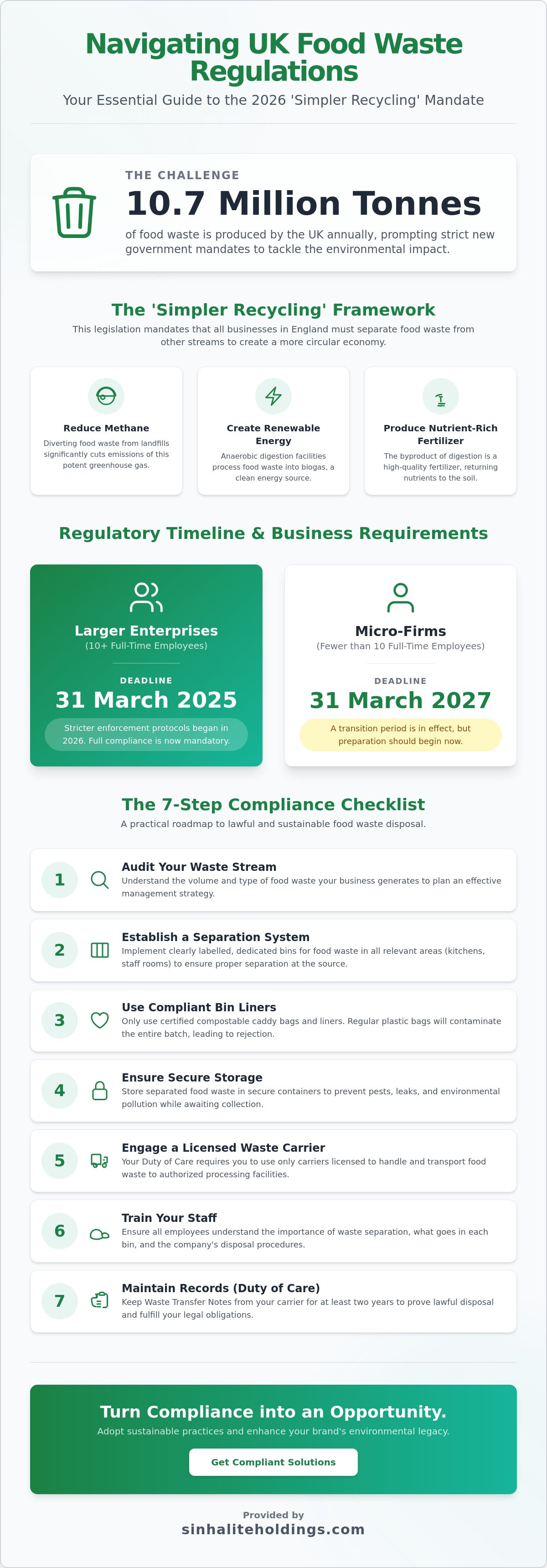
The 2026 Compliance Checklist: 7 Steps to Lawful Disposal
Transitioning from conceptual understanding to practical application is where environmental stewardship becomes a reality. Adhering to the regulations for food waste disposal uk business requires a methodical strategy to ensure no operational detail is overlooked. By following this structured checklist, your organization can achieve full compliance while maintaining the highest standards of workplace hygiene and efficiency.
- Step 1: Conduct a Food Waste Audit. Before investing in equipment, determine the volume and frequency of your waste production. This data allows you to size your bins correctly and negotiate fair collection schedules with carriers.
- Step 2: Procure Designated Bins. You'll need separate internal caddies for kitchens and staff rooms, along with larger external containers for collection. These must be clearly distinguishable from general waste bins.
- Step 3: Source Certified Liners. Maintaining hygiene is a primary concern for many managers. Utilize BS EN 13432 certified compostable caddy bags to keep bins clean. These liners are engineered to break down during industrial composting, preventing plastic contamination in the organic stream.
- Step 4: Contract a Licensed Waste Carrier. Ensure your provider is specifically authorized to handle organic waste. Verify their credentials to ensure the waste reaches an anaerobic digestion facility rather than a landfill.
- Step 5: Launch a Staff Training Programme. Education is the bridge between policy and practice. Train your team on exactly what constitutes food waste and the importance of preventing cross-contamination.
- Step 6: Establish a Documentation System. Set up a secure digital or physical file for your Waste Transfer Notes. You're legally required to retain these records for two years to prove your compliance during audits.
- Step 7: Monitor and Refine. Perform monthly spot checks on your bins. Identifying contamination early allows you to provide targeted retraining before it leads to carrier surcharges or legal issues.
Internal Infrastructure and Signage
Success in waste segregation often depends on the physical layout of your workspace. Use colour-coded bins, typically green for food waste, to provide an immediate visual cue for employees. Supplement these with icon-based signage that's easy to understand at a glance, as this is more effective than text-heavy instructions in a fast-paced environment. Strategic placement is equally vital. Position caddies directly at food preparation stations to make separation the path of least resistance. To maintain a healthy environment and prevent pest attraction, empty internal bins at least every four hours or at the end of every shift.
Staff Training and Behavioural Change
Introducing new workflows can sometimes meet with internal resistance. To overcome this, frame the transition as a shared mission toward a more sustainable future rather than a mere administrative burden. Implementing a "champion" model is often effective. By empowering passionate team members to lead the recycling effort, you create a culture of peer-to-peer accountability. In retail or hospitality settings, clear communication with customers is necessary. Use high-visibility labels on public-facing bins to guide visitors. When your team understands the "why" behind the regulations for food waste disposal uk business, they're far more likely to commit to the "how" of daily segregation.
Beyond Compliance: Leveraging Compostable Solutions for Growth
Compliance with the regulations for food waste disposal uk business shouldn't be viewed merely as a checklist of legal restrictions. Instead, it's a strategic opportunity to align your daily operations with modern ethical standards and environmental stewardship. Sinhalite Holdings acts as a visionary partner in this transition, providing the tangible tools required to reach your sustainability goals with confidence. By integrating high-performance compostable caddy bags and garbage bags into your workflow, you solve the practical challenges of waste separation while reinforcing your brand's commitment to a plastic-free future. This proactive approach transforms a regulatory requirement into a clear reputational advantage that resonates with eco-conscious clients and investors.
Traditional plastic liners are inherently incompatible with organic recycling streams, often leading to rejected loads and increased operational costs. In contrast, advanced compostable materials offer a sophisticated blend of industrial pragmatism and ecological responsibility. These solutions are engineered to withstand the rigours of a busy commercial kitchen while ensuring that the containment material itself returns to the earth as a resource. Embracing these innovations allows your business to project the persona of a responsible innovator, leading the way in your sector through practical, systemic change.
The Science of High-Performance Compostables
The technical superiority of our compostable solutions lies in their advanced material composition. Unlike traditional plastic, which traps moisture and accelerates rot, breathable compostable liners allow water vapour to escape. This breathability significantly reduces the buildup of unpleasant odours and liquids at the bottom of your bins, creating a more hygienic environment for your staff. Our materials are strictly PFAS-free and GMO-free, meeting the highest standards of safety and integrity. By choosing these high-performance options, you ensure that your waste stream remains pure and compatible with anaerobic digestion, preventing the contamination issues that often lead to heavy surcharges.
Your Next Steps with Sinhalite Holdings
Achieving total alignment with the regulations for food waste disposal uk business involves looking beyond the bin itself. We encourage you to audit your entire inventory for plastic-free swaps that support your waste segregation goals. Replacing standard plastic with compostable household clingfilm or utilizing compostable food roller bags for preparation can eliminate hidden microplastics from your organic stream. For organizations managing multiple sites, establishing a bulk procurement path for compostable shopping bags and waste liners ensures consistency and reliability across your entire operation. Taking these methodical steps today ensures you're a steady, dependable ally in the UK's mission for long-term ecological impact.
Ensure your business is 2026-ready with our compostable waste solutions.
Securing Your Business Legacy Through Sustainable Compliance
Mastering the regulations for food waste disposal uk business is a transformative step that moves your organization from passive compliance to active environmental leadership. By establishing a clear audit trail and implementing the seven-step checklist, you ensure that your operations remain resilient against shifting legal standards. The transition is most effective when you pair rigorous staff training with high-performance tools that maintain workplace hygiene. This systematic approach protects your organization from penalties while demonstrating a profound commitment to the circular economy.
Sinhalite Holdings is a dedicated specialist in plastic-free solutions, offering products that are certified BS EN 13432 compliant for industrial composting. Our durable, leak-proof designs are trusted by UK businesses to handle the demands of commercial waste management without compromising on integrity. You can take the next step in your sustainability journey today by choosing tools that work in harmony with natural processes. Browse our range of commercial compostable caddy liners and garbage bags to find the perfect fit for your facility. Embracing these changes today ensures a cleaner, more prosperous future for your business and the planet.
Frequently Asked Questions
Does my small UK business really need a separate food waste bin in 2026?
Yes, if your business employs 10 or more full-time equivalent staff, you are already legally required to have a separate bin as of March 2025. Micro-businesses with fewer than 10 employees have a temporary exemption until 31 March 2027. However, adopting these practices now ensures you're ready for the final deadline and helps establish a culture of environmental responsibility within your team.
What are the penalties for mixing food waste with general waste?
Penalties for non-compliance include formal compliance notices and fixed penalty notices of up to £300. Persistent offenders who ignore the regulations for food waste disposal uk business face prosecution and fines of up to £5,000. These measures ensure that commercial entities take their environmental duties seriously and prevent organic material from entering landfills where it produces harmful methane.
Can I use regular plastic bin liners for my food waste caddy?
No, regular plastic liners are prohibited in food waste caddies because they contaminate the organic recycling process. Traditional plastic doesn't break down and can cause entire loads to be rejected by anaerobic digestion facilities. Utilizing certified compostable caddy bags ensures that your waste remains compatible with industrial composting standards while maintaining kitchen hygiene and preventing unpleasant moisture buildup.
What is the "Simpler Recycling" law and how does it affect my office?
Simpler Recycling is a legislative reform designed to standardize waste collection across England, ensuring all workplaces separate food waste from other streams. In an office environment, this means providing dedicated bins for items like tea bags, coffee grounds, and staff lunch remains. It removes the confusion of varying local rules and creates a unified national standard for corporate waste management and accountability.
How often should a business arrange for food waste collection?
Most businesses find that a weekly external collection is sufficient, though high-volume food producers may require more frequent pickups. Internally, you should empty caddies into your external bins at least once per day to prevent odours and pest attraction. Monitoring your waste volume during an initial audit will help you determine the most cost-effective collection frequency for your specific commercial site.
Are compostable bags allowed in commercial food waste collections?
Yes, compostable bags are generally allowed and often encouraged, provided they meet the BS EN 13432 standard. These bags are specifically designed to decompose alongside organic matter in industrial facilities. Using these tools helps prevent the contamination associated with conventional plastic and simplifies the segregation process for your employees, making the transition to new waste streams much smoother.
How do I check if my waste carrier is legally licensed?
You can verify a carrier's legitimacy by searching the Environment Agency’s public register of waste carriers, brokers, and dealers. It's your legal responsibility under the Duty of Care to ensure that anyone transporting your waste is properly authorized. Checking these credentials protects your business from being linked to illegal disposal practices and ensures your food waste is processed correctly.
What is a Waste Transfer Note and why do I need to keep it?
A Waste Transfer Note (WTN) is a legal document that tracks the movement of waste from your premises to a disposal or recycling site. You are required by law to keep these records for at least two years to provide an audit trail for local authorities. It serves as proof that you have fulfilled your obligations under the regulations for food waste disposal uk business.