
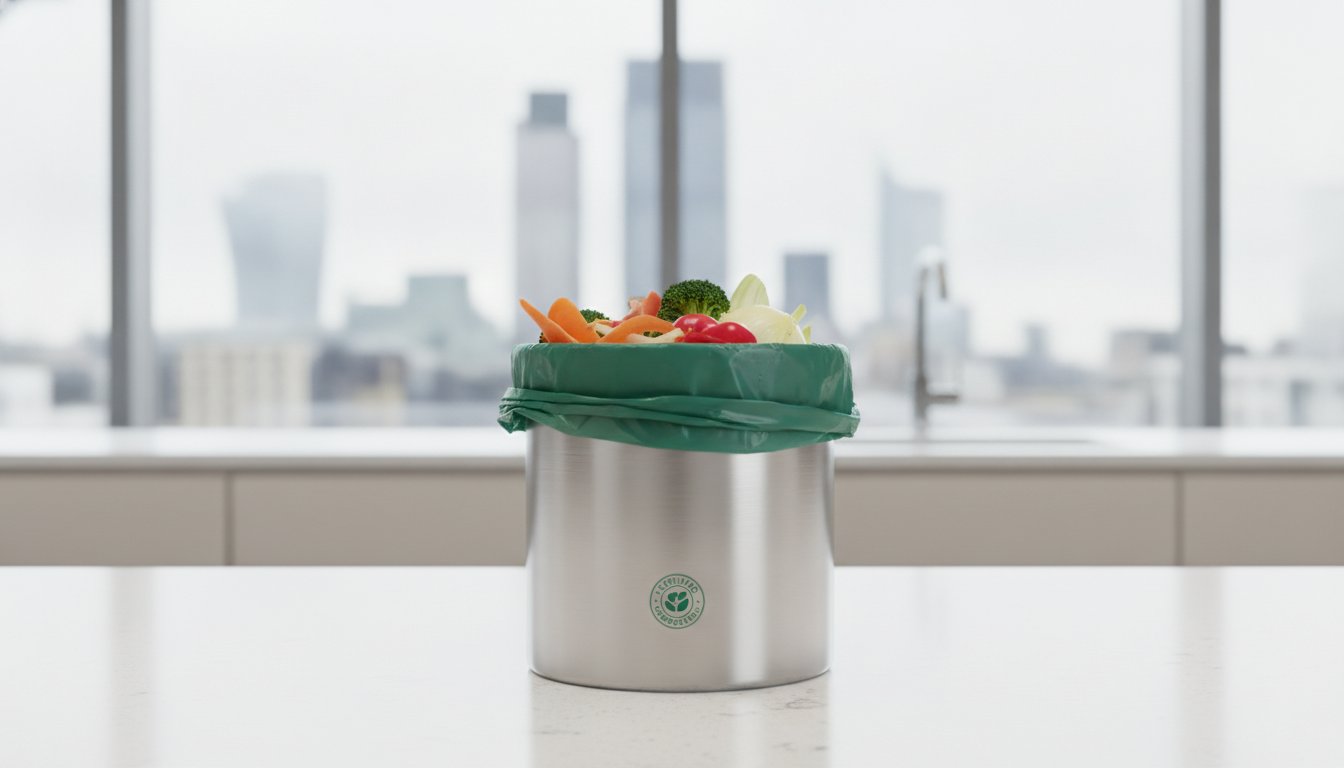
Did you know that the UK generates approximately 9.5 million tonnes of food waste every year, a staggering figure that has made the March 31, 2026, "Simpler Recycling" mandate a defining moment for British industry? You likely understand that diverting organic matter from landfills is a vital step toward a circular economy, yet the practical reality often involves the frustration of liners that split or fail to meet rigorous EN 13432 standards. It's difficult to champion environmental stewardship when your waste management tools don't perform to a professional grade or fail to meet the legal requirements for food waste separation.
This guide will show you how to identify high-performance compostable food bin liners uk that combine industrial strength with full regulatory compliance. We'll help you secure your organisation's sustainability credentials while eliminating the mess and liability associated with inferior products. We'll examine the critical differences between misleading terminology, explain the importance of material gauge for commercial durability, and provide a clear roadmap for selecting the right sizes for your diverse operational needs. By the end of this guide, you'll have the knowledge to transition away from traditional plastics with confidence and precision.
Key Takeaways
- Learn how to distinguish between "biodegradable" and EN 13432 certified compostable food bin liners uk to ensure your organisation remains fully compliant with the 2026 Simpler Recycling mandate.
- Understand the technical relationship between gauge and microns to select liners that provide the durability required for heavy-duty commercial food waste without risk of splitting.
- Discover how to balance bag capacity with organic waste weight to optimise collection efficiency and maintain a clean, professional environment.
- Explore the strategic advantages of transitioning to compostable alternatives, including the reduction of plastic tax liabilities and the enhancement of your corporate ESG reporting.
Understanding Performance: Gauge, Microns, and Certification Standards
Selecting the right compostable food bin liners uk requires a technical understanding that goes beyond simple dimensions. In traditional plastic manufacturing, "gauge" was the standard unit of measurement, but the modern industry has shifted toward "microns" to provide the precision needed for advanced biopolymers. While a higher micron count generally indicates a thicker material, the performance of starch-based liners depends more on the integrity of the polymer blend than sheer thickness alone. This distinction is vital when evaluating Compostable vs. Biodegradable Standards, as professional-grade liners must maintain structural integrity under the weight of wet organic waste without the brittleness often found in inferior alternatives.
To better understand how these materials function in a practical setting, watch this helpful video:
High-performance base seals are the silent heroes of efficient waste management. In busy commercial kitchens, a single leak can lead to cross-contamination and significant time lost to sanitisation. By choosing liners with reinforced star or flat seals, organisations reduce waste-handling time and maintain a safer, more efficient workspace. It is a practical application of how better material science leads directly to better operational outcomes.
The 2026 UK Standards: EN 13432 vs OK compost HOME
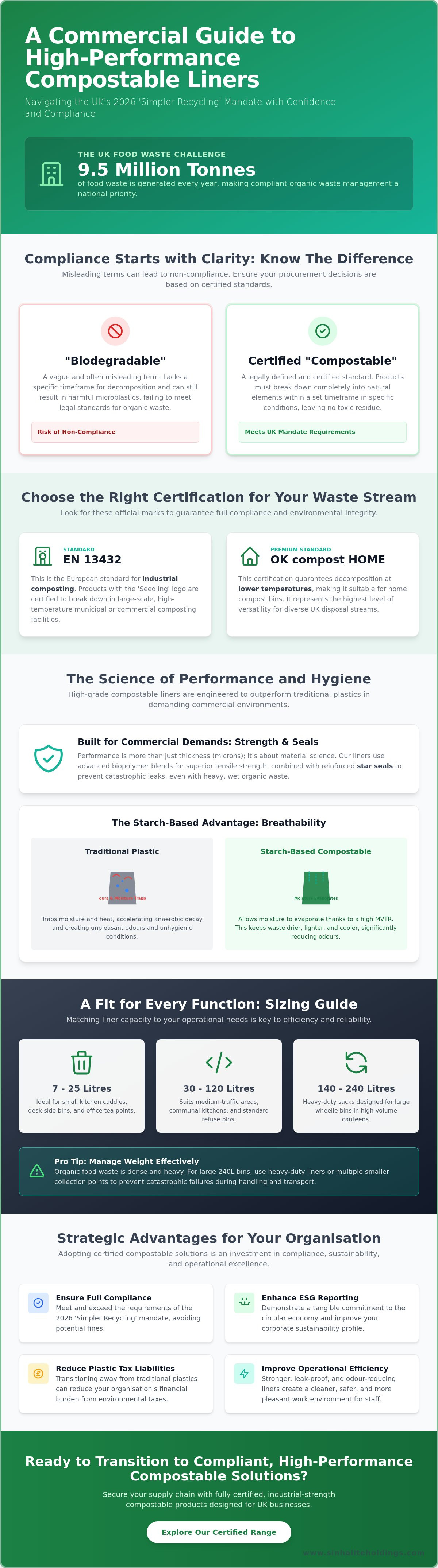
Regulatory compliance in 2026 hinges on understanding certification tiers. The EN 13432 standard ensures a product will break down in industrial composting facilities, but for many UK businesses, OK compost HOME certification explained represents the pinnacle of versatility. This certification guarantees that the material will decompose at lower temperatures, making it suitable for a wider range of disposal streams. UK buyers should look for the "Seedling" logo or the OK compost HOME mark to ensure their procurement aligns with mandatory waste separation laws.
Breathability and Hygiene: The Science of Starch-Based Liners
One unique advantage of using compostable caddy bags is their high Moisture-Vapor Transmission Rate (MVTR). Traditional plastic traps heat and moisture, which accelerates the anaerobic breakdown of food and creates foul odours. Starch-based liners allow moisture to evaporate, keeping the waste drier and significantly cooler. This natural breathability improves kitchen hygiene and makes the transition to organic waste separation a more pleasant, odour-free experience for your staff.
Selecting the Right Compostable Food Bin Liners for Your Organisation
Successful waste management relies on matching the specific material properties of your liners to the unique demands of your facility. Organic waste is significantly heavier and more moisture-dense than residual waste, which means a standard "one size fits all" approach often leads to operational failure. When sourcing compostable food bin liners uk, you must first audit your primary waste streams. A high-traffic canteen requires a different tensile strength than a communal office tea point. Optimising your choice of compostable food bin liners uk is not just about environmental compliance; it's about operational reliability.
Organic matter is dense. Filling a large 240L wheelie bin to capacity with food waste creates immense pressure on the base seal, which can lead to catastrophic failures during collection. For these high-volume areas, it's often more efficient to use multiple smaller collection points or specify heavy-duty liners designed to withstand the vertical load. Integrating "bags on a roll" into your cleaning stations ensures that staff can quickly replace liners without searching through bulky boxes, maintaining a seamless workflow in busy commercial environments. This simple change in storage format can significantly improve the speed of your janitorial operations.
From Caddy Liners to Heavy-Duty Refuse Sacks
Small 7L to 25L caddy bags are ideal for desk-side collection or kitchenettes where waste is emptied daily. However, industrial operations or larger catering facilities require puncture resistant compostable garbage bags to handle bones, shells, or heavy liquids. Avoiding the temptation to over-spec smaller bins with industrial-grade sacks will keep your procurement costs balanced while ensuring that the bags you do use are fit for purpose. It is a matter of finding the precise balance between material cost and performance safety.
Preventing Common Issues: Splitting and Sticking
Liners often stick to bin walls due to vacuum seals or excessive moisture. Choosing a liner that is slightly larger than the bin dimensions allows for better airflow, which prevents the "suction" effect when removing full bags. For wet waste, look for liners with high vapor permeability to keep the contents cooler and more stable. If you are ready to upgrade your facility's waste systems, you can view our full range of certified compostable solutions to find the perfect fit for your organisation's specific needs.
Strategic Implementation: ROI and the Circular Economy Transition
Implementing a robust waste strategy in 2026 requires looking beyond the immediate cost per unit. For UK organisations, the transition to compostable food bin liners uk serves as a tangible demonstration of environmental stewardship that directly strengthens ESG portfolios. Understanding how switching business to sustainable packaging influences these metrics is essential for modern corporate transparency. By replacing traditional plastics with certified compostable alternatives, businesses can mitigate their exposure to the UK Plastic Packaging Tax. This tax specifically targets packaging with less than 30% recycled content, making high-quality plant-based materials a fiscally prudent choice for the long term.
Sinhalite Holdings acts as a visionary partner in this transition. We provide the tangible tools needed to align your daily operations with the principles of a circular economy. A seamless shift involves three core stages. First, audit your current plastic usage. Second, trial performance-matched liners in high-traffic zones. Finally, scale these solutions across the entire organisation. This methodical approach ensures that your sustainability goals are met without disrupting operational efficiency. It's about making the right choice easy and permanent.
Bulk Procurement and Supply Chain Reliability
Reliability is the cornerstone of any commercial waste system. Partnering with a specialist UK provider ensures that your supply of compostable caddy bags and garbage bags remains consistent despite shifting global market conditions. Effective forecasting is key. By analysing monthly waste volumes, you can maintain optimal inventory levels, avoiding both stockouts and excessive storage costs. Our commitment to industrial pragmatism means we support your growth with scalable supply solutions that grow alongside your business needs.
Beyond the Bin: Integrating Other Compostable Essentials
A truly circular model extends into the kitchen and the storefront. Integrating compostable clingfilm uk into food preparation areas ensures that organic waste streams remain uncontaminated by traditional plastic wraps. This holistic strategy is further supported by using compostable shopping bags and food roller bags. When every touchpoint of your packaging cycle is certified compostable, you create a cohesive system. This simplifies waste separation for your staff and reinforces your brand's integrity to your customers, proving that your commitment to the planet is thorough and sincere.
Securing Your Organisation’s Sustainable Future
Adopting the right waste management strategy is a fundamental step toward achieving operational excellence and environmental integrity. By prioritising technical performance metrics like micron precision and ensuring your supplies meet rigorous EN 13432 and OK compost HOME standards, you protect your organisation from the mess and liability of inferior products. This transition is about more than just compliance; it's a commitment to a cleaner, more efficient circular economy that removes the burden of plastic tax and strengthens your corporate reputation.
Since 2018, Sinhalite Holdings has served as a specialist UK supplier, providing industrial-strength solutions that bridge the gap between innovation and practical utility. Whether you require heavy-duty garbage bags or reliable compostable food bin liners uk for office tea points, we provide the tools needed to facilitate a seamless shift away from traditional plastics. We invite you to explore the Sinhalite range of high-performance compostable caddy and garbage bags today. Together, we can build a future where responsible business practices and high-performance utility work in perfect harmony. The path to a sustainable tomorrow starts with the conscious choices you make today.
Frequently Asked Questions
Are compostable bin liners as strong as traditional plastic liners?
Modern compostable food bin liners uk provide industrial-grade durability that rivals traditional plastic alternatives when selected at the correct micron thickness. These liners use advanced starch-based polymers specifically engineered to withstand the high moisture and weight associated with organic waste. By choosing a high-gauge commercial garbage bag, you ensure that your facility maintains a clean and hygienic environment without the risk of splitting or leakage.
Can I use compostable food bin liners in my garden compost heap?
You can only use these liners in a domestic heap if they are specifically certified as "OK compost HOME." Standard liners designed for industrial facilities require the high, sustained temperatures of a professional composting plant to break down within the expected timeframe. Attempting to compost an industrial-grade bag in a garden environment won't work effectively; it will likely remain intact for a significant period.
Do compostable liners have an expiry date or shelf life?
These liners generally have a shelf life of 12 to 18 months because they are constructed from natural, organic polymers. Because they are designed to biodegrade, they'll eventually lose their tensile strength if stored for several years. It's best to store your stock in a cool, dry area to prevent premature degradation. Managing your procurement to match your actual usage ensures you always have high-performance liners available.
Will my local UK council accept these liners in the food waste collection?
Most local authorities in England accept these products following the 2026 Simpler Recycling mandate that requires separate food waste collections. Using certified compostable food bin liners uk helps councils process organic matter into renewable energy and nutrient-rich fertiliser. To ensure compliance, you should verify that your liners carry the EN 13432 certification, which is the recognised standard for industrial composting across the UK waste management sector.


