

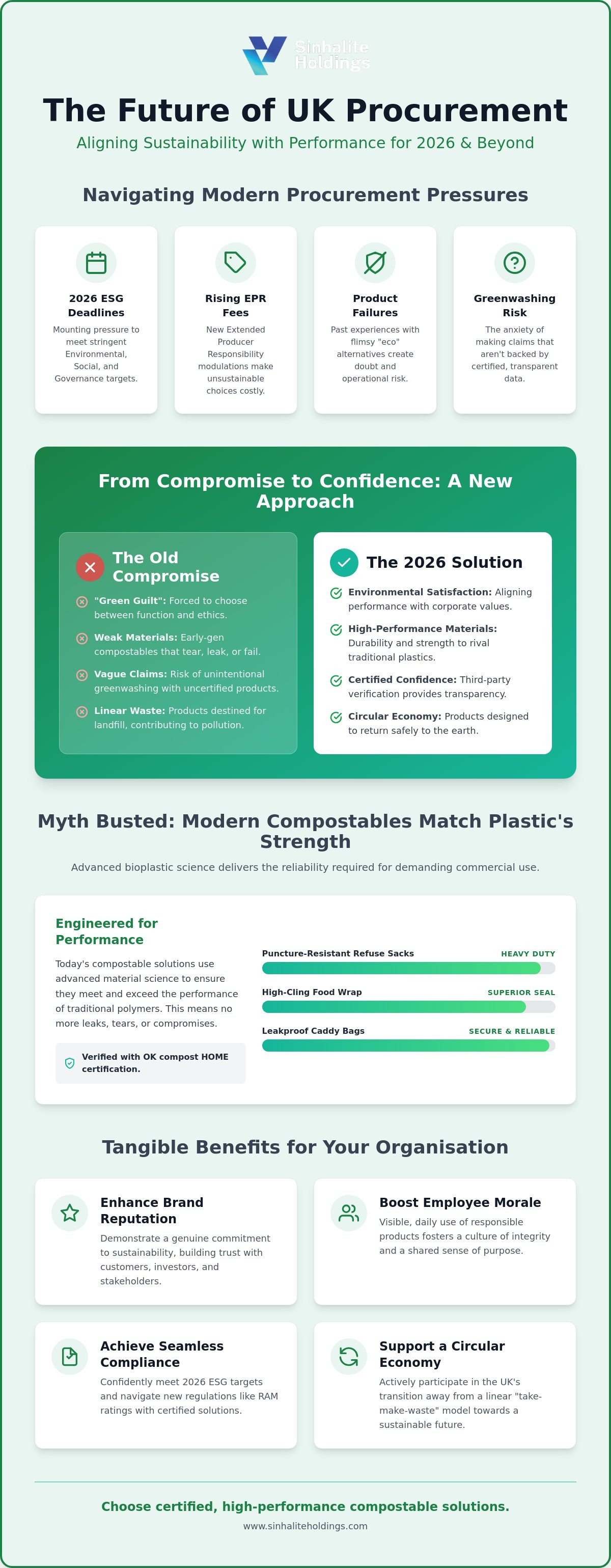
What if your commitment to the planet didn't have to feel like a constant compromise in the warehouse or the office kitchen? It's a common frustration for UK procurement teams who've dealt with "eco-friendly" alternatives that fail under pressure, such as compostable clingfilm that won't stick or caddy bags that tear far too easily. You're likely feeling the mounting pressure of 2026 ESG targets and the new Extended Producer Responsibility fee modulations, which now make every choice a matter of both conscience and cost. Finding reliable sustainable packaging solutions for UK businesses shouldn't be a source of anxiety or a risk of unintentional greenwashing.
We understand that true environmental satisfaction comes from aligning functional necessity with ethical integrity. This guide will show you how to meet the latest 2026 standards with confidence, ensuring your procurement choices enhance your brand's reputation and your operational efficiency. We'll examine the shift toward high-performance compostable materials and the practical steps your organisation can take to thrive under the new Recyclability Assessment Methodology (RAM) ratings. Discover how choosing certified, durable alternatives can finally bridge the gap between your corporate values and your daily performance.
Key Takeaways
- Understand how aligning procurement with corporate values eliminates "green guilt" and fosters long-term organisational well-being.
- Learn why modern compostable materials provide the high-performance durability required to replace traditional plastics in demanding professional environments.
- Discover how implementing sustainable packaging solutions for UK businesses ensures seamless compliance with 2026 ESG targets and evolving packaging regulations.
- Recognise how transitioning to certified compostable essentials directly supports the UK's circular economy and enhances your brand's ethical standing.
The Psychology of Sustainability: Why Ethical Procurement Matters in 2026
Environmental satisfaction is more than a corporate buzzword; it is the state of professional well-being achieved when your organisational actions align perfectly with your ecological values. For many years, procurement teams across the UK operated under a cloud of "green guilt," often feeling forced to choose between functional reliability and environmental responsibility. In 2026, we are seeing a profound transition from this reactive guilt toward proactive stewardship. This shift allows leaders to move beyond simply avoiding harm and instead focus on making a positive, measurable impact on the planet. Understanding what is sustainable packaging is the first step in resolving the cognitive dissonance that occurs when professional requirements conflict with personal ethics.
To better understand the connection between business operations and environmental responsibility, watch this helpful video:
Choosing high-performance sustainable packaging solutions for UK businesses provides procurement teams with the psychological relief of knowing their choices are both practical and principled. This clarity is essential for maintaining operational integrity while meeting the strict demands of modern ESG reporting. Having OK compost HOME certification explained provides the psychological security of verified impact, ensuring that your transition away from traditional plastics is backed by rigorous, third-party scientific standards.
Reducing Green Guilt in the Boardroom
The fear of unintentional greenwashing remains a significant source of anxiety for business leaders. Transparent sourcing and evidence-based procurement are the most effective tools for mitigating this risk and building long-term organisational trust. By selecting products with clear, certified lifecycles, organisations can present their sustainability progress to stakeholders with absolute confidence. This evidence-based approach replaces vague promises with tangible data, turning environmental commitments into a source of corporate pride rather than a liability.
The Impact of Sustainable Choices on Employee Morale
Sustainability becomes tangible for employees when they see it reflected in their daily work environment. Using visible items like compostable caddy bags or high-strength garbage bags creates a shared sense of purpose across the workforce. When staff see that their employer prioritises responsible innovation, it reinforces a culture of integrity. These small, daily operational habits connect individual efforts to global climate goals, fostering a more engaged and motivated team that feels proud of where they work.
Aligning Corporate Values with Functional Performance
Feeling good about an environmental choice is impossible if the product fails to perform its intended task. When a caddy bag leaks or a shopping bag splits, the procurement team feels a sense of failure rather than stewardship. Genuine reliability is the foundation of any successful transition to high-quality sustainable packaging solutions for UK businesses.
A common objection in professional environments is the belief that compostables aren't as strong as plastic. However, 2026 material science has bridged this gap. High-performance alternatives now offer the same tensile strength as traditional polymers without the long-term ecological cost. For example, using puncture resistant compostable garbage bags ensures that heavy-duty commercial waste management remains efficient and mess-free. Similarly, professional kitchens shouldn't compromise on safety; choosing compostable cling film that actually clings is essential for maintaining strict food hygiene standards.
Criteria for High-Performance Eco-Swaps
Material science in 2026 bioplastics focuses on molecular integrity to ensure durability. When evaluating swaps, organisations must prioritise products that have moved beyond vague "biodegradable" claims to become "certified compostable." This certification guarantees that the material will break down safely in specific conditions while providing the strength required for daily industrial use.
The ROI of Ethical Integrity
Investing in high-quality compostables reduces the hidden costs of waste-stream contamination. When "eco" products fail, they often end up in the wrong bin, leading to expensive disposal fees. Switching business to sustainable packaging also protects your bottom line against the evolving UK Plastic Packaging Tax by reducing your reliance on taxable single-use plastics.
Transitioning to a Circular Economy with Sinhalite Holdings
Sinhalite Holdings acts as a visionary partner for organisations ready to move beyond linear waste models. By integrating compostable household and commercial essentials into your operations, you contribute directly to a robust UK circular economy. These materials are designed to return to the earth as nutrient-rich compost, effectively closing the loop on organic waste streams. This biological cycle ensures that resources are kept in use for as long as possible, extracting the maximum value while regenerating natural systems.
For councils and large organisations, scalability is often the primary barrier to change. We provide the infrastructure and volume required to make these transitions seamless and effective. Strategic partnerships allow for the mass adoption of sustainable packaging solutions for UK businesses without disrupting existing logistical workflows. This approach turns environmental responsibility into a practical, scalable reality for even the largest commercial entities.
A Comprehensive Range of Compostable Essentials
Our offering spans every operational need, from compostable food roller bags for retail to heavy-duty garbage bags for industrial waste. Providing a total solution means your organisation doesn't have to manage multiple fragmented suppliers. We ensure supply chain reliability for national UK organisations, guaranteeing that your commitment to sustainability is never compromised by stock shortages or delivery delays. Our focus on puncture resistance and high performance ensures these essentials thrive in demanding professional environments.
The Future of UK Packaging in 2026
The UK's regulatory landscape is shifting rapidly, particularly with the 2026 introduction of fee modulations under Extended Producer Responsibility (EPR). By staying ahead of these environmental standards, Sinhalite Holdings helps you navigate complex Recyclability Assessment Methodology (RAM) ratings with ease. We lead the "responsible innovator" movement by providing the tangible tools needed to meet these strict requirements today. Taking immediate action toward a plastic-free future is a strategic necessity that builds long-term resilience. Through collaborative partnerships, we help you create a future-proof operation that reflects a deep-seated commitment to environmental stewardship.
Building a Future Defined by Integrity and Innovation
Transitioning toward a plastic-free operation is a journey that rewards both your conscience and your corporate resilience. By aligning procurement with ethical stewardship, you eliminate green guilt and foster a culture of genuine purpose. We've established that modern material science now delivers the durability required for professional environments, ensuring that your commitment to the planet never compromises your daily efficiency. Implementing sustainable packaging solutions for UK businesses is a strategic step toward a more circular and sustainable economy.
As a specialist provider of OK compost HOME certified clingfilm and bags, we're dedicated to providing the high-strength, puncture-resistant commercial garbage bags needed to support large-scale organisations and councils. Our mission is to ensure that your transition to responsible practices is both advantageous and seamless. Partner with Sinhalite Holdings for high-performance compostable solutions across the UK to lead your industry with confidence and purpose. The path to a cleaner, greener future is entirely achievable when you have the right tools and a dedicated ally by your side.
Frequently Asked Questions
How can I be sure I am making the right environmental choices for my business?
You can ensure your choices are sound by prioritising products with third-party verified lifecycles rather than relying on vague marketing terms. By selecting materials that are genuinely compostable, you align your operational habits with the UK's circular economy goals. This approach eliminates the risk of contributing to microplastic pollution and ensures your procurement decisions stand up to rigorous stakeholder scrutiny.
Do compostable products perform as well as traditional plastic in a commercial setting?
Modern bioplastics are specifically engineered to match the tensile strength and utility of traditional polymers. High-performance sustainable packaging solutions for UK businesses now offer the durability required for heavy-duty waste management and professional food hygiene. Items like puncture-resistant sacks and high-cling films prove that you don't have to sacrifice operational efficiency to achieve your environmental objectives.
What certifications should I look for to avoid greenwashing in 2026?
The most reliable standards to look for are OK compost HOME and OK compost INDUSTRIAL certifications. These labels guarantee that a product has been scientifically tested to break down safely without leaving harmful residues behind. In 2026, relying on these verified certifications is essential for navigating the UK's fee-modulation systems and ensuring your packaging meets the highest recyclability ratings.
How do compostable choices impact a business’s ESG rating?
Transitioning to compostable alternatives directly improves the environmental pillar of your ESG strategy by reducing fossil-fuel dependency and carbon emissions. Implementing sustainable packaging solutions for UK businesses also enhances the social pillar by boosting employee morale and demonstrating ethical leadership to your clients. This proactive stance shows that your organisation is a responsible innovator, which is increasingly vital for securing long-term investment and trust.


