

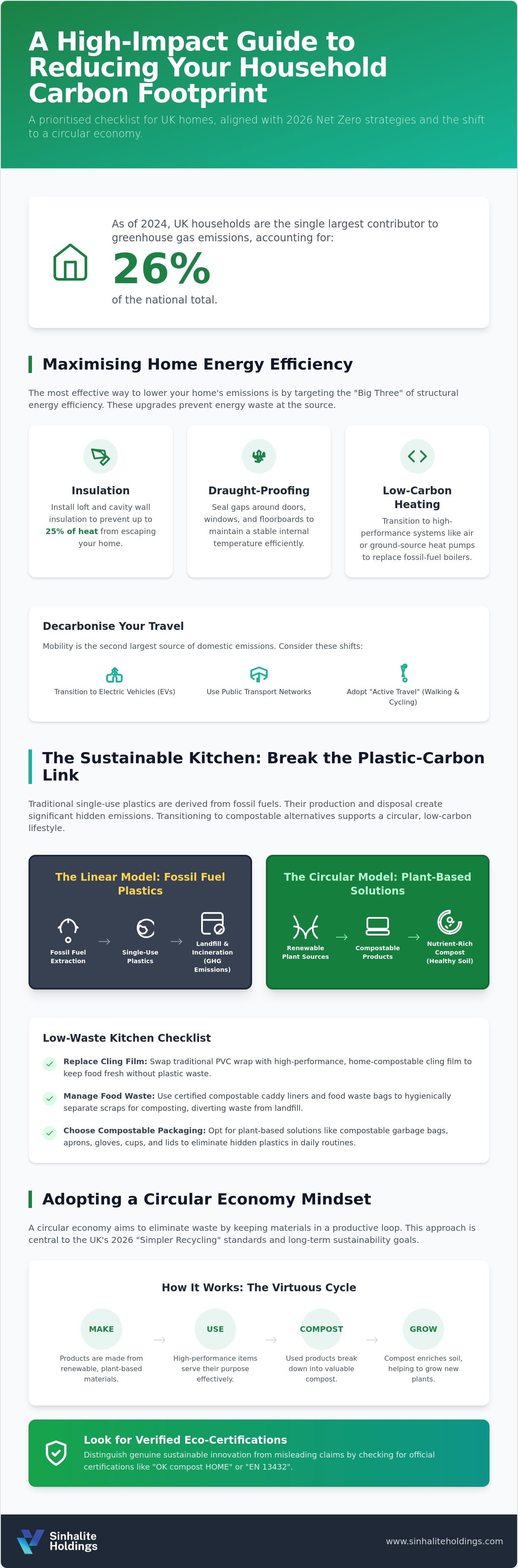
Did you know that as of 2024, households became the single largest contributor to UK greenhouse gas emissions, accounting for nearly 26% of the national total? It's understandable if you feel overwhelmed by the constant stream of climate news and the pressure to make every change count. You likely already know that heating and transport are vital, but the sheer volume of conflicting advice on reducing your household carbon footprint can make it difficult to know where your efforts actually move the needle.
We believe that a transition to more responsible practices is both achievable and advantageous for every home. This guide clears the confusion by providing a prioritised, high-impact checklist designed for the UK's 2026 regulatory landscape. We'll show you how to transition beyond simple energy efficiency toward a truly circular, plastic-free lifestyle that reduces emissions at the source. By focusing on the intersection of modern innovation and natural processes, you can turn your home into a beacon of sustainability.
You'll discover how to leverage the latest "Simpler Recycling" rules, master hygienic food waste management with high-performance compostable solutions, and eliminate hidden fossil-fuel dependencies in your daily routine.
Key Takeaways
- Prioritise the "Big Three" of home energy upgrades to target the primary drivers of domestic emissions efficiently.
- Discover how reducing your household carbon footprint starts in the kitchen by breaking the link between fossil-fuel-based plastics and daily waste.
- Adopt a circular mindset by replacing traditional single-use plastics with high-performance compostable caddy bags and household clingfilm.
- Streamline your waste management through the 2026 "Simpler Recycling" standards to ensure materials remain in a productive loop.
- Use verified eco-certifications to distinguish between genuine sustainable innovation and misleading environmental claims.
Maximising Energy Efficiency and Home Heating
A household carbon footprint is the sum of greenhouse gas emissions generated by a home's energy use, transport, and consumption, serving as a primary metric for success within the 2026 UK Net Zero strategy. Understanding What is a carbon footprint? allows you to see the direct link between a drafty window and global atmospheric changes. By identifying the specific sources of emissions within your property, you can transition from passive observation to proactive stewardship.
High-impact change begins with visibility. Smart meters and modern heating controls provide the transparency needed to identify energy leaks in real-time. This visibility shifts energy use from an abstract monthly bill to a manageable, actionable metric. By monitoring these fluctuations, you can make informed decisions about reducing your household carbon footprint through targeted interventions that yield both environmental and financial rewards.
To better understand how these small changes accumulate into a significant impact, watch this helpful video:
The Energy Efficiency Checklist
Addressing the "Big Three" of home efficiency—insulation, draught-proofing, and heating systems—is the most effective way to lower your home's output. These structural improvements ensure that energy isn't wasted before it can provide comfort. Consider the following steps:
- Install loft and cavity wall insulation to prevent up to 25% of your home's heat from escaping through the structure.
- Upgrade to energy-efficient LED lighting and A-rated appliances to lower your baseline electricity demand.
- Draught-proof doors, windows, and floorboards to maintain a stable internal temperature without overworking your heating system.
Transitioning to low-carbon heating systems, such as air-source or ground-source heat pumps, represents the most significant leap a homeowner can take. These systems leverage modern innovation to replace fossil-fuel-dependent boilers with high-performance, electric alternatives.
Decarbonising Your Travel and Commute
Mobility is the second largest driver of domestic emissions. Evaluating a transition to electric vehicles (EVs) or increasing your reliance on the UK's rail and bus networks can slash your personal output. For short UK journeys, adopting "active travel" habits like walking or cycling offers a dual benefit of zero-emission transit and improved physical health. These choices are essential components of reducing your household carbon footprint and aligning your lifestyle with a sustainable future.
The Sustainable Kitchen: Slashing Food and Plastic Waste
While structural energy efficiency is vital, the kitchen often hides a significant portion of a home's environmental impact through the "plastic-carbon link." Traditional plastics are derived directly from fossil fuel extraction. Their production, transport, and eventual incineration or landfilling represent a major emission source that many overlook. Transitioning to a circular kitchen is a critical step in reducing your household carbon footprint. Official UK Parliament's research on housing and net zero highlights the necessity of addressing every aspect of domestic consumption to meet national decarbonisation targets.
Choosing high-performance compostable alternatives allows you to maintain modern convenience without the associated carbon cost. For instance, switching to compostable clingfilm uk removes PVC and other toxic, carbon-heavy materials from your daily routine. This shift supports a systemic move away from the linear "take-make-dispose" model toward a restorative circular economy.
The Low-Waste Food Storage Checklist
Effective food storage preserves resources and prevents the emissions associated with food production and transport. Consider these practical swaps for a lower-carbon kitchen:
- Swap traditional plastic wrap for compostable cling film that actually clings to ensure food stays fresh without creating non-recyclable waste.
- Use plant-based food roller bags for bulk shopping to eliminate the need for single-use plastic produce bags.
- Implement meal planning to ensure zero food waste reaches the general waste bin. The average UK household currently wastes food costing around £470 annually, representing a significant waste of embedded carbon.
Mastering Your Food Caddy Hygiene
Food waste in landfills produces methane, a greenhouse gas significantly more potent than CO2. Diverting organic matter to municipal composting or anaerobic digestion is a high-impact strategy for reducing your household carbon footprint. Utilising leak-proof caddy liners ensures this process is hygienic and efficient for your household. If you're hesitant about the transition, learning how to keep a food waste bin from smelling makes the process simple and manageable. You can explore our range of high-performance compostable solutions to begin your kitchen transformation today.
Adopting a Circular Economy in Household Consumption
A circular economy is a restorative system designed to keep materials in use through composting or recycling rather than disposal. This model replaces the linear "take-make-waste" approach that has historically driven climate change. By embracing this shift, you're directly reducing your household carbon footprint by lowering the demand for virgin resources and fossil-fuel-intensive manufacturing. It's a visionary way to view our possessions, treating every item as a future resource rather than a burden on the environment.
Skepticism regarding "compostable" labels is often a reaction to greenwashing. However, the science of bioplastics has advanced significantly. Genuine compostables are derived from renewable plant starches that break down into organic matter under specific conditions. To navigate this landscape with confidence, you must rely on verified standards. Having the OK compost HOME certification explained helps you distinguish between vague marketing and products that meet strict ecological performance criteria.
The Conscious Consumer Checklist
- Choose products with the 'OK compost HOME' certification. This ensures they'll safely break down in garden compost heaps without requiring high-temperature industrial facilities.
- Opt for high-quality, puncture resistant compostable garbage bags to manage unavoidable residual waste without resorting to traditional single-use plastics.
- Prioritise second-hand purchases for electronics and furniture. This avoids the "embodied carbon" created during new manufacturing, which often accounts for a significant portion of an item's lifetime emissions.
Closing the Loop: Proper Disposal Habits
Success in a circular economy depends on how we handle the end of a product's life. You should verify your local UK council's specific rules for food waste and compostable packaging collection, especially as the 2026 "Simpler Recycling" standards are rolled out nationwide. These rules ensure that your efforts to separate waste lead to actual environmental benefits rather than contamination.
Maintaining a home compost bin is perhaps the most empowering action for reducing your household carbon footprint. It turns kitchen scraps and garden waste into nutrient-rich soil right on your property. This on-site processing eliminates the carbon emissions associated with waste transport and provides a natural, chemical-free way to nourish your local ecosystem.
Embracing a Visionary Approach to Domestic Sustainability
Transitioning to a more responsible lifestyle is an achievable and advantageous shift that begins with the purposeful choices you make inside your home. We've explored how structural energy upgrades and mindful food waste management serve as the foundational pillars of a restorative circular economy. These actions don't just lower emissions; they foster a deeper sense of stewardship and integrity in our daily routines. By aligning your consumption with natural processes, you're contributing to a systemic change that benefits the entire UK landscape.
By following this 2026 checklist, you're taking definitive, high-impact steps toward reducing your household carbon footprint. As a UK-based sustainable specialist, Sinhalite Holdings is dedicated to providing the high-performance, plant-based materials needed to replace fossil-fuel-dependent plastics. Our OK compost HOME certified options ensure that your transition to a cleaner, greener home is supported by rigorous environmental standards and reliable utility. We believe that high standards of durability and strength should never be sacrificed in the pursuit of ecological responsibility.
Ready to start your plastic-free journey? Explore our range of compostable household essentials at Sinhalite Holdings. Positive change is within your reach, and every sustainable swap brings us closer to a resilient, net-zero future.
Frequently Asked Questions
What is the fastest way to reduce my household carbon footprint?
The most immediate impact comes from addressing your home's energy efficiency while simultaneously auditing your daily high-frequency waste. Structural changes like draught-proofing provide long-term gains, but immediate swaps of single-use plastics for compostable alternatives offer an instant reduction in fossil-fuel-dependent consumption. This dual approach ensures you're reducing your household carbon footprint from both a systemic and a practical, everyday perspective.
Is compostable clingfilm better for the environment than regular plastic wrap?
Compostable clingfilm is significantly better because it eliminates the use of PVC and other fossil-fuel-derived materials that release toxins during production and disposal. Our compostable household clingfilm offers a non-toxic, carbon-saving alternative that provides the same high-performance stretch and seal without the environmental cost. It supports a circular economy by returning to the earth as organic matter rather than persisting as microplastic pollution.
How does reducing food waste help lower my carbon emissions?
Reducing food waste prevents the release of methane, a greenhouse gas that's far more potent than CO2 when organic matter decomposes in oxygen-poor landfills. By using compostable caddy bags to divert scraps to municipal composting, you ensure these nutrients are captured rather than wasted. This process is vital for reducing your household carbon footprint because it also accounts for the energy used to grow, pack, and transport that food.
Can I compost compostable bags in my garden at home?
You can compost these bags at home only if they carry the "OK compost HOME" certification. Standard industrial compostable bags require the high temperatures of a municipal facility to break down properly. Always look for the specific home-composting logo to ensure the material will decompose safely in your garden heap. This choice empowers you to close the waste loop directly on your property, enhancing soil health without industrial intervention.


