

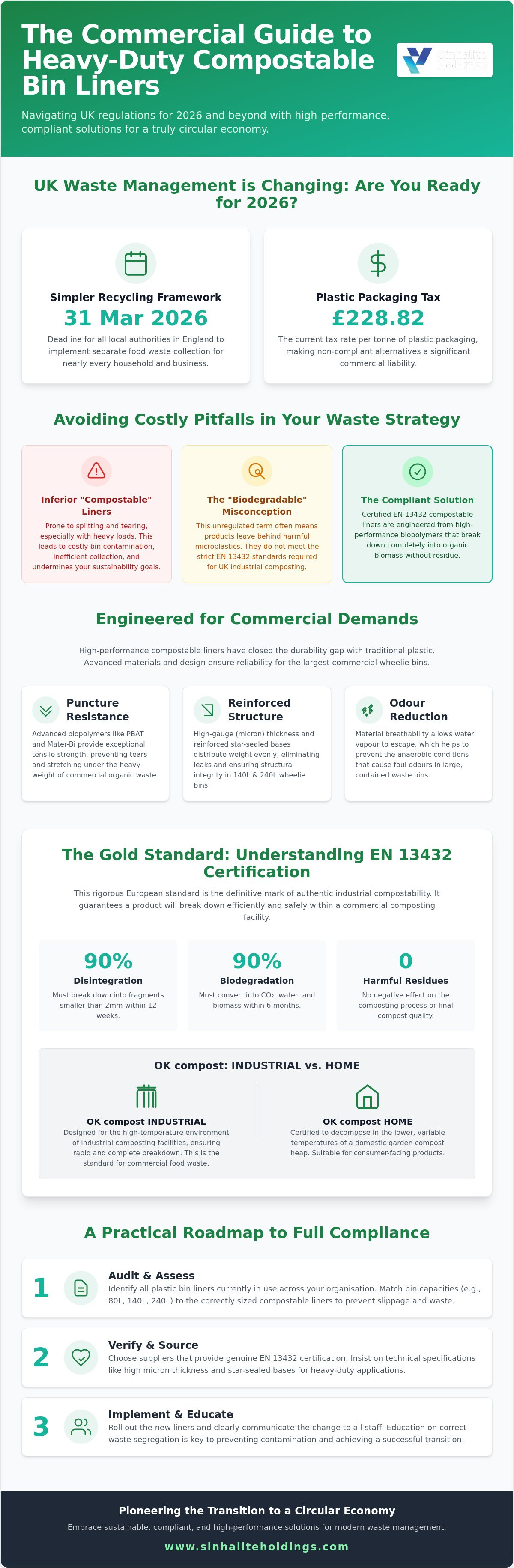
By March 31, 2026, all local authorities in England are required to implement the "Simpler Recycling" framework, effectively mandating the separate collection of food waste for every household and most businesses. This regulatory shift, combined with a Plastic Packaging Tax that has risen to £228.82 per tonne, means that finding reliable heavy duty compostable bin liners UK organisations can depend on is no longer just an environmental goal; it's a commercial necessity.
We understand the hesitation that often accompanies this transition, especially when standard compostable options have historically failed to withstand the rigours of large-scale waste management. It's frustrating when a liner splits during collection, leading to costly bin contamination and undermining your sustainability efforts. You shouldn't have to choose between your corporate environmental targets and the practical durability required for 240-litre wheelie bins.
This guide provides the clarity you need to move forward with confidence. We'll show you how to identify genuine EN 13432 certifications, explain why high-gauge bioplastic engineering is the key to puncture resistance, and help you secure a steady supply of high-performance sacks. You'll discover how to reduce your carbon footprint and achieve full compliance through a circular waste management strategy that actually works.
Key Takeaways
- Understand why generic "biodegradable" claims no longer satisfy UK regulatory standards and how to verify industrial-grade material compliance for 2026.
- Learn the technical requirements for heavy duty compostable bin liners UK commercial sectors utilize, focusing on micron thickness and puncture resistance for large wheelie bins.
- Differentiate between OK compost INDUSTRIAL and HOME certifications to ensure your waste is processed correctly within the UK's circular economy.
- Follow a practical, scalable roadmap to replace traditional plastic garbage bags with certified compostable alternatives across your entire organisation.
The Evolution of Heavy Duty Compostable Bin Liners in 2026
The operational environment for UK waste management has undergone a fundamental transformation. By 2026, the standard for industrial-grade compostable materials has moved beyond simple disposal to active participation in the circular economy. Selecting heavy duty compostable bin liners UK organisations can trust requires an understanding of high-performance biopolymers that maintain structural integrity under significant stress. These modern materials represent a shift from passive waste containment to proactive environmental stewardship.
The distinction between "biodegradable" and "compostable" is no longer just a matter of semantics for commercial entities. Traditional biodegradable labels often obscure the presence of microplastics, which fail to meet the rigorous EN 13432 standards required for industrial processing. The Evolution of Heavy Duty Compostable Bin Liners highlights how modern material science has replaced these legacy products with fully certified alternatives that break down entirely into organic biomass without leaving harmful residues behind.
To better understand the performance of modern compostable materials, watch this helpful overview:
Sinhalite’s compostable garbage bags are engineered to meet the specific load-bearing requirements of 140L and 240L wheelie bins. These high-gauge solutions ensure that heavy organic waste can be transported without the risk of failure. By focusing on high tensile strength, we provide a reliable bridge between facility management and sustainable outcomes, ensuring that your transition away from plastic remains seamless and efficient.
Addressing the Durability Myth
Many procurement officers previously viewed bioplastics as inferior to traditional low-density polyethylene (LDPE). However, the integration of advanced polymers like PBAT and Mater-Bi has effectively closed the performance gap. These materials offer exceptional puncture resistance, ensuring they don't stretch or tear under the weight of commercial refuse. The inherent moisture-breathability of these liners also helps reduce bin odours by allowing water vapour to escape, which prevents the anaerobic conditions that lead to foul smells in large containers.
The Circular Economy in UK Waste Management
Choosing the right liner is a critical component of a broader environmental strategy. This choice is intrinsically linked to the future of compostable food packaging UK wide, where consistency in material streams is vital for industrial composting success. High-quality liners act as a safeguard against contamination. They ensure that the valuable organic matter inside can be successfully converted into nutrient-rich compost rather than being diverted to landfill due to plastic residue, supporting a truly circular waste stream.
Technical Criteria for Selecting Commercial-Grade Wheelie Bin Liners
Selecting the right heavy duty compostable bin liners UK facilities require involves looking past marketing claims to the underlying technical specifications. For commercial applications, the structural integrity of a liner is determined by its micron thickness and base construction. A 240L wheelie bin liner needs a reinforced star-sealed bottom to distribute weight evenly and prevent the leaks that often plague standard alternatives. Wave-tie tops are equally essential; they provide a secure closure that simplifies the collection process for waste management teams.
Standard UK wheelie bin sizes range from 80L and 120L for smaller office footprints to the 140L and 240L containers used in high-volume settings. Ensuring your liners match these dimensions exactly prevents the bag from slipping inside the bin during use. To explore our range of professionally engineered solutions, you can view our high-performance compostable garbage bags designed specifically for these industrial loads.
Verifying Sustainability Certifications
Compliance is the foundation of any responsible waste strategy. While EN 13432 serves as the non-negotiable European standard for industrial compostability, understanding the nuances of individual certifications is vital. For many organisations, an OK compost HOME certification explained provides clarity on materials that can break down in lower-temperature environments. However, for large-scale commercial food waste, the "INDUSTRIAL" certification is usually required to ensure the liners disintegrate within the 12-week window mandated by UK processing facilities.
Puncture Resistance and Load Capacity
The thickness of a liner, measured in microns or gauge, is the primary indicator of its load-bearing potential. For a 240L sack, a higher gauge directly correlates to a greater weight limit and increased resistance to the sharp edges often found in mixed commercial waste. Integrating puncture resistant compostable garbage bags into high-traffic commercial kitchens ensures that heavy organic matter doesn't compromise the bag's structure. By choosing a specific micron thickness tailored to your waste profile, you eliminate the risk of contamination and maintain a clean, efficient disposal site.
Implementing Sustainable Waste Solutions Across Your Organisation
Transitioning your facility requires a methodical approach that balances operational efficiency with environmental integrity. The first step involves auditing your current waste volume to ensure you're deploying heavy duty compostable bin liners UK teams can rely on without over-ordering. This transition is financially incentivised by the Plastic Packaging Tax, which remains at £228.82 per tonne for non-compliant plastic as of April 2026. By choosing certified compostable alternatives, your organisation avoids these mounting costs while preparing for the 2027 deadline for micro-businesses to separate food waste.
Staff engagement is the linchpin of this process. Clear signage and hands-on training prevent the "greenwashing" pitfalls that occur when traditional plastics contaminate organic waste streams. If non-compostable items enter the stream, the entire batch may be diverted to landfill, negating your sustainability efforts. Sinhalite Holdings supports this journey by providing consistent, high-gauge sacks and the technical expertise needed to manage large-scale procurement across multiple sites. We ensure that your transition to a circular economy is supported by a reliable UK distribution network.
Strategic Integration for ESG Compliance
ESG compliance is no longer optional for modern commercial entities. Aligning your waste management with switching business to sustainable packaging goals allows you to quantify your impact. By replacing traditional garbage bags with compostable options, you directly reduce Scope 3 emissions within your supply chain. This creates a transparent narrative of responsibility for stakeholders and regulators alike, proving that your organisation is proactive in its environmental stewardship.
Optimising Storage for Liner Longevity
Because bioplastics are designed to break down, they require specific storage conditions to maintain their shelf life. Keep your stock in a cool, dry environment away from direct sunlight to prevent premature degradation. For large-scale facilities, we recommend a first-in, first-out (FIFO) inventory system. This ensures that every liner retains its full tensile strength and puncture resistance when it's finally deployed in a high-traffic 240L wheelie bin. Using heavy duty compostable bin liners UK wide ensures that your facility meets the "Simpler Recycling" standards while maintaining the hygiene of your waste areas.
Advancing Your Organisation Toward a Plastic-Free Future
The transition to sustainable waste management is no longer a distant goal but a present operational requirement. By choosing heavy duty compostable bin liners UK businesses can finally align their daily logistics with their broader ESG commitments. We've established that technical specifications like micron thickness and industrial certifications are the foundation of a reliable system. When these high-performance materials are paired with correct staff training and storage, the result is a seamless waste stream that supports the national circular economy.
Since 2018, we've acted as a specialist partner for organisations seeking to eliminate single-use plastics without sacrificing utility. Our compostable garbage bags are engineered specifically for commercial load-bearing and puncture resistance, ensuring your wheelie bins remain clean and compliant. You have the power to turn waste management into a proactive environmental statement that resonates with stakeholders and regulators alike.
Take the next step in your sustainability journey today. Explore Sinhalite Holdings’ range of high-performance compostable solutions to find the right fit for your facility. Together, we can build a cleaner, greener outlook for the future of British industry.
Frequently Asked Questions
Do compostable bags for large wheelie bins split easily?
Modern bioplastics are engineered specifically to withstand the weight and sharp edges of commercial refuse. The heavy duty compostable bin liners UK businesses use in 2026 feature high-gauge thickness and reinforced star-sealed bottoms to prevent failure under load. These design choices ensure that 240-litre wheelie bins remain clean while providing the same puncture resistance as traditional plastic alternatives. Investing in quality biopolymers means you don't have to sacrifice durability for environmental compliance.
What is the difference between biodegradable and compostable bin liners?
Compostable liners meet the EN 13432 standard, meaning they break down into CO2, water, and biomass within 12 weeks in industrial facilities. Conversely, products labelled "biodegradable" often lack third-party certification and can fragment into harmful microplastics. This distinction is critical for UK organisations aiming to meet circular economy targets. Choosing certified compostable garbage bags ensures your waste stream remains free from plastic contamination and is suitable for high-quality composting.
Are these liners compatible with UK council food waste collection schemes?
Certified liners are fully compatible with UK council schemes that utilise industrial composting facilities. Under the "Simpler Recycling" framework mandated by March 31, 2026, separate food waste collection is standard across England. Most local authorities require liners to bear the OK compost INDUSTRIAL logo to ensure they disintegrate at the high temperatures maintained in commercial processing plants. These heavy duty compostable bin liners UK councils accept help organisations streamline their transition to mandatory food waste separation.
How long can I store compostable bin liners before they start to break down?
Most compostable liners have a shelf life of approximately 12 to 18 months when stored in optimal conditions. To maintain their structural integrity, it's best to keep your stock in a cool, dry place away from direct sunlight and high humidity. Implementing a first-in, first-out inventory system is recommended for large-scale facilities to ensure every sack performs at its peak. This proactive management prevents the premature degradation of bioplastics and ensures reliable performance during disposal.


