

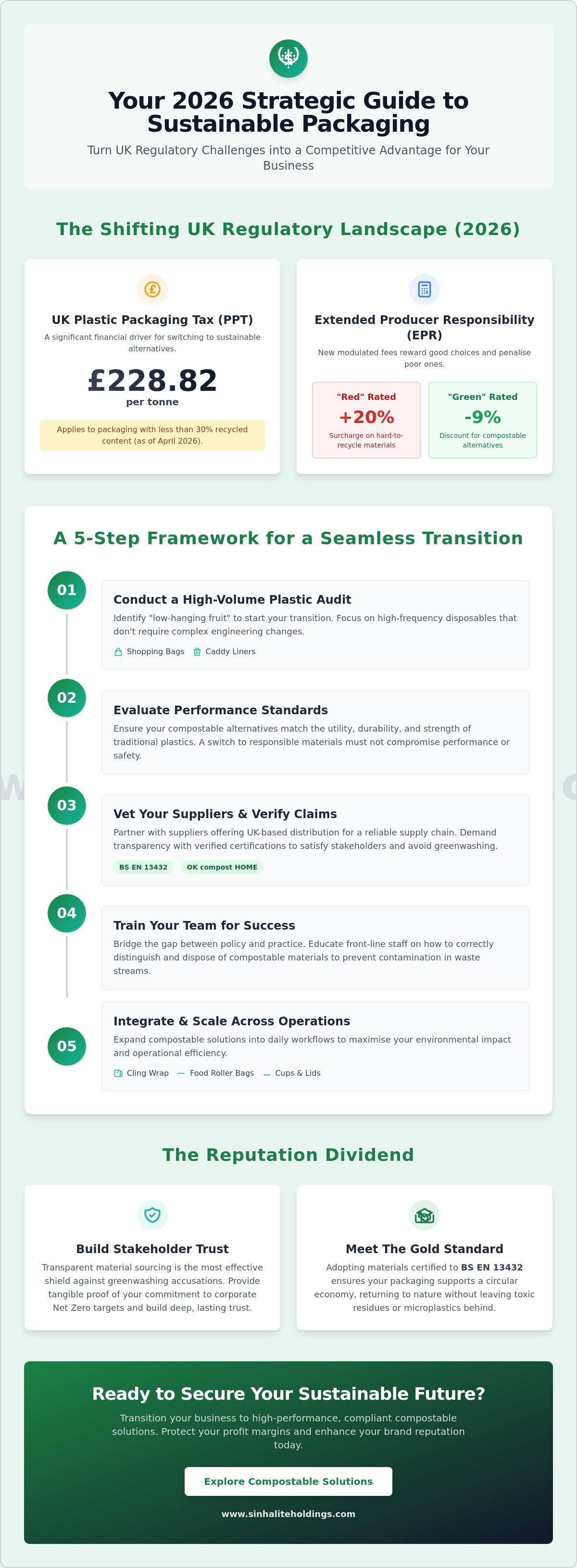
Did you know that as of April 2026, the UK Plastic Packaging Tax has climbed to £228.82 per tonne for materials with less than 30% recycled content? This increase makes switching business to sustainable packaging a financial necessity rather than just an ethical goal. You're likely feeling the weight of these rising costs and the confusion surrounding the new Extended Producer Responsibility (EPR) modulated fees, where "Red" rated packaging now carries a 20% surcharge. It's a complex environment where the fear of greenwashing accusations often feels as high as the mounting regulatory stakes.
We understand that you want a clear path forward that doesn't sacrifice performance or profit. This 2026 strategic guide is designed to simplify the transition by providing a verified roadmap through the latest UK regulations, including the Product Regulation and Metrology Act 2025. You'll learn how to align your operations with the BS EN 13432 standard and leverage high-performance compostable solutions to boost your brand's reputation. We'll break down the financial incentives of the new "Green" rating and provide a step-by-step transition plan that turns regulatory compliance into a long-term competitive advantage.
Key Takeaways
- Navigate the 2026 regulatory landscape by understanding how the Plastic Packaging Tax and EPR fee modulations directly impact your operational costs.
- Implement a structured framework for switching business to sustainable packaging by identifying high-volume plastic waste sources like caddy liners and shopping bags.
- Ensure your transition maintains high standards of utility and strength by choosing compostable garbage bags that meet rigorous industrial performance benchmarks.
- Streamline your daily workflows with practical, high-performance alternatives such as compostable cling wrap and food roller bags for efficient food preparation.
- Build long-term brand trust and ensure compliance by adopting materials that meet the BS EN 13432 standard for circular, residue-free waste management.
The Strategic Imperative: Why UK Businesses are Switching to Sustainable Packaging in 2026
In 2026, the definition of sustainable packaging has evolved beyond simple recycling. It now describes a systemic move toward materials that re-enter the economy or the natural environment without leaving toxic residues or microplastics behind. For UK organisations, this shift is no longer a peripheral CSR project; it's a fundamental pivot toward circularity. By prioritising compostable solutions that meet the BS EN 13432 standard, businesses ensure their packaging supports healthy soil systems rather than contributing to the growing burden of landfill waste.
To better understand the shift toward renewable materials, watch this helpful video:
The financial weight of the UK Plastic Packaging Tax (PPT) is a primary driver for this change. As of April 2026, the tax has risen to £228.82 per tonne for any packaging containing less than 30% recycled content. This fiscal pressure makes switching business to sustainable packaging a vital strategy for protecting profit margins. Beyond immediate taxes, adopting circular materials mitigates the volatility of carbon taxes and the rising costs of fossil-fuel-based polymers. What began as a consumer preference has matured into a strict institutional requirement, with supply chain tenders now demanding verified sustainability credentials as a prerequisite for partnership.
Navigating the 2026 UK Regulatory Landscape
Compliance is the cornerstone of modern operations. Understanding the Plastic Packaging Tax explained for small business helps leaders navigate the 10-tonne annual threshold that triggers registration. Additionally, the 2026 implementation of Extended Producer Responsibility (EPR) modulated fees introduces a 20% surcharge on "Red" rated materials. Businesses that switch to "Green" rated compostable alternatives can instead benefit from a 9% discount, directly rewarding responsible innovation.
ESG and the Reputation Dividend
Transparent material sourcing is the most effective shield against greenwashing accusations. By integrating compostable garbage bags and shopping bags into your facility management, you provide tangible proof of your commitment to corporate Net Zero targets. This transparency builds deep stakeholder trust, positioning your organisation as a visionary leader that prioritises long-term ecological health over short-term convenience.
The 5-Step Framework for a Seamless Transition to Eco-Friendly Materials
Success in switching business to sustainable packaging requires a methodical approach that balances environmental ambition with operational stability. The first step is conducting a high-volume plastic audit to identify "low hanging fruit." Items such as shopping bags and caddy liners are ideal starting points because they are high-frequency disposables that don't require complex engineering changes. Once these are identified, you must evaluate performance standards to ensure that compostable alternatives match the utility and durability of traditional polymers. It's vital that a switch to responsible materials doesn't lead to a compromise in strength or safety.
Supplier vetting is equally critical. UK-based distribution ensures a reliable supply chain, while verified certifications like OK compost HOME provide the transparency needed to satisfy stakeholders. When you're Getting Started With Eco-Friendly Packaging, remember that employee training is the bridge between policy and practice. Front-line staff must be educated on how to distinguish and dispose of these materials correctly to prevent contamination in waste streams. For those ready to begin this transition, exploring a range of certified compostable solutions is an excellent way to benchmark quality.
Comparing Compostable vs. Recyclable Solutions
Compostable materials offer a distinct advantage in environments where food contamination is common. Traditional recycling often fails when plastics are soiled with organic matter, leading to entire batches being rejected. In contrast, using puncture resistant compostable garbage bags allows businesses to process food waste and packaging together. This simplifies waste management and ensures that the materials actually reach their intended end-of-life destination.
Cost Management and ROI Analysis
Transitioning involves an honest assessment of ROI. While compostable SKUs may have a higher initial unit cost, they generate savings by reducing waste disposal fees and exempting your organisation from the Plastic Packaging Tax. A phased implementation strategy allows you to switch departments incrementally, which preserves cash flow while you build a robust, circular infrastructure.
Operationalising Sustainability: Integrating Compostable Solutions into Daily Workflows
Moving from high-level strategy to daily operations is where the real impact of switching business to sustainable packaging becomes visible. This transition is about more than just compliance. Replacing traditional PVC cling wrap with high-performance compostable alternatives directly addresses the risk of microplastic contamination in food prep areas. For retailers and fresh food counters, the integration of compostable food bags on a roll for delis ensures that speed and hygiene are maintained without relying on single-use plastics. Switching to compostable shopping bags simplifies the customer experience at the point of sale by providing a premium, guilt-free way to carry goods that can later be reused as organic waste liners. To truly close the loop, organisations should align their internal processes with UK packaging waste regulations and partner with local waste contractors for industrial composting.
Optimising Food Service with Compostable Clingfilm
Choosing commercial compostable cling film in the UK is becoming the gold standard for hospitality in 2026. These modern films are engineered to manage moisture effectively while maintaining the seal integrity required in professional kitchen environments. They provide the same cling performance as traditional versions but break down completely in industrial composting facilities. This switch doesn't compromise on quality or efficiency.
Scaling Waste Management with Heavy-Duty Compostable Sacks
Scaling up means transitioning from standard plastic garbage bags to certified compostable sacks for all organic waste streams. These heavy-duty solutions are designed to be leak-proof and tear-resistant, ensuring hygiene is never compromised in high-traffic commercial bins. By using these bags, businesses ensure that their waste management systems are as responsible as the products they sell. It's a practical step toward a cleaner, circular future.
Leading the Transition to a Circular UK Economy
The landscape of 2026 has made it clear that environmental stewardship is the new baseline for commercial success. By understanding the fiscal implications of the Plastic Packaging Tax and the operational benefits of compostable materials, your organisation can turn regulatory pressure into a distinct competitive edge. Integrating high-performance alternatives into your daily workflows doesn't just reduce waste; it builds a transparent, future-proof brand that stakeholders can trust. Switching business to sustainable packaging is a decisive step toward a world where industrial utility and natural processes exist in harmony.
As you move forward, you need a steady, dependable ally to navigate these complex shifts. We invite you to partner with Sinhalite Holdings for your national compostable packaging transition. As specialists in high-performance compostable clingfilm and heavy-duty sacks, we provide the tangible tools required for a seamless shift. Our solutions are fully compliant with TUV Austria and OK compost HOME standards, making us a proven supply chain partner for UK commercial entities. Let's work together to create a cleaner, greener, and more prosperous future for your organisation.
Frequently Asked Questions
Is switching to sustainable packaging more expensive for UK businesses in 2026?
While the unit price for compostable materials can be higher than virgin plastic, the total cost of ownership often reaches parity when factoring in regulatory fees. By switching business to sustainable packaging, you avoid the £228.82 per tonne Plastic Packaging Tax applied to non-recycled materials. Furthermore, the 2026 EPR fee modulation offers a 9% discount for "Green" rated materials, significantly offsetting the initial investment through direct tax savings and reduced waste disposal costs.
What is the difference between biodegradable and compostable packaging for commercial use?
Compostable packaging is the superior choice for commercial entities because it must meet the BS EN 13432 standard for residue-free breakdown. This ensures the material decomposes into organic matter within a specific timeframe without leaving microplastics behind. In contrast, "biodegradable" is an unregulated term that doesn't guarantee a safe or timely end-of-life process. Choosing certified compostable solutions protects your organisation from greenwashing accusations and ensures your waste actually supports a circular economy.
How does the UK Plastic Packaging Tax impact my choice of materials this year?
The tax creates a clear financial mandate to move away from traditional polymers that contain less than 30% recycled content. Since the rate increased in April 2026, the fiscal burden on high-volume plastic users has become a significant drain on profit margins. Transitioning to compostable food roller bags and shopping bags allows you to bypass this tax entirely. It's a proactive way to future-proof your supply chain against further tax hikes and tightening environmental legislation.
Can compostable packaging handle heavy-duty commercial requirements like traditional plastic?
Yes, modern compostable solutions are engineered to match or exceed the durability of traditional single-use plastics. High-performance compostable garbage bags and sacks are designed with advanced puncture resistance and leak-proofing to handle the rigours of commercial kitchens and high-traffic facilities. These products undergo rigorous testing to ensure they maintain seal integrity and load-bearing strength, proving that responsible business practices don't require a compromise on operational utility or hygiene standards.


