

With the Plastic Packaging Tax rate rising to £228.82 per tonne as of April 2026, many entrepreneurs are discovering that even "eco-friendly" bioplastics don't automatically exempt them from HMRC's reach. It's often frustrating to face an administrative mountain when you're simply trying to run an ethical company. You likely feel that tracking the precise weight of every component is a heavy burden that pulls focus away from your core mission. We believe that a transition to more responsible practices should be empowering, not exhausting.
This guide provides the plastic packaging tax explained for small business leaders who want to replace confusion with a clear, actionable strategy. You'll master the 10-tonne registration threshold and discover how to protect your bottom line from rising costs while maintaining high standards of utility. We'll examine the 2026 compliance landscape, provide a practical step-by-step checklist, and highlight how transitioning to high-quality compostable solutions like certified garbage bags and food wraps can align your operations with a circular economy. Let's turn these regulatory challenges into an opportunity for responsible innovation and long-term impact.
Key Takeaways
- Understand the dual triggers of the 10-tonne threshold, covering both your historical 12-month records and forward-looking 30-day projections.
- Navigate the "bioplastic trap" by learning why HMRC classifies most bio-based and biodegradable materials as taxable plastic packaging.
- Use this plastic packaging tax explained for small business guide to audit your supply chain and accurately identify the predominant material of every component.
- Establish a rigorous six-year record-keeping process to verify recycled content and protect your business from significant non-compliance penalties.
- Explore strategic shifts toward certified compostable solutions, such as food waste bags and cling wrap, to eliminate tax liability while advancing your circular economy goals.
Determining Your Liability: The 10-Tonnes Threshold and the 'Bioplastic Trap'
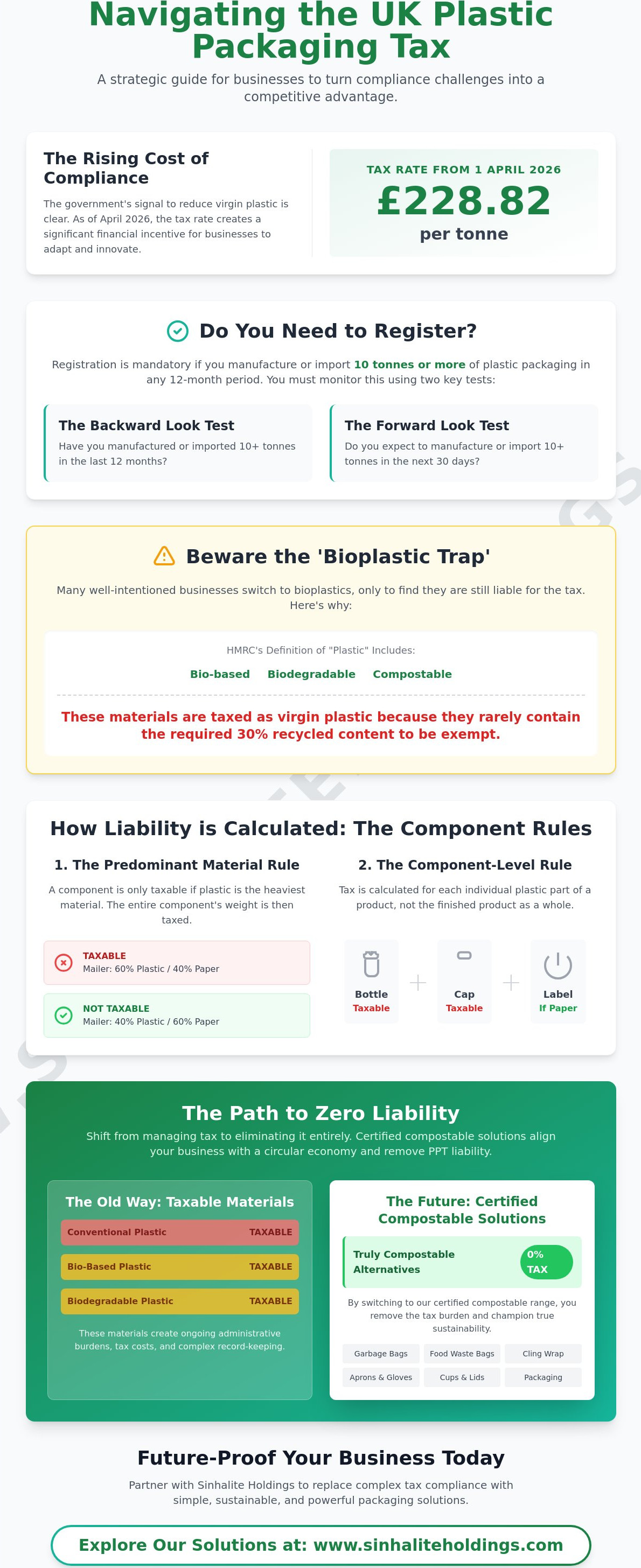
To understand the plastic packaging tax explained for small business, you must first determine if your operations trigger the mandatory registration threshold. HMRC requires any business that manufactures or imports 10 tonnes or more of plastic packaging within a 12-month period to register. This applies even if your packaging contains more than 30% recycled content and no tax is actually due. You must monitor this on a rolling basis by looking back at the previous 12 months or looking forward at the next 30 days. If you expect to import or produce 10 tonnes in the coming month alone, you've already met the criteria.
The current rate of £228.82 per tonne, effective from 1 April 2026, represents a clear financial signal from the government to reduce reliance on virgin materials. This legislation sits within the wider framework of managing Waste in the United Kingdom, aiming to drive a systemic shift toward a circular economy. Ignoring these thresholds can lead to significant penalties, so maintaining precise weight records for every packaging component is essential for your compliance strategy.
To better understand the core mechanics of this legislation, watch this helpful video summary:
The Reality of Compostable Plastics Under PPT
Many responsible innovators are surprised to find themselves caught in the "bioplastic trap." HMRC defines plastic to include polymer-based materials that are bio-based, biodegradable, or compostable. Because most compostable solutions, such as certain types of compostable cling film or shopping bags, are designed for organic recovery rather than mechanical recycling, they rarely contain 30% recycled content. Consequently, they are taxed as virgin plastic. This creates a unique challenge for businesses that have already made the switch to "greener" plastics but haven't yet moved toward fully circular, non-plastic alternatives.
Identifying 'Components' vs. Finished Products
Liability is calculated at the component level. A single product might consist of multiple taxable parts, such as a bottle, a cap, and a label. A component is considered "plastic" if plastic is the predominant material by weight. If you use a multi-material mailer that is 60% paper and 40% plastic by weight, it isn't taxable. However, if the plastic exceeds 50%, the entire weight of that component is subject to the tax. We encourage you to audit your supply chain to identify these specific weights, as even small variations can change your tax status.
How to Calculate and Report Your Plastic Packaging Tax Liability
Calculating your liability requires a methodical approach to data collection. We recommend starting with a comprehensive audit of your entire supply chain to identify every plastic component you manufacture or import. This process is essential for providing the plastic packaging tax explained for small business owners who need to move beyond guesswork and into verifiable compliance. You should follow these four critical steps to ensure your reporting is accurate and robust.
- Audit your supply chain: Identify every individual component, from outer wraps to small labels, to ensure nothing is overlooked.
- Perform component math: Weigh each part individually. If plastic is the predominant material by weight, the entire component weight is considered taxable.
- Verify recycled content: Secure written evidence from suppliers, such as ISO 14021 certifications, to prove a component contains at least 30% recycled plastic.
- Register promptly: You must notify HMRC within 30 days of reaching the 10-tonne threshold to avoid automatic penalties.
For a deeper dive into these regulatory nuances, you can consult this complete guide to Plastic Packaging Tax. This resource provides the technical depth needed for complex reporting scenarios and multi-part packaging assessments.
Record-Keeping Requirements for Small Businesses
Maintaining an audit-ready trail is your best defense against HMRC scrutiny. You must keep records for at least six years, documenting the weight and material composition of all packaging. It's particularly important to distinguish between traditional polymers and bioplastics. If you are unsure whether your current supplies are exempt, researching do compostable bags contain plastic will help you categorise materials correctly in your ledger. Accurate records demonstrate your commitment to transparency and responsible business practices.
Calculating the Financial Impact
With the 2026 tax rate set at £228.82 per tonne, forecasting your quarterly liability is a vital financial exercise. You calculate this by taking the total weight of plastic packaging and subtracting any components that are either exempt or meet the 30% recycled content threshold. This "taxable weight" is then multiplied by the current rate. Many businesses find that switching to compostable alternatives is a more cost-effective long-term strategy than managing the rising costs and administrative burdens of traditional plastic.
Strategising for a Post-Plastic Future: Reducing Liability and Building Brand Value
While the official government guidance on PPT focuses heavily on registration and payment, a visionary business leader looks beyond mere compliance. The most effective way to address the plastic packaging tax explained for small business is to eliminate the liability altogether by transitioning to non-plastic alternatives. This isn't just a defensive financial move; it's a proactive step toward a circular economy that resonates deeply with modern consumers. By adopting solutions like commercial compostable cling film, you align your operations with broader Environmental, Social, and Governance (ESG) goals.
Communicating this switch effectively can transform a regulatory hurdle into a powerful marketing asset. Customers increasingly prefer brands that demonstrate genuine environmental stewardship rather than those that simply pass on tax costs. Partnering with responsible innovators allows you to source high-performance packaging that maintains operational integrity while showcasing your commitment to a cleaner future. It's about leading the market rather than reacting to it.
The ROI of Sustainable Packaging
Investing in compostable SKUs often yields a superior return on investment when you factor in the rising costs of tax liability and potential non-compliance penalties. For instance, using puncture resistant compostable garbage bags reduces waste management friction and avoids the administrative burden of tracking traditional plastic weights. These high-performance alternatives ensure that your sustainability targets are met without sacrificing the durability your business requires for daily operations.
Navigating the Transition
We suggest a three-stage plan to phase out virgin plastic inventory. First, audit your current stock to identify high-weight plastic components that carry the heaviest tax burden. Second, test compostable replacements to ensure they meet your utility standards for strength and shelf life. Finally, leverage certifications like OK compost HOME to build trust with B2B partners and local councils. This methodical approach ensures a smooth transition that protects your bottom line and reinforces your reputation as a steady, dependable ally in the global effort to reduce plastic waste.
Leading the Transition to a Circular Economy
The 2026 landscape for plastic packaging tax explained for small business is one of both challenge and significant opportunity. By identifying your 10-tonne liability early and understanding the nuances of the "bioplastic trap," you've already taken the first step toward securing your company's financial future. Maintaining a rigorous audit trail and weighing components individually ensures you remain compliant with HMRC while protecting your bottom line from unnecessary penalties.
True success lies in moving beyond the administrative burden of traditional polymers. Transitioning to high-performance, circular solutions doesn't just reduce your tax liability; it positions your brand as a responsible innovator in an increasingly eco-conscious market. As a specialist in UK-compliant compostable packaging, we provide performance-tested alternatives that never sacrifice strength for sustainability. It's a strategic choice that aligns your operational needs with a profound sense of environmental stewardship.
Explore high-performance compostable solutions for your business and discover how our specialist range of garbage bags, food wraps, and caddy bags can support your journey. Together, we can build a more sustainable future where operational excellence and environmental stewardship go hand in hand.
Frequently Asked Questions
Is bioplastic exempt from the Plastic Packaging Tax?
No, bioplastic is not automatically exempt. HMRC classifies most bio-based, compostable, and biodegradable polymers as taxable plastic packaging. Because these materials are designed for organic recovery, they often lack the 30% recycled content required for tax-free status. Transitioning to circular, non-plastic solutions remains the most effective way to eliminate this liability while supporting your environmental stewardship goals.
What happens if my business imports less than 10 tonnes of plastic a year?
You aren't required to register if your total weight stays under 10 tonnes. However, you must maintain clear weight records for six years to prove you haven't met the threshold. If you expect to reach 10 tonnes in the next 30 days or have done so in the last 12 months, you must notify HMRC. Proactive monitoring ensures your operations remain compliant with the rules for plastic packaging tax explained for small business.
How do I prove my packaging contains 30% recycled plastic?
You prove recycled content by maintaining a robust evidence trail from your suppliers. This typically includes detailed product specifications, purchase contracts, and certifications such as ISO 14021. You must demonstrate that the recycled material was incorporated at the point of manufacture. Keeping these records organised ensures you are always ready for an HMRC audit without disrupting your daily operations.
Do I need to register for PPT if all my packaging is exempt?
Yes, you must register if you meet the 10-tonne threshold even if no tax is due. Registration is mandatory based on the total weight of plastic packaging handled, including exempt items. This requirement is a critical part of the plastic packaging tax explained for small business as it ensures HMRC can monitor market shifts toward recycled materials. Failing to register can lead to unnecessary financial penalties.
What are the penalties for failing to register or report Plastic Packaging Tax?
HMRC issues fixed and daily penalties for failing to register or report on time. A fixed penalty of £500 often applies for late registration, and daily charges can accrue for ongoing non-compliance. You'll also be liable for interest on any unpaid tax amounts. We believe that professional authority and proactive reporting are the best ways to protect your business from these avoidable costs.
Can I pass the cost of the Plastic Packaging Tax on to my customers?
You can pass the tax cost to your customers, but it may impact your competitiveness. Many organisations prefer to avoid this by switching to high-performance compostable alternatives like shopping bags or food roller bags. This approach eliminates the tax entirely while providing a visionary solution for clients who value sustainability. It's a practical way to align your commercial success with responsible business practices.


