

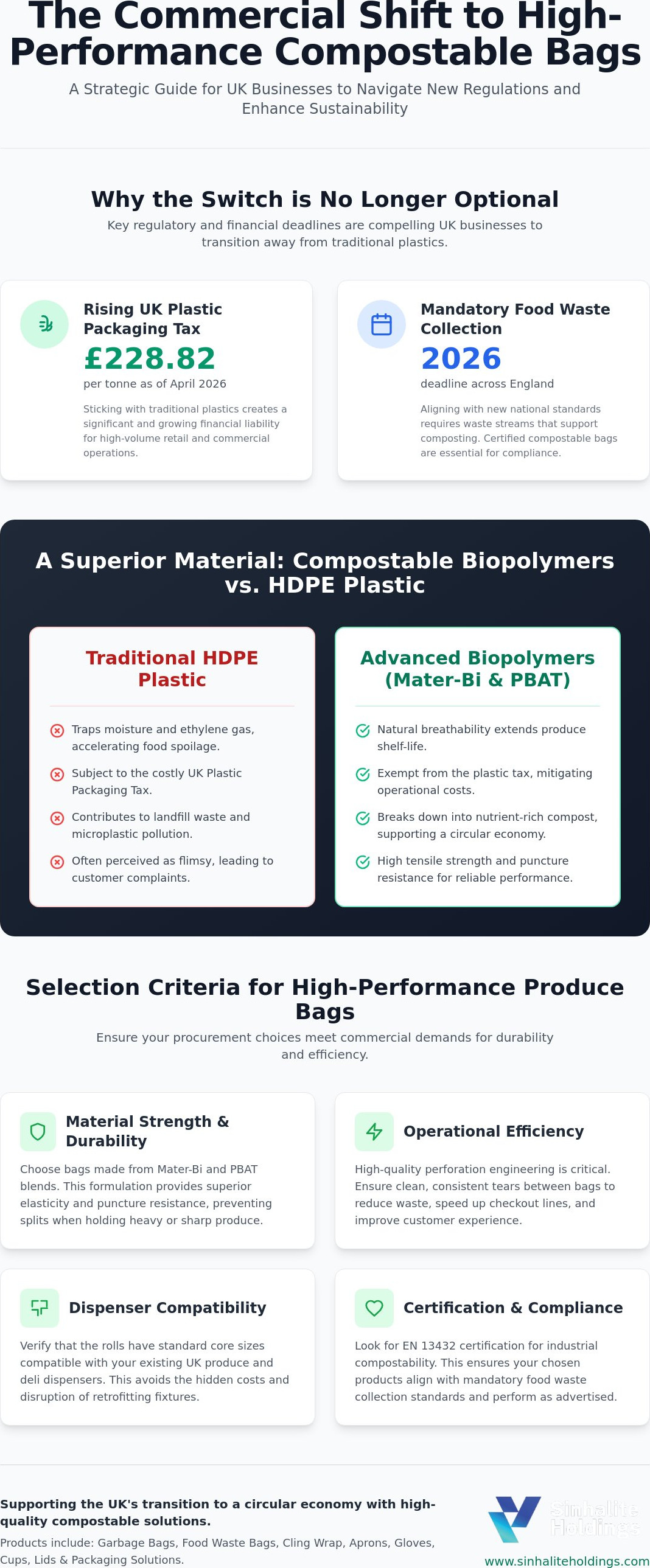
With the UK Plastic Packaging Tax rising to £228.82 per tonne as of April 2026, sticking with traditional plastics has become a significant financial liability for your retail operations. You're likely tired of hearing customer complaints about flimsy eco-alternatives that split at the perforation or fail under the weight of heavy produce. It's a frustrating balance to strike between meeting strict zero-waste mandates and maintaining the speed of your checkout lines. Choosing the right compostable food roller bags UK businesses can rely on is now a critical pillar of your commercial strategy.
We understand that a truly sustainable transition requires more than just a label; it requires industrial-grade performance that supports your ESG commitments without sacrificing utility. This guide will help you master the transition to high-performance, compliant produce bags that integrate seamlessly into your existing dispensers. We will examine the technical differences between EN 13432 and home compostable certifications, ensuring your procurement choices align perfectly with the 2026 mandatory food waste collection standards across England. By the end of this guide, you'll have the tools to secure a reliable, high-tensile supply chain that protects both your reputation and the planet.
Key Takeaways
- Navigate the financial implications of the 2026 Plastic Packaging Tax by identifying compliant, non-plastic alternatives for your produce aisles.
- Evaluate the performance benefits of advanced biopolymers like Mater-Bi and PBAT to ensure your eco-friendly bags match the durability of traditional plastics.
- Streamline your procurement process by selecting compostable food roller bags UK that fit existing dispensers while offering superior puncture resistance.
- Align your retail operations with the 2026 mandatory food waste collection laws through strategic waste stream audits and staff training.
- Enhance your brand’s ESG profile by integrating certified compostable solutions that support a circular economy and meet consumer expectations.
The Strategic Shift to Compostable Food Roller Bags in the UK
Industrial-grade compostable food roller bags UK retailers rely on are no longer a niche luxury; they're a technical necessity for the modern supply chain. These products are engineered from plant-based polymers specifically for high-traffic retail and deli environments. Unlike traditional HDPE, these rolls facilitate a circular system where the packaging itself becomes part of the nutrient recovery process. This shift isn't just about reducing waste; it's about adopting a material science approach that respects natural cycles while meeting commercial demands.
The year 2026 represents a definitive tipping point for switching business to sustainable packaging. This urgency is driven by the UK Plastic Packaging Tax, which reached £228.82 per tonne in April 2026. For high-volume produce departments, the financial liability of non-compliant plastic is now a significant overhead. Transitioning to certified compostable alternatives allows businesses to mitigate these costs while aligning with mandatory food waste collection mandates across England.
To better understand this concept, watch this helpful video:
Moving toward a fully integrated nutrient recovery model requires understanding compostable materials and how they interact with organic waste streams. When a produce bag can be disposed of alongside food scraps, it simplifies the customer journey and ensures that zero-waste goals are actually achievable. This holistic view of packaging performance is what separates industry leaders from those merely reacting to regulation.
Food Preservation and Breathability
One of the most significant advantages of bioplastic is its inherent breathability. Traditional HDPE produce bags trap ethylene gas and moisture, which accelerates the ripening process and leads to premature spoilage. High-quality compostable food roller bags UK suppliers provide are designed with natural permeability. This moisture management science reduces condensation and ethylene build-up, effectively extending the shelf-life of fresh produce on the shelf and in the customer's home.
Enhancing the Customer Experience
UK consumers are increasingly observant of a brand's environmental stewardship. Visible compostable branding on every roll signals a clear commitment to ESG goals. We've found that addressing the "flimsy bag" stigma is essential for customer satisfaction. By utilizing advanced Mater-Bi and PBAT blends, these bags offer a superior tactile quality and tensile strength. They don't just feel better; they perform better, holding heavy produce without the risk of splitting at the perforation line.
Selection Criteria for High-Performance Produce Roller Bags
Achieving the necessary tensile strength for high-traffic retail environments requires a precise formulation of biopolymers. Mater-Bi and PBAT blends are essential for creating puncture resistant compostable garbage bags and the high-quality compostable food roller bags UK businesses demand. These materials provide the elasticity needed to accommodate varied produce shapes while maintaining a rigid structure that prevents stretching. This technical balance ensures that the bag remains intact from the produce aisle to the customer's kitchen.
Operational efficiency in a busy supermarket depends heavily on perforation engineering. Clean, consistent tears reduce material waste and prevent the frustration often associated with lower-quality eco-alternatives. It's equally vital to ensure dispenser compatibility; standard core sizes for UK roller stands must be verified during procurement to avoid the hidden costs of retrofitting existing deli or produce fixtures. If you're looking to upgrade your current stock, you can view our commercial-grade compostable range to find the exact fit for your dispensers.
Inventory management requires a strategic approach to storage stability. Unlike traditional plastics, bioplastics can be sensitive to humid warehouse conditions or extreme temperature fluctuations. Following expert guidance on compostable packaging ensures you implement "first-in, first-out" protocols to prevent premature degradation. Proper storage maintains the polymer's integrity, ensuring every roll performs as expected even after months in the stockroom.
Certifications Every UK Procurement Officer Must Know
Distinguishing between OK compost HOME certification and industrial standards is paramount for regulatory compliance. While BS EN 13432 ensures bags are accepted by UK municipal composting facilities, home-compostable options provide the ultimate convenience for the end-user by allowing disposal in garden heaps. This clarity prevents "greenwashing" and ensures your organic waste streams remain uncontaminated by non-certified materials.
Material Integrity and Load Bearing
Heavy produce like potatoes or citrus typically requires a thickness of 15 to 18 microns to maintain structural integrity during the customer's journey home. Sinhalite’s focus on industrial pragmatism ensures that our compostable food roller bags UK clients use don't split under weight, providing a reliable bridge between environmental goals and daily operational needs.
Implementing a National Compostable Transition Strategy
A successful transition to sustainable alternatives requires a structured approach that goes beyond simple procurement. Conducting a comprehensive waste stream audit is the first step to ensure your compostable food roller bags UK strategy aligns with local organic waste collection services. This audit identifies where traditional plastics are still leaking into your waste streams and where bioplastics can facilitate better nutrient recovery. By mapping out these flows, you ensure that every bag used in your produce aisle has a clear, compliant path to a composting facility.
Training your staff is equally vital for operational success. They need to understand the functional differences between plant-based polymers and traditional HDPE to manage stock correctly and assist inquisitive customers. Clear, transparent signage helps communicate the 'why' behind the change, transforming a simple produce bag into a visible symbol of your commitment to the circular economy. Partnering with a specialist UK supplier ensures you have the logistical support needed for scalable, national distribution across all your retail sites, ensuring consistency from the Highlands to the South Coast.
Operational Hygiene and Odour Control
Integrating these bags into your back-of-house operations significantly improves workplace hygiene. Using certified compostable liners in retail food prep areas allows for the simultaneous disposal of bags and organic scraps, which streamlines the cleaning process and reduces cross-contamination risks. This method is a key component in learning how to keep a food waste bin from smelling by ensuring organic waste is contained in breathable, compliant materials that mitigate anaerobic decomposition. The result is a cleaner, more efficient prep environment that supports your broader zero-waste goals.
The ROI of Sustainable Procurement
While the marginal cost of bioplastics might be higher than traditional film, the long-term return on investment is substantial. Modern UK consumers reward brands that demonstrate genuine environmental stewardship with increased loyalty and advocacy. Investing in high-quality compostable food roller bags UK retailers use today also future-proofs your business against upcoming environmental legislation and the escalating costs associated with the Plastic Packaging Tax. By choosing responsible innovation now, you protect your bottom line and your brand's reputation for years to come.
Securing Your Business’s Future in the Circular Economy
The transition toward a circular economy requires more than just compliance; it demands a visionary approach to material science and operational logistics. By selecting high-tensile compostable food roller bags UK retailers can rely on, you eliminate the financial risks of the Plastic Packaging Tax while enhancing your brand’s reputation for environmental stewardship. We've explored how technical certifications like BS EN 13432 and advanced Mater-Bi blends provide the industrial strength necessary for high-traffic environments. This shift ensures that your produce aisles remain efficient while supporting national nutrient recovery goals.
Sinhalite Holdings stands as your steady, dependable ally in this journey. As a specialist UK provider, we offer professional-grade solutions that bridge the gap between modern innovation and natural processes. Our commitment to visionary leadership and industrial pragmatism ensures that your transition is both seamless and advantageous for your long-term ESG strategy. We provide the tangible tools needed to align your operations with modern ethical standards without sacrificing performance.
Explore Sinhalite’s range of high-performance compostable food roller bags for UK businesses to future-proof your operations today. Together, we can build a more responsible and resilient future for the UK retail sector.
Frequently Asked Questions
Are compostable food roller bags strong enough for heavy fruit and vegetables?
High-performance compostable food roller bags UK retailers utilize are specifically engineered to match the load-bearing capacity of traditional HDPE. By utilizing advanced Mater-Bi and PBAT blends, these bags maintain structural integrity even when carrying dense items like five-kilogram potato packs or large citrus assortments. This industrial-grade strength ensures that the bags don't stretch or tear prematurely, providing a reliable experience for both your staff and your customers.
Do these bags have a shelf-life, and how should they be stored in a warehouse?
Certified compostable bags typically have a commercial shelf-life of 10 to 12 months when stored under optimal conditions. To prevent premature degradation, you should keep your stock in a cool, dry warehouse environment away from direct sunlight and high humidity levels. Implementing a "first-in, first-out" inventory system ensures that the biopolymers maintain their high-tensile performance and perforation quality when they finally reach the produce aisle.
Will my local UK council accept these bags in their organic waste collection?
Most UK councils accept bags that meet the BS EN 13432 industrial composting standard, particularly as mandatory weekly food waste collections roll out across England by 31st March 2026. These bags are designed to break down completely in industrial facilities without leaving harmful microplastic residues. We recommend verifying specific requirements with your local authority or waste contractor to ensure your chosen bags align with their organic waste processing streams.
How do I know if a roller bag is truly plastic-free and not just 'degradable'?
Authentic compostable options are distinguished by verified certification logos, such as the "Seedling" mark or TUV Austria’s "OK compost" labels. Unlike "degradable" or "oxo-degradable" plastics, which simply fragment into microplastics, true compostable food roller bags UK businesses procure are made from plant-based starches and polymers. These materials undergo rigorous testing to ensure they revert to organic matter within a specific timeframe, leaving no toxic residue in the nutrient recovery cycle.


