

If your organisation is still relying on traditional plastics, you aren't just creating waste; you're falling behind a global regulatory shift that demands smarter, cleaner packaging solutions. The debate over beeswax wraps vs compostable cling film often leaves businesses caught between a desire for reusability and the harsh realities of commercial hygiene standards. It's a common challenge to find a balance between environmental stewardship and the practical demands of a high-volume professional environment, especially as new regulations like the EU's Packaging and Packaging Waste Regulation begin to take full effect in 2026.
You likely want to eliminate single-use plastics but feel frustrated by alternatives that don't actually hold up in a busy kitchen or warehouse. This guide provides the clarity you need to choose a waste-reduction strategy that actually scales without compromising on food safety or operational efficiency. We will examine the performance, regulatory compliance, and industrial suitability of both materials to help you lead your organisation toward a cleaner, more responsible future. By the end of this guide, you'll understand which product serves as the superior replacement for your specific operational needs.
Key Takeaways
- Understand the fundamental material differences between reusable cotton-based wraps and bio-based polymers to determine which best supports your operational requirements.
- Evaluate the critical safety standards of beeswax wraps vs compostable cling film, particularly regarding cross-contamination risks and the safe storage of raw proteins.
- Discover how innovative compostable clingfilm provides the airtight barrier and stretch performance necessary for high-volume commercial food preservation.
- Identify why compostable alternatives offer a more systemic, scalable solution for large organisations by reducing the hidden labour costs of sanitising reusable products.
- Align your procurement strategy with 2026 environmental regulations by transitioning to certified home-compostable solutions that effectively eliminate single-use plastic waste.
Comparing the Mechanics of Beeswax Wraps and Compostable Cling Film
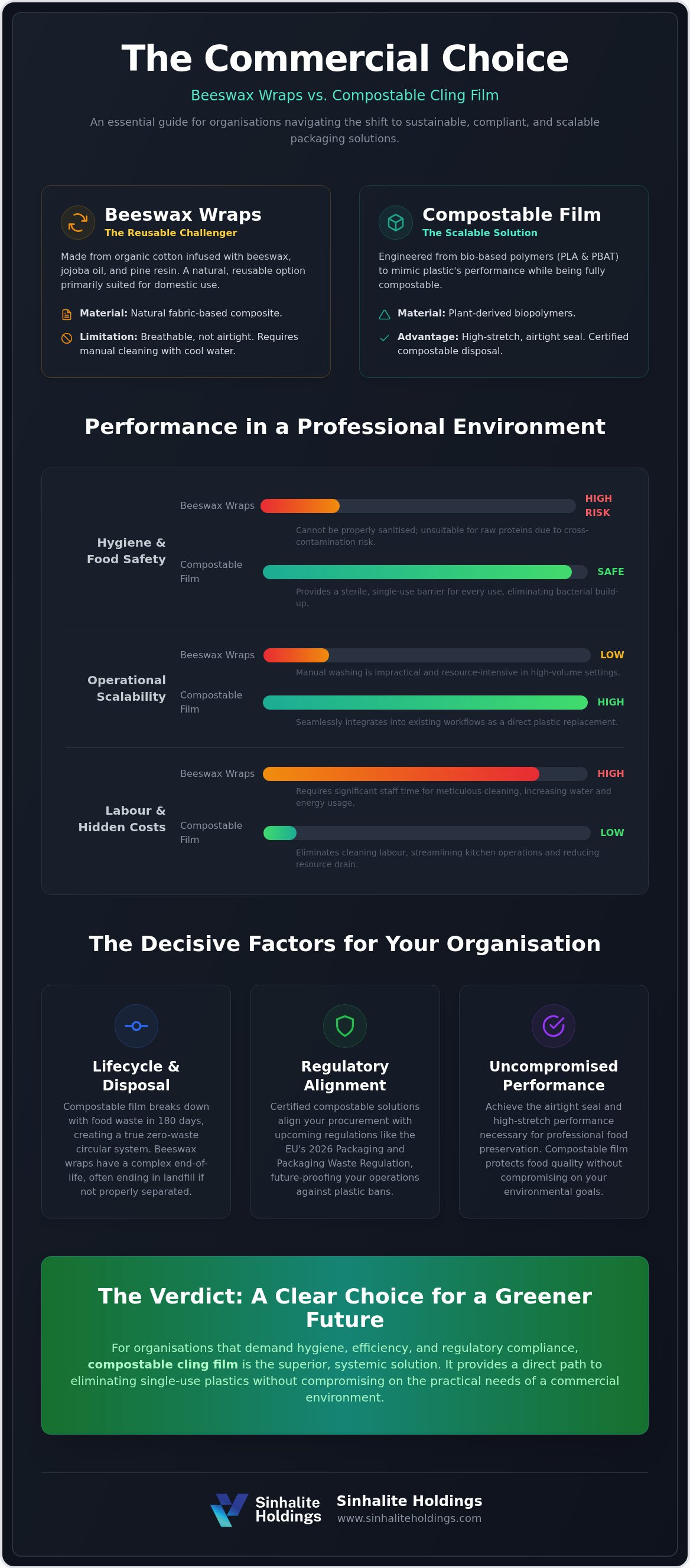
Understanding the physical properties of these materials is essential for any organisation aiming to align its operations with modern sustainability standards. A Beeswax wrap is typically composed of organic cotton infused with a blend of food-grade beeswax, jojoba oil, and pine resin. This combination creates a breathable, malleable fabric that can be shaped around containers or food items using the warmth of your hands. Conversely, compostable cling film is an innovative material engineered from bio-based polymers like PLA (Polylactic Acid) and PBAT (Polybutylene adipate terephthalate). These materials are specifically designed to mimic the high-performance stretch and airtight seal of traditional plastic while remaining entirely biodegradable.
To better understand how these materials function in a practical setting, watch this helpful comparison:
When evaluating beeswax wraps vs compostable cling film, the choice often hinges on the distinction between reusability and systemic efficiency. While beeswax wraps are celebrated for their natural components, they require a meticulous cleaning process using cool water and mild soap to maintain their integrity. In a commercial or high-volume environment, this introduces a hidden carbon footprint through increased water usage and the energy required for manual sanitisation. The use of bioplastics in compostable films avoids this secondary resource drain, providing a direct replacement for plastic that maintains professional hygiene standards.
Lifecycle Analysis: From Production to Disposal
The lifecycle of these products differs significantly in professional applications. Cleaning beeswax wraps at scale can be labour-intensive and resource-heavy; it often makes them less practical for busy kitchens. In contrast, compostable clingfilm integrates seamlessly into existing organic waste management systems. It offers the convenience of single-use disposal without the environmental guilt, as it's designed to break down alongside food waste in a controlled environment.
Environmental Impact: Home vs. Industrial Composting
Sinhalite Holdings focuses on solutions that support rapid biodegradation to achieve zero-waste goals. A certified compostable film is engineered to break down within 180 days in a composting environment, returning to the earth as nutrient-rich soil. While a beeswax wrap may last for several years with proper care, its eventual disposal is more complex if the cotton is not properly separated from the wax coating. For organisations seeking a scalable waste-reduction strategy, the predictable decomposition of certified films provides a more reliable path toward environmental stewardship.
Hygiene, Performance, and Practicality: A Comparative Analysis
Operational success in the food industry relies on uncompromising hygiene and consistent performance. When comparing beeswax wraps vs compostable cling film, the most significant divergence appears in how these materials handle high-risk items. Beeswax wraps are fundamentally unsuitable for storing raw proteins or wet foods because they can't be sanitised with high-temperature water without destroying the protective wax coating. This creates a persistent risk of bacterial growth and cross-contamination that most professional organisations simply can't accept. In contrast, bio-based films provide a fresh, sterile barrier for every use, ensuring compliance with 2026 food safety standards.
Food Safety and Cross-Contamination
Single-use compostable film serves as the most secure option for high-risk food environments because it eliminates the cumulative bacterial risk associated with reusable surfaces that are difficult to deep-clean. Maintaining beeswax wraps requires significant manual labour; even with diligent care, the porous nature of the cotton fabric can harbour microscopic residues that compromise safety over time.
Performance in Professional Environments
A primary frustration with many eco-friendly alternatives is their inability to adhere to containers effectively. Finding a compostable cling film that actually clings is essential for maintaining an airtight seal, which prevents oxidation and extends the shelf life of ingredients. While beeswax relies on hand warmth to create a seal, it often fails to provide the true vacuum-like grip needed for professional food preservation. Additionally, the transparency of high-quality bioplastics allows for effortless inventory management. Staff can identify contents in commercial fridges at a glance, a task made difficult by the opaque or patterned nature of most beeswax wraps.
Temperature sensitivity also dictates utility. Beeswax begins to soften and lose its structure at relatively low temperatures, making it unusable in microwaves or near heat sources. Modern compostable films are engineered for greater versatility, performing reliably across a wider range of thermal conditions. For businesses looking to modernise their operations, choosing innovative packaging solutions ensures that environmental goals are met without sacrificing the speed and safety of a professional kitchen.
Strategic Sustainability: Why Organisations are Choosing Compostable Film
Choosing between beeswax wraps vs compostable cling film depends largely on the scale of your operations. While beeswax wraps serve as a charming boutique solution for individual households, they lack the systemic flexibility required by large-scale organisations. For businesses processing hundreds of meals daily, the labour costs associated with washing, drying, and re-waxing reusable wraps quickly outweigh any initial perceived savings. Switching to high-performance bioplastics allows for a seamless transition that maintains industrial speed while upholding ethical commitments.
Regulatory compliance is another driving factor for this shift. As we move through 2026, many jurisdictions are enforcing stricter plastic reduction targets that require verifiable, certified alternatives. Sinhalite Holdings provides the professional expertise needed for switching business to sustainable packaging without disrupting existing workflows. By adopting compostable films, companies can meet these legal requirements while demonstrating a genuine dedication to environmental stewardship.
Implementation for Councils and Large Organisations
Municipalities and councils find that compostable film is a vital tool for successful food waste collection schemes. Traditional plastic films often contaminate recycling streams or end up in landfill because they're difficult to separate from organic matter. Compostable alternatives solve this issue; they can be processed alongside food scraps in industrial composting facilities. This simplifies the waste management process for residents and ensures that organic waste is actually converted into useful compost rather than becoming a pollutant.
Building a Plastic-Free Future with Sinhalite
Transitioning away from single-use plastics requires a partner who understands both environmental idealism and industrial pragmatism. Sinhalite Holdings offers a comprehensive range of SKUs designed to replace every plastic touchpoint in your organisation. Our selection includes everything from compostable food roller bags for retail environments to heavy-duty compostable garbage bags for industrial waste management. By choosing these innovative solutions, you aren't just buying a product; you're investing in a cleaner, greener future for the global community.
#Sustainability2026 #ZeroWasteSriLanka #EcoFriendlyBusiness #CompostableInnovation #PlasticFreeFuture #GreenRevolution #SinhaliteHoldings #SustainablePackaging #GoGreenLK #WasteReduction
Advancing Toward a Systemic Circular Economy
The choice between beeswax wraps vs compostable cling film marks a critical decision for organisations committed to long-term environmental stewardship. While beeswax offers a natural alternative for domestic use, it often falls short in high-volume environments where hygiene and scalability are non-negotiable. Certified bioplastics provide a practical path forward; they allow businesses to meet 2026 plastic reduction targets while maintaining the operational speed and food safety standards required in professional kitchens.
By integrating OK compost HOME certified materials into your workflow, you eliminate the resource-heavy maintenance of reusables and the environmental damage of traditional plastics. Sinhalite Holdings remains a dedicated partner for both UK and Sri Lankan organisations, providing durable, high-performance bioplastic alternatives that support municipal food waste collection. Adopting these innovative solutions ensures your waste-reduction strategy is both achievable and advantageous.
Transition your business to sustainable packaging with Sinhalite Holdings today and lead the way toward a cleaner, more responsible future. We are here to support your journey with tools that balance industrial pragmatism with a visionary outlook.
#Sustainability2026 #ZeroWasteSriLanka #EcoFriendlyBusiness #CompostableInnovation #PlasticFreeFuture #GreenRevolution #SinhaliteHoldings #SustainablePackaging #GoGreenLK #WasteReduction #PackagingSolutions #CircularEconomy
Frequently Asked Questions
Can beeswax wraps be used for raw meat or fish?
No, you shouldn't use beeswax wraps for raw meat or fish because they cannot be sanitised with hot water. Pathogens such as Salmonella require high temperatures for total elimination; however, heat melts the protective wax coating and ruins the wrap. For high-risk proteins, compostable cling film provides a sterile, single-use barrier that ensures food safety without leaving a legacy of plastic waste. It's the responsible choice for maintaining professional hygiene standards.
How long does compostable cling film take to break down compared to beeswax wraps?
Certified compostable cling film typically breaks down within 180 days in a composting environment, whereas beeswax wraps are designed to last for six to twelve months of active use. While the reusable nature of beeswax seems efficient, the eventual disposal of the cotton fabric takes significantly longer to degrade than bio-based polymers. In the debate of beeswax wraps vs compostable cling film, the film offers a more predictable and rapid return to the earth.
Is compostable cling film as strong as traditional plastic wrap?
Modern compostable cling film is engineered to match the tensile strength and puncture resistance of traditional polyethylene wrap. High-performance bioplastics provide the necessary elasticity to create an airtight seal around various container shapes. You don't have to sacrifice durability for sustainability; these innovative materials ensure that your food remains protected during transport and storage while supporting your organisation's transition toward a cleaner, greener future without the environmental cost of plastic.
Which option is more cost-effective for a commercial kitchen or business?
Compostable cling film is generally more cost-effective for commercial kitchens due to the significantly lower labour requirements. While beeswax wraps are reusable, the time staff must spend washing, drying, and inspecting them for damage creates a substantial hidden expense. For high-volume operations, the per-use cost and systemic efficiency of a high-performance compostable roll allow for better resource allocation and a more scalable waste-reduction strategy that actually works at size.


