
As of June 2026, the standard office kitchen bin is no longer just a utility; it's a frontline tool for legal compliance and corporate responsibility. With the Simpler Recycling legislation now in full effect across England, your choice of compostable bin liners for office kitchens determines whether your business meets mandatory food waste separation rules or faces rising operational friction. You likely understand the frustration of a liner splitting under the weight of wet coffee grounds, or the confusion caused by vague biodegradable labels that don't meet industrial standards. Transitioning to responsible waste practices shouldn't mean compromising on durability or inflating your overheads.
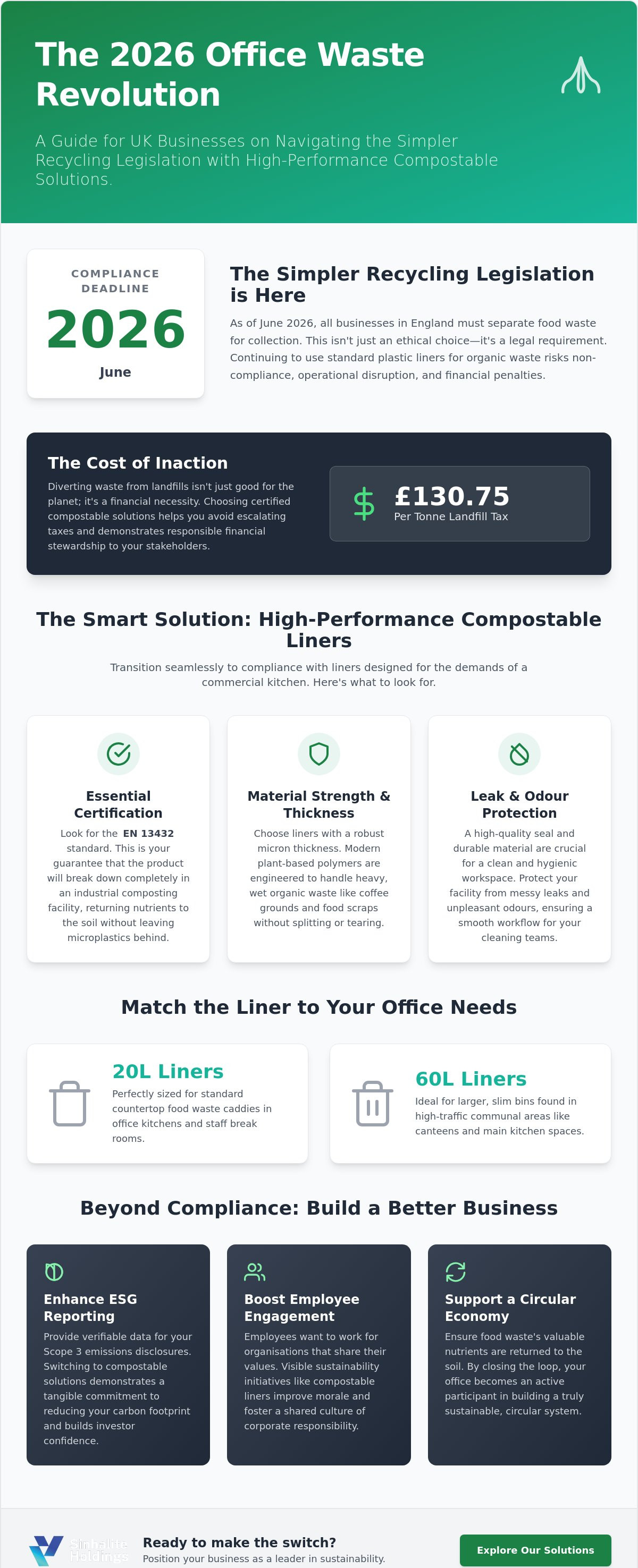
This guide helps you identify high-performance, EN 13432 certified solutions that protect your workspace from leaks and odours while advancing your ESG goals. We'll examine how the current £130.75 per tonne landfill tax makes waste diversion a financial necessity rather than just an ethical choice. You'll discover how to integrate durable, plant-based materials into your facility management strategy to ensure compliance and support a true circular economy. By the end of this article, you'll have a clear roadmap for selecting reliable compostable products that turn your sustainability commitments into tangible, everyday results.
Key Takeaways
- Align your waste management strategy with 2026 corporate social responsibility targets by transitioning to high-performance compostable alternatives.
- Evaluate micron thickness and material strength to ensure your compostable bin liners for office kitchens can reliably manage heavy organic waste like coffee grounds without splitting.
- Select the appropriate capacity for your facility by matching 20L to 60L liners with standard UK office kitchen caddies and slim bins.
- Establish clear employee training and waste audit protocols to eliminate contamination and ensure your office contributes effectively to a circular economy.
Why UK Businesses are Switching to Compostable Bin Liners for Office Kitchens in 2026
The landscape of corporate waste management has fundamentally changed. UK organisations are moving away from traditional plastics not just as an ethical choice, but as a strategic necessity. Adopting compostable bin liners for office kitchens represents a proactive response to the Simpler Recycling regulations that now mandate food waste separation for all businesses. By choosing liners made from innovative bioplastic materials, companies ensure their organic waste is processed correctly without contributing to microplastic pollution or landfill accumulation.
Public and regulatory scrutiny of single-use plastic has reached a critical point. Organisations that continue to rely on fossil-fuel-based bags face reputational risks and the financial burden of the UK Plastic Packaging Tax. Fortunately, the market for compostable garbage bags and caddy liners has matured significantly. These products are now high-quality, cost-competitive alternatives that match the durability of traditional options, making the transition both environmentally sound and fiscally responsible.
To better understand how these solutions function in a real-world setting, watch this helpful video:
Positioning your office as a leader in the UK circular economy starts with closing the food waste loop. When you use compostable bin liners for office kitchens, you facilitate a seamless journey from the staff canteen to the industrial composting facility. This operational change ensures that nutrients return to the soil, rather than being trapped in a landfill for centuries inside a non-degradable plastic bag.
Aligning Office Waste with ESG and Corporate Sustainability Goals
Effective waste management is a core component of Scope 3 emissions reporting. By switching business to sustainable packaging and waste solutions, you provide verifiable data for your annual ESG disclosures. This transparency builds trust with stakeholders and investors who prioritise long-term environmental stewardship. It's a practical way to demonstrate that your organisation is serious about its carbon footprint.
The visibility of these initiatives has a profound impact on workforce engagement. Employees want to work for organisations that reflect their personal values. Seeing compostable liners in daily use provides tangible proof of a company's commitment to the planet. This visible progress boosts office morale and reinforces a culture of responsibility, making sustainability a shared mission for everyone in the building.
Selecting the Right Compostable Liners: Strength, Size, and Certification Standards
Success in sustainable waste management depends on the structural integrity of your tools. High-performance compostable bin liners for office kitchens must withstand the unique challenges of organic waste, specifically the weight and moisture of coffee grounds and food scraps. Choosing a liner with a robust micron thickness ensures the bag maintains its shape and prevents messy leaks that disrupt janitorial workflows. Modern plant-based polymers now offer the tensile strength and stretch once reserved for conventional plastics, providing a reliable barrier without the long-term ecological footprint.
Efficiency is paramount for commercial facilities managing multiple waste streams. Most UK office kitchen setups utilise 20L caddies for immediate food scraps or 60L slim bins for high-traffic communal areas. Procuring bags on a roll simplifies storage and speeds up bin changes for cleaning teams, making the transition to green alternatives seamless. For organisations seeking professional-grade options, exploring a range of compostable garbage bags can help standardise your green procurement across multiple sites while maintaining high utility standards.
Understanding EN 13432 and OK compost HOME Standards
Certification is the only way to verify that a product will truly return to the earth. In the UK, the EN 13432 standard is the essential benchmark for industrial composting. It ensures that the material breaks down completely within a specific timeframe in a controlled environment. However, many businesses also benefit from having OK compost HOME certification explained to understand if their liners are suitable for less intensive processing or local garden schemes.
You should be wary of products labelled simply as "biodegradable." Unlike certified compostable materials, biodegradable plastics can fragment into harmful microplastics that persist in the environment for decades. Following authoritative guidance on integrating compostable packaging helps businesses navigate these technical distinctions with confidence. By insisting on certified compostable bin liners for office kitchens, you protect your organisation from greenwashing and ensure your waste contributes to a healthy, circular economy.
Operational Excellence: Integrating Sustainable Disposal into Your Office Routine
Integrating sustainable practices requires a methodical approach to ensure long-term success. The transition to compostable bin liners for office kitchens is most effective when treated as a systemic upgrade rather than a simple product swap. Businesses should begin by auditing their waste volume to determine the precise capacity and thickness required for their specific needs. This data-driven start prevents over-ordering and ensures that your compostable garbage bags are fit for purpose and capable of handling daily office demands.
Education serves as the foundation for operational excellence. You must train both your cleaning staff and employees on the critical importance of avoiding contamination. Even the highest quality compostable liners cannot perform their role in a circular economy if they're mixed with non-compostable plastics or metals. Partnering with a UK specialist like Sinhalite Holdings ensures a consistent supply of certified products and provides access to expert advice on waste management. Finally, communicate these successes to your stakeholders. Sharing the tangible impact of your plastic reduction through internal sustainability reports reinforces your brand’s commitment to environmental stewardship.
Preventing Leaks and Odours in Communal Kitchen Areas
Maintaining hygiene is a primary concern in shared spaces. Understanding how to keep a food waste bin from smelling is vital for employee comfort and facility standards. High-quality compostable bin liners for office kitchens utilise the science of breathability to manage moisture. Unlike traditional plastic, these materials allow water vapour to escape, which significantly slows down the anaerobic decomposition process that creates foul odours. This breathability, paired with advanced puncture resistance, ensures that heavy food waste stays contained without the risk of messy leaks. By choosing liners engineered for the rigours of a professional kitchen, you maintain a clean, odour-neutral environment that supports your broader sustainability mission.
Leading the Transition to a Circular UK Workplace
As the UK embraces a more sustainable waste infrastructure, the transition to responsible procurement becomes a defining characteristic of forward-thinking organisations. Selecting high-quality compostable bin liners for office kitchens is a foundational step in meeting the Simpler Recycling mandate and fulfilling your corporate ESG commitments. By prioritising EN 13432 certified materials and durable plant-based polymers, you ensure that your facility operates with high hygiene standards while actively contributing to a circular economy.
Sinhalite Holdings acts as a specialist UK provider dedicated to supporting this transition with high-performance solutions. Our products are engineered for industrial durability, ensuring that your shift away from single-use plastic is both practical and scalable. We provide dedicated support for corporate ESG integration, helping you turn environmental responsibility into a seamless part of your daily operations. It's about making a better future achievable today through practical innovation.
Explore Sinhalite Holdings’ range of commercial compostable garbage bags to find reliable tools for your sustainable journey. We're here to help you build a cleaner, greener workspace for years to come.
Frequently Asked Questions
Are compostable bin liners strong enough for heavy office kitchen waste?
Yes, modern compostable bin liners for office kitchens are engineered with high-performance plant-based polymers that match the tensile strength of traditional plastic. These liners are specifically designed to handle the moisture and weight of dense organic waste, such as wet coffee grounds and food scraps. Selecting a product with a suitable micron thickness ensures that the bag remains puncture-resistant and leak-proof during transport to the collection point.
What is the difference between biodegradable and compostable bin liners?
The primary difference lies in the end-of-life process and the residue left behind. "Biodegradable" is a broad term that simply means a material will break down eventually, often leaving behind harmful microplastics. In contrast, certified compostable liners must meet the EN 13432 standard. This certification guarantees they will decompose entirely into organic matter within a specific timeframe in an industrial composting facility, making them the only responsible choice for a circular economy.
Do compostable liners have a shelf life in an office storage cupboard?
Yes, compostable liners typically have a shelf life of 12 to 18 months when stored in a cool, dry place. Because these bags are designed to break down in the presence of moisture and microbial activity, they should be kept away from direct sunlight and damp environments. It's best for commercial entities to manage their inventory using a "first-in, first-out" approach to ensure the structural integrity remains optimal for daily kitchen use.
How should an office kitchen manage food waste to prevent odours when using compostable bags?
Effective odour management involves utilising the natural breathability of compostable bin liners for office kitchens to reduce moisture build-up. Unlike airtight plastic bags that trap heat and accelerate decay, compostable materials allow water vapour to escape. This keeps the waste drier and slows down the anaerobic processes that cause foul smells. Ensuring bins are emptied daily and using ventilated caddies further enhances this effect, maintaining a professional and hygienic environment.


