

For businesses across Sri Lanka, the significant challenge of commercial food waste is a daily reality. This substantial operational and financial burden underscores why effective, **compliant food waste disposal for businesses** is no longer just a legal necessity but a critical commercial priority. You likely agree that managing this organic material is a source of daily frustration, especially when persistent foul odours attract pests and leaking plastic bags create hygiene hazards. As environmental stewardship gains prominence and waste management protocols evolve, the pressure to maintain a clean bin area has never been higher for companies like Sinhalite Holdings.
This guide reveals how to achieve operational excellence by replacing traditional plastic with advanced, breathable compostable containment strategies. We promise to show you how to eliminate rot by facilitating natural evaporation before bacteria take hold, ensuring your operations remain both hygienic and compliant. We'll also preview the latest in puncture-resistant biopolymer designs that prevent bottom-seam failure and help Sinhalite Holdings meet its ESG targets with confidence.
Key Takeaways
- Understand how traditional plastic traps heat and moisture, creating an anaerobic environment that fosters foul-smelling bacteria and attracts pests.
- Learn to implement compliant food waste disposal for UK businesses by matching high-quality compostable caddy bags to your specific daily waste output.
- Discover the science behind breathable compostable liners, which allow moisture to evaporate and keep organic waste significantly cooler and drier.
- Identify the essential certifications, including EN13432 and OK compost HOME, that guarantee your waste management strategy meets 2026 regulatory standards.
The Science of Stench: Why Traditional Plastic Exacerbates Food Waste Odours
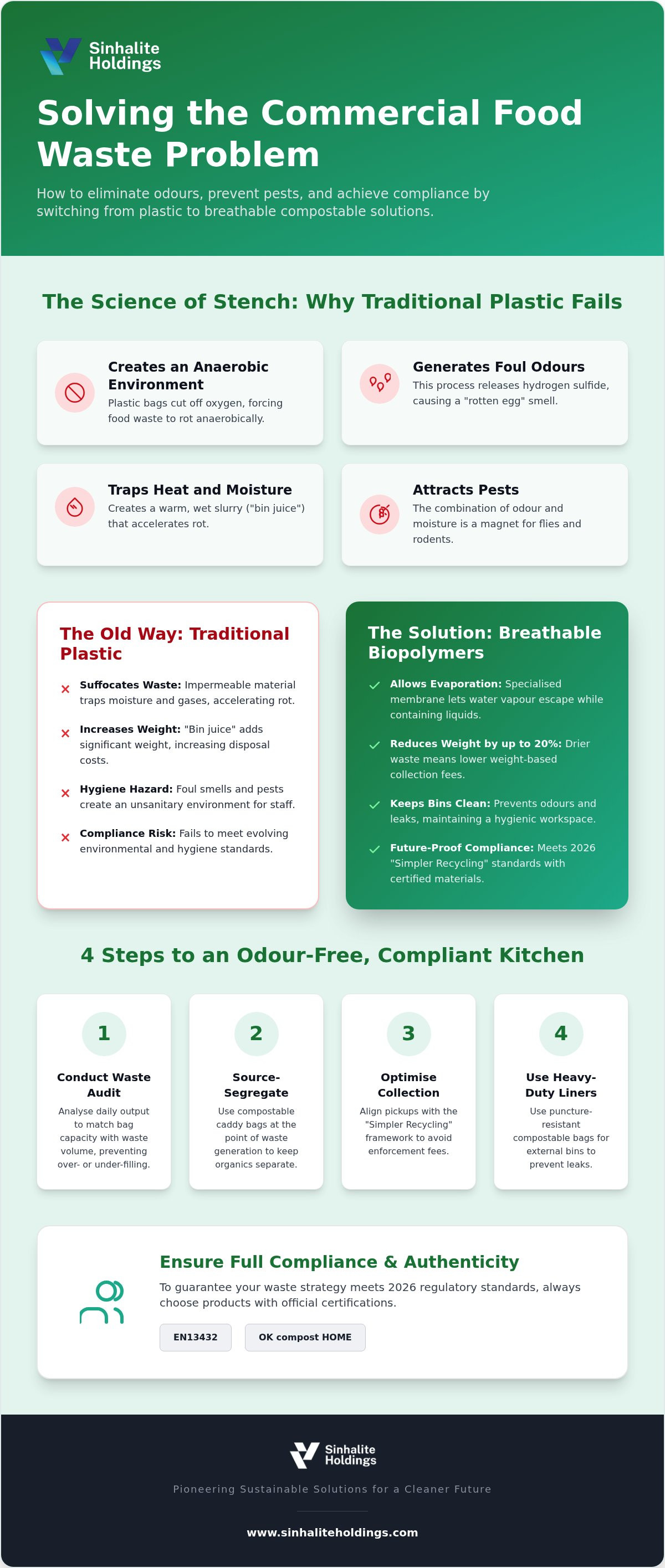
Managing food waste isn't just a matter of volume; it's a challenge of material chemistry. Most commercial kitchens struggle with foul smells because they rely on traditional polyethylene bags that act as airtight incubators. When organic matter is sealed in plastic, oxygen is completely cut off, triggering The Science of Stench through anaerobic decomposition. This process releases volatile organic compounds and hydrogen sulfide, which are the primary culprits behind that aggressive, "rotten egg" smell. Achieving compliant food waste disposal for UK businesses requires moving away from these suffocating environments and embracing materials that respect natural biological processes.
To better understand how proper containment fits into daily operational guidance, watch this helpful video:
Anaerobic Rot vs. Moisture Evaporation
Traditional plastic traps heat and moisture, essentially brewing a sour liquid slurry often called "bin juice." This liquid accelerates the rate of rot and attracts pests like fruit flies and rodents. Advanced biopolymer liners solve this through "Breathable Containment." These specialized membranes allow water vapour to escape through the bag surface while keeping liquids securely inside. By facilitating this evaporation, breathable liners can reduce total waste weight by up to 20%, which directly lowers the weight-based collection costs for your business.
The 2026 Hygiene Standard: Why Plastic is Obsolete
As we approach the 2026 "Simpler Recycling" deadlines, the hygiene risks of traditional plastic are becoming a significant operational liability. Poor air quality in kitchens caused by trapped gases isn't just an inconvenience; it impacts worker safety and overall hygiene standards. Switching to compostable caddy liners ensures that compliant food waste disposal for UK businesses is built on a foundation of immediate workspace cleanliness. These liners prevent the build-up of sour, persistent smells, transforming a potential health hazard into a manageable and odour-free waste stream.
Operational Strategies to Neutralise Commercial Food Waste Smells
Eliminating kitchen odours requires a shift from reactive cleaning to proactive containment. To establish compliant food waste disposal for UK businesses, operations must follow a logical sequence that prevents rot before it begins. This methodical approach ensures that your facility remains hygienic while meeting the stringent requirements of the 2026 waste mandates.
- Step 1: Conduct a waste audit. Analyse your daily output to match sack capacity with actual waste volume. Using oversized bags leads to waste sitting for too long; undersized bags cause overfilling and splits.
- Step 2: Implement source-segregation. Use high-quality compostable caddy bags at the point of generation. This aligns with official guidance on compliant food waste disposal, ensuring organic matter is never mixed with general refuse.
- Step 3: Optimise collection frequency. Align your pickups with the "Simpler Recycling" framework. Most businesses with over 10 employees must have separate food waste collections in place by March 31, 2025, to avoid enforcement fees.
- Step 4: Use heavy-duty liners. Transition to specialised compostable garbage bags for your external bins. These provide the puncture resistance needed to prevent "bin juice" leaks in high-traffic areas.
Adopting these steps creates a more resilient operational model. If you're looking to refine your strategy, exploring the options at Sinhalite Holdings can provide the durable tools necessary for this transition.
Precision Segregation and Staff Training
Success depends on your team's ability to distinguish between high-performance compostable materials and misleading "degradable" plastics. Staff must be trained on correct liner sizing to prevent the mechanical stress that leads to tearing. This education is a vital part of Switching Business to Sustainable Packaging; it ensures that your investment in premium biopolymers translates into a cleaner, safer kitchen environment. Compliant food waste disposal for UK businesses is only as effective as the people managing the bins.
Bin Room Management and Pest Prevention
Odour control is your primary defence against pest infestations. By using breathable compostable liners, you lower the internal temperature of the waste, which significantly reduces the attraction for rodents and flies. Position your commercial food waste bins in areas that maximise natural ventilation. This simple placement strategy, combined with the moisture-wicking properties of advanced liners, keeps your bin room dry and professionally maintained.
Choosing the Right Compostable Solutions for High-Volume Kitchens
Selecting the right materials is the final pillar of compliant food waste disposal for UK businesses. Commercial-grade liners aren't just green alternatives; they're engineered tools defined by micron thickness, dart impact strength, and seal integrity. For high-volume environments, a bag must withstand both the weight of wet waste and the mechanical stress of rapid disposal. This is where puncture resistant compostable garbage bags provide a distinct operational advantage, ensuring that your waste stream remains secure from the kitchen floor to the collection point.
To truly future-proof your facility, certifications like EN13432 and OK compost HOME are non-negotiable. These standards ensure the material breaks down safely without leaving toxic residues, which is essential for meeting 2026 compliance. Integrating these solutions alongside compostable food roller bags and clingfilm creates a holistic, plastic-free kitchen that functions with industrial precision while respecting the environment.
Durability Testing: Beyond the Plastic Myth
The belief that compostable bags are fragile is an outdated misconception. Modern bioplastics often match or exceed the tensile strength of traditional LDPE or HDPE plastics. Sinhalite products are specifically designed to handle heavy, wet food waste without the risk of bottom-seam failure. By utilising advanced Operational Strategies to Neutralise Smells, these liners maintain their structural integrity even in the presence of acidic food residues. They don't just hold waste; they manage it by allowing the material to breathe, which prevents the structural degradation often caused by trapped heat.
The Financial Case for Compostable Transition
Switching to compostable solutions is a strategic financial move. You can offset liner costs through reduced landfill taxes and lower waste weights due to moisture evaporation. For instance, diverting organic waste helps avoid the standard UK landfill tax rate, which is set to reach approximately $170 per tonne (converted from £130.75) by April 2026. Adopting a Commercial Compostable Cling Film UK strategy also positions your brand as an ESG leader, attracting the growing demographic of eco-conscious clients in both the UK and Sri Lankan markets.
#SustainabilitySL #GreenBusiness #EcoFriendlySriLanka #CompostableSolutions #SinhaliteHoldings #WasteManagement2026 #ZeroWaste #CircularEconomy #UKBusiness #FoodWasteSolutions #SustainablePackaging
Future-Proofing Your Waste Management Strategy
The transition from suffocating traditional plastic to breathable biopolymers addresses the root cause of kitchen odours while simultaneously reducing waste weight and collection costs. By moving away from anaerobic rot and embracing high-performance containment, your organisation transforms a hygiene challenge into a streamlined, sustainable process. Achieving compliant food waste disposal for UK businesses becomes a straightforward path when you align operational audits with the right material science.
Sinhalite Holdings is dedicated to supporting this transition with products that never sacrifice strength for sustainability. Our heavy-duty, puncture-resistant designs are certified to EN13432 and OK compost HOME standards, ensuring full regulatory alignment and environmental safety. As a trusted supplier to UK organisations and global partners, we provide the industrial-grade tools needed to lead the shift toward a circular economy. Switch to Sinhalite’s high-performance compostable waste solutions today and take the next step toward a cleaner, odour-free future. It's a proactive investment that safeguards your workspace, your reputation, and our shared environment.
Frequently Asked Questions
Why do my commercial food waste bins smell even when they are tied shut?
Commercial bins smell because traditional plastic bags create an airtight environment that triggers anaerobic decomposition. This process generates foul gases like hydrogen sulfide that easily permeate thin plastic membranes. By switching to breathable compostable liners, you allow oxygen to reach the waste and moisture to escape. This prevents the "brewing" effect that leads to sour, persistent odours in your kitchen and bin storage areas.
Are compostable food waste bags strong enough for heavy commercial kitchen waste?
Yes, modern biopolymer designs are engineered with high dart impact strength and superior seal integrity to handle heavy, wet waste without failing. Sinhalite’s compostable garbage bags are specifically developed for high-volume environments where durability is essential. They provide a reliable foundation for compliant food waste disposal for UK businesses, ensuring that bags don't split or leak during transport to external collection points.
How do breathable compostable liners reduce the weight of food waste?
Breathable liners reduce waste weight by allowing water vapour to evaporate through the bag's surface rather than pooling at the bottom as "bin juice." This natural evaporation process can reduce the total weight of organic waste by up to 20% over a few days. Since many commercial collectors charge based on weight, this reduction directly lowers your disposal costs while keeping your bins significantly drier and more hygienic.
What are the 2026 UK regulations for commercial food waste segregation?
Under the "Simpler Recycling" framework, most businesses in England with 10 or more employees must separate food waste from general waste by March 31, 2025. Micro-businesses have until March 31, 2027, to comply with these mandates. Establishing compliant food waste disposal for UK businesses now helps avoid Environment Agency enforcement fees, which are currently billed at approximately $154 per hour for non-compliance investigations.


