
What if the biggest risk to your business in 2026 isn't the cost of switching to sustainable packaging, but the cost of not switching at all? For many organisations, that question reframes everything. Switching business to sustainable packaging has long been perceived as a financial burden or an operational gamble, and those concerns are entirely understandable. Rising material costs, a maze of eco-certifications, and genuine doubts about whether compostable alternatives can match the performance of conventional plastic are real obstacles, not imagined ones.
But here's the reality: the regulatory landscape is shifting, consumer expectations are hardening, and businesses that treat this transition as a strategic investment rather than a reluctant compliance exercise are the ones building lasting competitive advantage. The question is no longer whether to make the move, but how to make it without disrupting operations or overspending.
This guide cuts through the confusion. You'll find a clear, commercially grounded roadmap for transitioning your organisation to compostable packaging solutions, with practical guidance on managing costs, understanding certifications, and demonstrating measurable returns. From compostable mailer bags for e-commerce operations to clingfilm and caddy bags for food-facing businesses, the path forward is more accessible than you might expect.
Key Takeaways
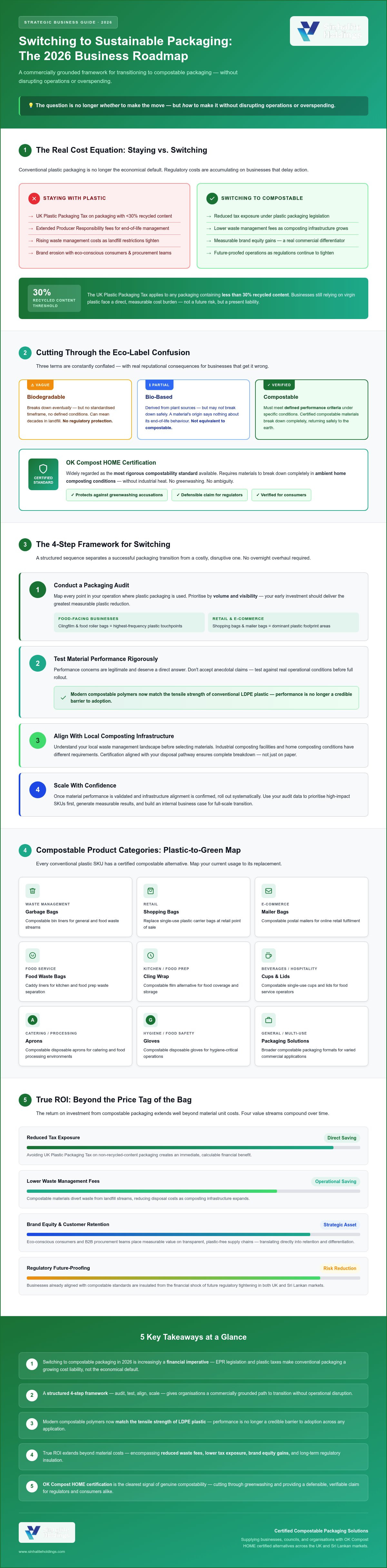
- Switching business to sustainable packaging in 2026 is increasingly a financial imperative, as Extended Producer Responsibility legislation and plastic taxes are making conventional packaging a growing cost liability rather than the default economical choice.
- A structured four-step framework — beginning with a packaging audit to identify your highest-volume plastic waste points — gives organisations a commercially grounded path to transition without operational disruption.
- Modern compostable polymers now match the tensile strength of traditional LDPE plastic, meaning performance is no longer a credible barrier to adoption across applications from food wrap to e-commerce mailer bags.
- The true return on investment from compostable packaging extends beyond material costs, encompassing reduced waste management fees, lower tax exposure, and measurable gains in brand equity with increasingly eco-conscious consumers.
- Certifications such as OK Compost HOME provide a reliable benchmark for evaluating compostable alternatives, helping businesses cut through greenwashing and select solutions that meet genuine industrial and regulatory standards.
The Strategic Case for Sustainable Packaging in 2026
Sustainable packaging isn't simply a material swap. At its core, it represents a shift toward a circular system, one designed from the outset to eliminate permanent waste rather than defer it. Where conventional plastics persist in landfill or ocean environments for centuries, genuinely compostable alternatives return to the earth within defined timeframes, closing the loop between production and disposal. That systemic distinction is precisely why switching business to sustainable packaging has moved from a corporate social responsibility talking point to a boardroom-level commercial decision.
The 2026 Regulatory Landscape: A Growing Financial Liability
The regulatory environment across both the UK and Sri Lanka is tightening in ways that directly affect operating costs. The UK's Extended Producer Responsibility framework places financial accountability on businesses for the end-of-life management of the packaging they place on the market. Separately, the UK Plastic Packaging Tax applies to packaging containing less than 30% recycled content, creating a measurable cost burden for organisations still reliant on virgin plastic. Sri Lanka has progressively strengthened restrictions on single-use plastics, with enforcement continuing to expand. Businesses that treat these developments as distant policy concerns are, in practical terms, accepting a growing and preventable cost exposure.
Brand Value and Consumer Expectations
Consumer sentiment in both markets has hardened considerably. Shoppers and procurement teams alike are scrutinising supply chains with greater rigour, and transparent, plastic-free packaging has become a meaningful differentiator rather than a premium novelty. Organisations that demonstrate credible environmental commitments are building the kind of brand equity that translates into customer retention and long-term commercial resilience.
Beyond Greenwashing: Choosing Authentic Compostability
Not all "eco" packaging deserves that label. The terms biodegradable, bio-based, and compostable are frequently conflated, and that confusion creates real reputational risk. A bio-based material is derived from plant sources but may not break down safely. Biodegradable claims carry no standardised timeframe or conditions. Truly compostable materials, by contrast, must meet defined performance criteria under specific conditions.
This is where certification becomes the clearest signal of integrity. OK Compost HOME certification is widely regarded as the most rigorous standard available, requiring that materials break down completely in ambient home composting conditions, without industrial heat. For businesses switching business to sustainable packaging, selecting certified compostable products removes ambiguity, protects against greenwashing accusations, and provides a defensible, verifiable claim for both regulators and consumers. Sinhalite Holdings' compostable product range is built around this standard, offering organisations a credible foundation for their transition.
A 4-Step Framework for Switching to Compostable Packaging
A structured approach is what separates a successful packaging transition from a costly, disruptive one. Switching business to sustainable packaging doesn't require overhauling your entire operation overnight. It requires a clear sequence: understand where you are, test what works, align with local infrastructure, and scale with confidence.
Step 1: Conduct a Packaging Audit
Begin by mapping every point in your operation where plastic packaging is used. Prioritise by volume and visibility. For food-facing businesses, clingfilm and food roller bags typically represent the highest-frequency plastic touchpoints. For retail and e-commerce operations, shopping bags and mailer bags dominate. Identifying these high-impact areas first means your early investment delivers the greatest measurable reduction in plastic waste.
Step 2: Test Material Performance Rigorously
Performance concerns are legitimate, and they deserve a direct answer. Modern compostable polymers are engineered to meet the same tensile and barrier requirements as conventional LDPE plastic. Commercial compostable cling film now delivers the same cling, puncture resistance, and moisture retention that food businesses depend on. Test compostable alternatives under your actual operating conditions, not just in a controlled environment, before committing to volume procurement.
Step 3: Align with Your Local Waste Infrastructure
Not all compostable materials are processed identically. Some require industrial composting facilities with controlled heat and humidity. Others, certified to OK Compost HOME standard, break down in ambient home composting conditions. Matching your product selection to the waste infrastructure available to your customers and your own facilities isn't a minor logistical detail; it's the difference between a genuinely circular outcome and a packaging claim that doesn't hold up to scrutiny.
Step 4: Pilot, Measure, and Scale
Choose one department or product line as your pilot. Introduce compostable mailer bags for a single e-commerce fulfilment category, or replace plastic caddy liners in one facility. Measure staff adoption, customer feedback, and waste processing outcomes over a defined period before expanding. This approach limits risk, generates internal proof points, and builds the organisational confidence needed for a full-scale rollout.
Replacing High-Impact Plastics with Compostable Alternatives
The practical substitutions are more straightforward than many businesses anticipate. Compostable shopping bags carry the same loads as their plastic equivalents, and compostable food roller bags perform reliably in chilled and ambient food retail environments. Both eliminate the permanent waste footprint of conventional plastic without requiring customers or staff to change their behaviour.
The e-commerce sector deserves particular attention here. The growth of online retail has made single-use plastic mailer bags one of the most visible and criticised forms of packaging waste. Compostable mailer bags address this directly, offering the same protective properties, printability, and tamper-evident functionality that logistics operations require, while giving brands a credible, certifiable environmental story to tell at the point of delivery. For organisations already investing in sustainable packaging transitions, this is one of the highest-visibility changes available.
If you're ready to identify the right compostable products for your specific operation, explore Sinhalite Holdings' compostable packaging range as a starting point for your audit.
Overcoming Operational Barriers and Scaling Impact
The cost objection is the one most organisations raise first, and it deserves a direct response. The upfront unit cost of compostable packaging can be higher than conventional plastic alternatives, but that comparison is incomplete. When you factor in the UK Plastic Packaging Tax liability for packaging with less than 30% recycled content, rising Extended Producer Responsibility fees, and the waste management costs associated with non-recyclable plastic, the financial case for switching business to sustainable packaging becomes considerably more compelling over a 12 to 24-month horizon. The transition isn't an added expense; it's a reallocation away from a growing liability.
On performance: modern compostable polymers now match the tensile strength of conventional LDPE plastic, making material performance a settled question rather than a genuine barrier.
Building Internal Buy-In
Operational transitions fail when they're treated as procurement decisions rather than organisational ones. Waste segregation, in particular, only delivers its intended outcomes when staff understand why it matters and how to execute it correctly. A brief, practical training session for facilities, logistics, and customer-facing teams removes ambiguity, reduces contamination in compostable waste streams, and builds the internal confidence needed to sustain the change beyond the pilot phase. Stakeholder education isn't a soft consideration; it's a core operational requirement.
Communicating Your Transition to Customers
Once your compostable packaging is in place, the way you communicate that shift shapes its commercial value. Be specific rather than vague. Telling customers you've switched your business to sustainable packaging certified to OK Compost HOME standard is a verifiable, defensible claim. That specificity builds trust in a way that generic "eco-friendly" messaging simply doesn't.
Collaborating with Specialist Suppliers
Sourcing from a dedicated compostable packaging provider matters more than it might initially appear. SKU consistency across your compostable shopping bags, caddy bags, garbage bags, and mailer bags ensures that your waste segregation guidance remains coherent and that staff aren't navigating conflicting disposal instructions. Sinhalite Holdings' focus on certified compostable solutions means businesses can also access supplier expertise for more demanding applications, such as heavy-duty compostable garbage bags for commercial waste streams, where load-bearing performance and composting credentials must both be met without compromise.
Scaling impact is ultimately a question of sequencing: start with your highest-volume plastic touchpoints, demonstrate measurable outcomes, and expand from a position of internal confidence rather than external pressure.
The Time to Act Is Now: Build Your Sustainable Packaging Strategy
Switching business to sustainable packaging in 2026 isn't a question of whether your organisation is ready; it's a question of whether you can afford to wait. The regulatory pressure is real, the consumer expectations are measurable, and the performance gap between compostable and conventional plastic has closed. What remains is the decision to move forward with a clear plan rather than a reactive one.
Three things matter most as you take that next step: start with your highest-volume plastic touchpoints, choose certified compostable solutions that hold up under real operating conditions, and partner with a supplier who understands the full picture from material performance to waste infrastructure alignment.
Sinhalite Holdings brings specialist expertise in high-performance compostable packaging, with fully certified compostable SKUs trusted by organisations across the UK and Sri Lanka. From compostable clingfilm to mailer bags and caddy liners, the range is built to deliver genuine results at scale.
Partner with Sinhalite Holdings to begin your transition to certified compostable packaging and take the first practical step toward a more resilient, responsible business.
Frequently Asked Questions
Is switching to compostable packaging more expensive for small businesses?
The upfront unit cost of compostable packaging can be higher than conventional plastic, but the full financial picture is more nuanced for small businesses. Regulatory costs including plastic packaging taxes and producer responsibility fees apply regardless of business size, meaning the gap between compostable and conventional options narrows considerably once those liabilities are factored in.
A phased approach makes the transition financially manageable. Starting with one high-volume product, such as compostable shopping bags or food roller bags, allows smaller organisations to test costs and supplier relationships before committing to a broader switch. Volume procurement typically reduces per-unit costs further as your order quantities grow.
How do compostable bags compare to traditional plastic in terms of durability?
Modern compostable polymers are engineered to meet the same load-bearing and tensile requirements as conventional LDPE plastic. Compostable shopping bags, mailer bags, and caddy bags are designed to perform reliably under real operating conditions, not just controlled laboratory settings. The performance gap that existed in earlier generations of compostable materials has largely closed through advances in material science.
The key is testing under your specific conditions before scaling. A compostable mailer bag used in an e-commerce fulfilment environment, for instance, should be evaluated for puncture resistance and seal integrity against your actual product weights and handling processes, not just general specifications.
What certifications should my business look for when buying sustainable packaging?
OK Compost HOME certification is the most rigorous benchmark available for compostable packaging. It requires that materials break down completely under ambient home composting conditions, without industrial heat or controlled humidity. That distinction matters because it means the packaging performs as claimed across a wider range of real-world disposal scenarios, not just in specialised industrial facilities.
When switching business to sustainable packaging, prioritising OK Compost HOME certified products protects your organisation against greenwashing accusations and provides a verifiable, defensible claim for both regulators and customers. Be cautious of vague terms like "biodegradable" or "eco-friendly" without an accompanying third-party certification, as these carry no standardised performance criteria.
Can compostable packaging be used for food-grade products like clingwrap?
Yes, compostable clingfilm is a proven, food-safe alternative to conventional plastic wrap. It's formulated to deliver the same cling, puncture resistance, and moisture retention that food businesses depend on, making it suitable for use across chilled and ambient food retail environments. Sinhalite Holdings' compostable household clingfilm is designed specifically with food-grade performance in mind.
Compostable food roller bags follow the same principle, performing reliably in food-facing applications without compromising hygiene or barrier properties. If your business handles food products, these are typically among the highest-frequency plastic touchpoints and represent some of the most impactful early substitutions available during a packaging transition.


