

The assumption that "compostable" automatically means "tax-exempt" is a costly misunderstanding that could impact your 2026 financial projections. As the government increases the rate to £228.82 per tonne, ensuring total compliance with uk plastic packaging tax requires more than just good intentions. Many businesses are currently struggling to track plastic weights across their supply chains or are surprised to find that bioplastics like PLA are still subject to these levies. It's an intricate landscape where the cost of confusion is rising alongside the tax itself.
We understand that you want to lead with integrity while protecting your bottom line. This guide provides a strategic roadmap for the 2026 landscape, offering clarity on HMRC requirements and practical ways to reduce costs through better material choices. You'll discover how switching to high-quality compostable clingfilm, shopping bags, and garbage bags can help you meet your net-zero goals while maintaining full legal compliance. We'll explore the latest rate hikes, clarify the status of compostable materials, and provide the tools you need to transform a tax liability into a competitive advantage for your brand.
Key Takeaways
- Identify the financial impact of the £228.82 per tonne rate and the 10-tonne registration threshold for your 2026 operations.
- Establish a reliable framework for compliance with uk plastic packaging tax using precise weight-based record keeping and quarterly digital submissions.
- Learn to navigate HMRC’s reporting requirements with transparency to ensure your organisation remains audit-ready and legally secure.
- Discover how integrating compostable solutions, such as food roller bags and garbage bags, can reduce your overall tax liability.
- Align your corporate responsibility with practical material choices to foster a transition toward a more sustainable and circular economy.
The 2026 UK Plastic Packaging Tax Landscape
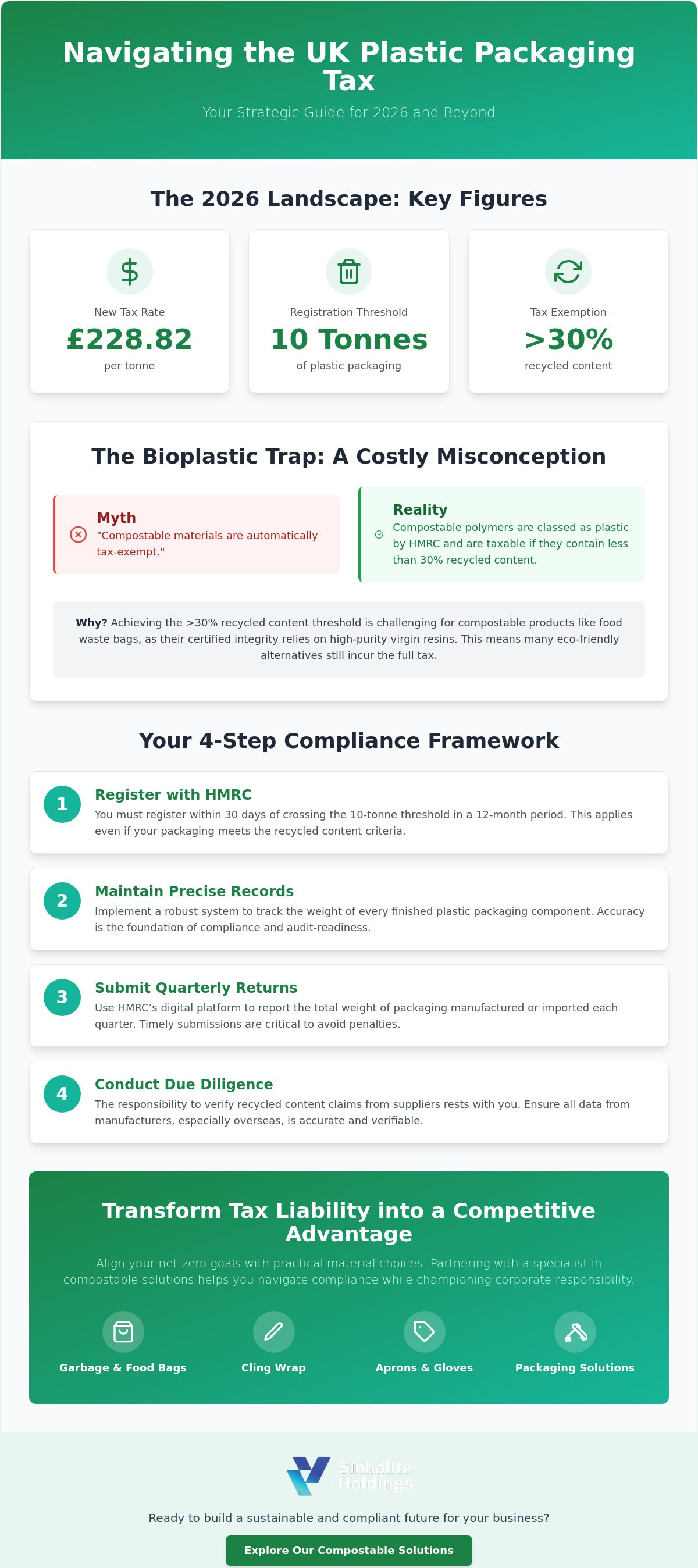
Effective from 1 April 2026, HMRC has adjusted the levy to £228.82 per tonne. This increase reflects the government's commitment to using fiscal measures to drive environmental change across the supply chain. For commercial entities, compliance with uk plastic packaging tax is no longer just about meeting a legal requirement; it's a strategic necessity to protect margins and uphold brand integrity. Proactive businesses are already reviewing their material sourcing to mitigate the impact of this higher rate.
The registration threshold remains at 10 tonnes of plastic packaging manufactured or imported within a rolling 12-month period. Even if your packaging exceeds the 30% recycled content threshold, you're still required to register with HMRC if you meet this volume. You must complete this registration within 30 days of crossing the 10-tonne limit to avoid potential penalties. This applies regardless of whether you're sourcing traditional polymers or bio-based alternatives.
To better understand the nuances of these requirements, watch this helpful video:
HMRC defines 'plastic' broadly to include both fossil-based and bio-based synthetic polymers. While most packaging falls under the scope of the UK Plastic Packaging Tax, specific exemptions exist for medicinal products and certain types of transport packaging for imported goods. Accurate compliance with uk plastic packaging tax requires a granular understanding of these categories to ensure you aren't overpaying or failing to report taxable components.
The Bioplastic Trap: Why Compostables are Taxed
A common misconception among businesses is that compostable materials are exempt because they're designed to break down naturally. However, HMRC classifies bio-based and compostable polymers as plastic for tax purposes. If these materials contain less than 30% recycled content, they're subject to the same levy as traditional virgin plastics. This policy aims to encourage the use of recycled materials across all polymer types, regardless of their end-of-life disposal method.
Meeting the 30% recycled content threshold is technically difficult for many compostable products like food waste bags or caddy bags. The structural integrity and certified compostability of these items often rely on high-purity virgin resins. Because high-quality recycled compostable material isn't yet available at industrial scale, these innovative solutions often carry the full tax burden despite their environmental benefits. Selecting a partner who understands these material complexities is essential for managing your long-term sustainability strategy.
The 'substantial modification' rule triggers tax liability for importers when a manufacturing process significantly alters the shape, structure, thickness, or weight of a plastic packaging component.
Practical Steps for Compliance and Reporting
Establishing a steady rhythm for reporting ensures your organisation stays ahead of deadlines and avoids unnecessary friction. HMRC requires quarterly submissions through their digital platform, where you'll need to report the total weight of finished plastic packaging components manufactured or imported during each three-month period. Referencing the official government guidance on Plastic Packaging Tax helps clarify which specific items are taxable and which qualify for relief based on their intended use. Accuracy at this stage prevents future adjustments and builds a foundation of trust with regulators.
Precision is the foundation of compliance with uk plastic packaging tax. You should implement a robust system that tracks the weight of every finished component down to the gramme. If you're an importer, the responsibility for verifying recycled content claims rests solely with you. You must conduct thorough due diligence on overseas manufacturers to ensure their data is accurate and verifiable. Failure to verify these claims can lead to significant financial penalties and reputational damage. For businesses seeking reliable alternatives, our range of compostable garbage bags and shopping bags offers a high-performance solution that aligns with rigorous environmental standards.
Third-party verification simplifies the due diligence process. Understanding the OK compost HOME certification explained provides a clear framework for supply chain transparency. These certifications offer tangible proof of material standards, making it easier to substantiate your reporting and prove that your materials meet specific environmental criteria. This level of detail is essential for maintaining integrity throughout your procurement process.
Evidence and Record Keeping Requirements
HMRC requires you to maintain records for at least six years to ensure long-term accountability. Your documentation must include invoices, detailed product specifications, and weight reports for each individual component. If you use multi-material packaging, the entire component is taxable if plastic is the predominant material by weight. Keeping clear, structured records ensures your business is always prepared for a potential audit and can defend its tax positions with confidence.
Aligning Tax Data with ESG Strategy
The data you collect for HMRC serves a dual purpose. It provides a clear baseline for switching business to sustainable packaging by highlighting exactly where your plastic usage is highest. Using this transparency to inform your ESG roadmap demonstrates a genuine commitment to environmental stewardship. When you share these insights with stakeholders, you transform a mandatory tax exercise into a narrative of progress and responsibility, proving that compliance with uk plastic packaging tax is a catalyst for positive change.
Strategic Transition: Reducing Liability with Compostables
Strategic transition is about moving beyond mere adherence to regulations. While compliance with uk plastic packaging tax is a legal necessity, the rising costs provide a compelling financial incentive to phase out virgin plastics entirely. By adopting plant-based materials, organisations doesn't just avoid a levy; they invest in a more resilient supply chain. This shift is explored in detail within the complete guide to Plastic Packaging Tax, which highlights how liability is calculated across different material types and provides a framework for evaluating your current usage.
In commercial kitchens and food preparation areas, the transition is particularly impactful. Implementing The Ultimate Guide to Compostable Clingfilm in the UK allows businesses to maintain high hygiene standards without the environmental or financial burden of traditional plastic wrap. Sinhalite Holdings acts as a dedicated partner in this journey, providing the storage innovation and sustainable disposal solutions required to make these changes practical and permanent. The long-term ROI is clear; you balance the immediate tax costs against the significant reputational gains of achieving plastic-free operations.
Scalable Solutions for Commercial Entities
Large-scale organisations can achieve immediate impact by replacing taxable bin liners with our compostable caddy bags and garbage bags. These items perform with the same durability as their plastic counterparts while simplifying waste management processes. Similarly, adopting compostable food roller bags in retail and hospitality settings eliminates the friction of single-use plastic. This allows your brand to lead with a clear, eco-conscious identity that resonates with modern consumers and professional stakeholders alike.
The Circular Economy Advantage
Compostable packaging serves a vital role in the circular economy by facilitating the efficient collection of food waste. When packaging can be processed alongside organic matter, it streamlines recycling efforts and reduces the volume of waste sent to landfill. This systemic change supports a cleaner, greener outlook for the entire organisation. Transitioning to high-quality plant-based materials ensures your compliance with uk plastic packaging tax remains effortless while future-proofing your operations against anticipated tax increases and regulatory shifts in 2027 and beyond.
Securing Your Sustainable Future Beyond 2026
The 2026 regulatory landscape presents a clear choice for commercial entities: continue with costly legacy materials or lead the way with innovative alternatives. Achieving compliance with uk plastic packaging tax is a foundational step, but the true advantage lies in reducing your taxable footprint altogether. By mastering weight-based reporting and verifying supply chain claims, your organisation can navigate these fiscal changes with confidence. Transitioning to plant-based materials isn't just about avoiding a levy; it's a commitment to a circular economy that resonates with both stakeholders and the environment.
As a specialist provider of sustainable UK packaging, Sinhalite Holdings offers the expert guidance needed for seamless circular economy transitions. We provide high-performance compostable alternatives to single-use plastics, ensuring your operations remain efficient and ethical. Whether you need durable garbage bags or food roller bags, our solutions are designed to meet the highest industrial standards. Explore Sinhalite Holdings’ range of compliant compostable solutions today to begin your journey toward a cleaner, more resilient future. Positive change is achievable, and we're here to help you reach it.
Frequently Asked Questions
Are compostable bags exempt from the UK Plastic Packaging Tax in 2026?
No, compostable bags aren't currently exempt from the tax. HMRC classifies bio-based and compostable polymers as plastic components, meaning they're subject to the standard levy unless they contain at least 30% recycled content. While these materials offer significant end-of-life benefits, the legislation focuses on the origin of the material rather than its degradability. Choosing high-quality compostable alternatives remains a visionary choice for businesses aiming to reduce their reliance on fossil-based polymers.
What is the 10-tonne threshold and how is it calculated for UK businesses?
The 10-tonne threshold applies to any UK business that manufactures or imports 10 tonnes or more of finished plastic packaging within a rolling 12-month period. You must calculate this weight based on the finished components, including items like food roller bags or bin liners. Once you cross this limit, you have 30 days to register with HMRC. Maintaining compliance with uk plastic packaging tax requires consistent monitoring of these weights to ensure your organisation stays legally secure.
Can I claim tax relief if I export plastic packaging components out of the UK?
You can claim tax relief or a credit if you export plastic packaging components from the UK, provided the export occurs within 12 months of manufacture or import. This mechanism prevents double taxation on goods destined for international markets. You'll need to maintain robust evidence, such as shipping documents and export invoices, to substantiate these claims during an HMRC audit. It's a vital part of managing your total tax liability and protecting your commercial margins.
How do I prove that my packaging contains at least 30% recycled plastic?
Proving that packaging meets the 30% recycled content threshold requires a comprehensive audit trail. You must maintain detailed product specifications, purchase invoices, and certifications from your manufacturers that explicitly state the recycled content by weight. For importers, this involves conducting thorough due diligence on overseas partners to verify their claims. Ensuring compliance with uk plastic packaging tax through transparent record-keeping protects your business from penalties while reinforcing your commitment to responsible, innovative sourcing.


