
What if the traditional plastic bag sitting in your warehouse is actually the most expensive liability on your balance sheet? As of April 2026, the UK Plastic Packaging Tax has risen to £228.82 per tonne for materials with less than 30% recycled content, fundamentally shifting the financial landscape. If you're currently conducting a cost analysis of compostable vs plastic bags for business, you've likely noticed that the initial unit price is only one part of a much larger equation. Rising general waste disposal fees, which now range from £170 to £250 per tonne, mean that sticking with conventional plastics often results in compounding hidden costs that erode your margins.
We understand the pressure to meet ambitious ESG targets without compromising your fiscal responsibility. You deserve a clear financial justification for making the switch to sustainable alternatives like compostable shopping bags, caddy bags, or industrial garbage bags. This guide explores the true total cost of ownership for responsible packaging and reveals how compostable solutions deliver genuine commercial value over traditional plastics. We'll provide a detailed roadmap for a cost-effective transition, ensuring your business remains both compliant and competitive in a greener economy.
Key Takeaways
- Understand the factors behind the purchase price of plant-based polymers and how increasing UK demand is improving unit cost efficiency.
- Conduct a thorough cost analysis of compostable vs plastic bags for business by accounting for the 2026 Plastic Packaging Tax and new modulated EPR fees.
- Discover how transitioning to compostable caddy bags and garbage bags can lower your total waste disposal expenses through improved separation of organics.
- Leverage the brand equity gained from sustainable packaging to align with the preferences of the majority of UK consumers who value ecological transparency.
- Build a practical roadmap for implementing compostable clingfilm and shopping bags to meet corporate ESG targets without exceeding your operational budget.
Analyzing the Purchase Price Premium: Raw Materials and Certifications
The initial purchase price of sustainable packaging often serves as the first hurdle for procurement teams. While petroleum based plastics have benefited from decades of established infrastructure, plant based polymers like PBAT and cornstarch require sophisticated agricultural processing. Any thorough cost analysis of compostable vs plastic bags for business must begin with these raw material commodities. In 2026, we're seeing a significant shift as UK demand scales up; manufacturing efficiencies are finally narrowing the gap that previously made eco friendly options feel out of reach for many enterprises.
To better understand how these materials function in a commercial setting, watch this helpful video:
Modern engineering has also achieved performance parity, which directly impacts your bottom line. High quality compostable food roller bags now offer the same tensile strength as their plastic counterparts, effectively eliminating the need for wasteful double bagging. This durability ensures that while the price per unit might be higher, the total volume of material used often decreases as staff find they need fewer bags to complete the same tasks.
The Material Science Gap: Petroleum vs. Plant-Based Polymers
The global oil market remains notoriously volatile, creating unpredictable price swings for traditional plastic products. In contrast, the supply chains for biodegradable and compostable materials are stabilising as agricultural bioplastic production becomes more localised. The intricate processing required to convert raw agricultural starches into functional commercial compostable clingfilm accounts for the majority of its manufacturing cost premium. This investment ensures the material maintains its integrity during use while remaining fully capable of breaking down in industrial composting environments.
The Value of Certification: Why Standards Matter for Business
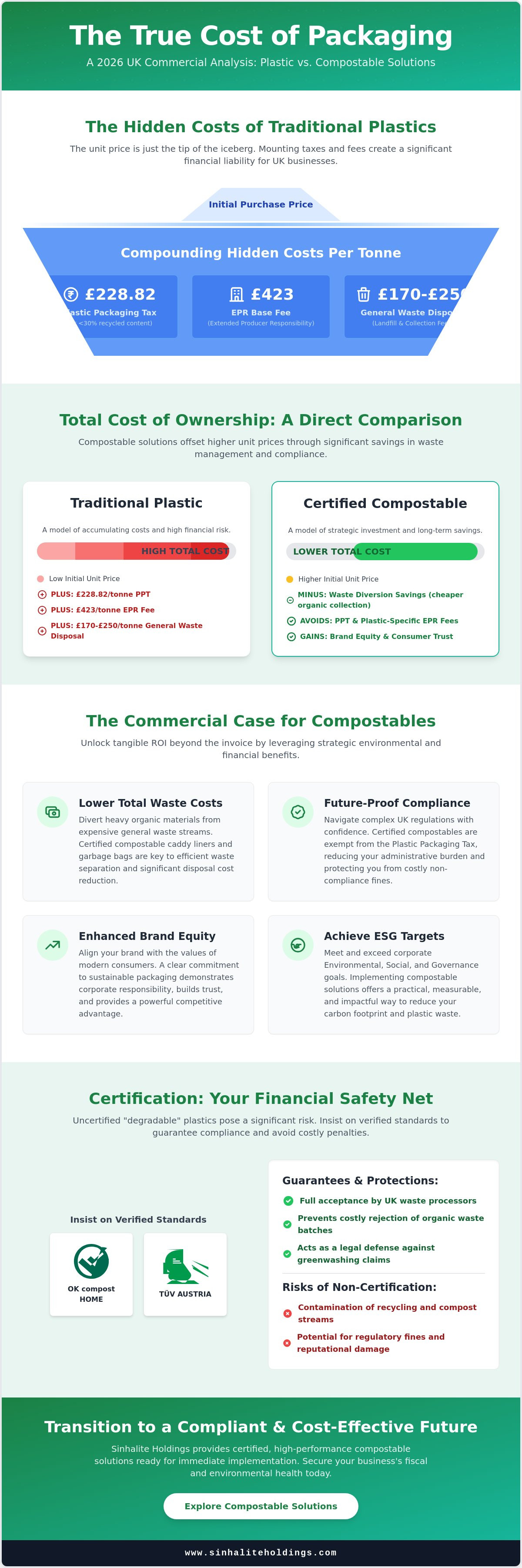
Opting for uncertified 'degradable' plastics presents a significant financial risk in the form of greenwashing. Without verified OK compost HOME and TUV Austria certifications, businesses face potential regulatory fines and reputational damage. These standards act as a non negotiable insurance policy for your commercial waste streams. They guarantee that your shopping bags and caddy bags will be accepted by waste processors, preventing the costly rejection of entire batches of organic waste that occurs when non certified materials contaminate the bin.
Total Cost of Ownership: Factoring in UK Regulations and Waste Fees
A narrow focus on unit price often overlooks the significant regulatory and operational costs that define the modern UK business environment. As of April 2026, the Plastic Packaging Tax (PPT) stands at £228.82 per tonne for packaging with less than 30% recycled content. When you perform a comprehensive cost analysis of compostable vs plastic bags for business, you must also factor in the Extended Producer Responsibility (EPR) base fee, which has reached £423 per tonne for plastic. These levies reflect the environmental impact of traditional materials, making the transition to sustainable alternatives a matter of fiscal prudence rather than just ethical choice.
The true economic value of compostable solutions is found in waste stream diversion. By using certified caddy liners and shopping bags, organisations can effectively separate organic matter from general waste. This is a critical step because disposing of general business waste now costs between £170 and £250 per tonne in landfill fees. A detailed cost-benefit analysis of compostable packaging demonstrates that the ability to move heavy food waste into cheaper organic collection streams significantly offsets the initial material investment.
Navigating the Plastic Packaging Tax and EPR in 2026
Compliance in 2026 requires meticulous reporting of every tonne of plastic manufactured or imported. While a precise cost analysis of compostable vs plastic bags for business must account for the £228.82 per tonne PPT rate, these materials offer a streamlined path for meeting "Simpler Recycling" regulations. These rules mandate that any business with 10 or more employees must separate food waste. Adopting compostable alternatives simplifies this administrative overhead by creating a unified, easily identifiable waste category that reduces the risk of cross-contamination and subsequent regulatory fines.
Operational Savings: Waste Stream Separation and Disposal
Effective waste management relies on the integrity of your collection tools. High performance compostable garbage bags play a vital role in keeping organic bins hygienic and manageable. Because commercial waste collectors often provide preferential rates for pure organic streams, typically costing between £5 and £15 per collection compared to the £30 charged for general waste, the operational savings accumulate rapidly. To begin optimising your waste expenditure, consider how a transition to responsibly sourced compostables can protect your bottom line from future environmental levies and the growing risks of microplastic litigation.
The Commercial Case for Compostables: ROI Beyond the Invoice
The financial logic for switching to sustainable packaging extends far beyond immediate tax savings. While our previous sections detailed the regulatory and waste disposal benefits, a complete cost analysis of compostable vs plastic bags for business must account for brand equity. In 2026, approximately 75% of UK consumers indicate a preference for businesses that demonstrate transparent sustainable practices. By adopting compostable shopping bags and commercial compostable clingfilm, you transform a standard operational expense into a powerful marketing asset that fosters long term loyalty.
Future proofing is another critical component of the return on investment. Early adoption allows your organisation to build resilient supply chains before potential full bans on certain single use plastics create sudden market shortages and price spikes. Aligning your operations with ESG (Environmental, Social, and Governance) targets isn't just a compliance exercise; it's a strategic move that enhances your attractiveness to investors and partners. Providing your staff with tools that align with their personal values also creates an internal ROI, as employees who feel their workplace is a responsible innovator are often more engaged and committed to the company's mission.
Brand Loyalty and the Circular Economy
Sustainable packaging acts as a silent ambassador for your brand. In retail and takeaway sectors, providing compostable alternatives serves as a premium differentiator that justifies a higher service value. It signals to your customers that you take responsibility for the entire lifecycle of your products, turning a routine transaction into an act of environmental stewardship. This transparency builds a level of trust that traditional plastics simply cannot replicate in the current market.
Strategic Implementation: Scaling Your Transition
When you conduct a cost analysis of compostable vs plastic bags for business, it's clear that a phased rollout offers the most stability. Phasing out plastic doesn't have to happen overnight. We recommend a structured 3-step approach:
- Identify high volume items like caddy bags and garbage bags for immediate replacement to maximise waste diversion and lower landfill fees.
- Integrate compostable clingfilm into your kitchens to simplify the management of organic food waste streams.
- Review your procurement quarterly to include food roller bags and shopping bags, ensuring a smooth transition that respects your operational budget while hitting sustainability milestones.
Securing Your Commercial Future in a Circular Economy
The transition to sustainable packaging is no longer a peripheral environmental goal; it's a central financial strategy for the resilient UK enterprise. A meticulous cost analysis of compostable vs plastic bags for business reveals that while initial unit prices vary, the total cost of ownership increasingly favours the responsible innovator. Rising plastic taxes, combined with the operational efficiencies of organic waste diversion, create a clear pathway for businesses to protect their margins while meeting modern ethical standards.
As a specialist UK provider of OK compost HOME certified solutions, Sinhalite Holdings delivers the high performance tools needed to reach your sustainability milestones. Our 2026-ready sustainable packaging range is already trusted by councils and national organisations to provide strength and reliability without ecological compromise. From compostable caddy bags to industrial garbage bags, we offer the scalable solutions your organisation needs to thrive in a greener economy.
Request a commercial quote for your sustainable transition at Sinhalite Holdings and take the first step toward a cleaner, more profitable future today. We're ready to support your journey toward a more responsible and commercially viable operation.
Frequently Asked Questions
Are compostable bags significantly more expensive than plastic in 2026?
Compostable packaging typically carries a unit price premium of 20% to 60% compared to conventional plastic alternatives in 2026. This initial investment reflects the higher cost of plant based polymers and the rigorous certification processes required for environmental integrity. However, a full cost analysis of compostable vs plastic bags for business shows this gap is narrowing. When you account for the £423 per tonne EPR base fee for plastic, the long term financial case for sustainable alternatives becomes much stronger.
Does the UK Plastic Packaging Tax apply to compostable bags?
The UK Plastic Packaging Tax applies to compostable bags at the full rate of £228.82 per tonne if they don't contain at least 30% recycled plastic. Since most compostable solutions rely on virgin plant based resins to maintain their structural and compostability standards, they often fall within this taxable category. It's vital to view this tax alongside the operational savings gained from diverting organic waste from expensive general waste streams, where disposal fees now reach up to £250 per tonne.
Can businesses save money by switching to compostable caddy liners?
Businesses can achieve substantial operational savings by using compostable caddy liners to divert organic waste from general bins. Landfill disposal fees for general business waste currently range from £170 to £250 per tonne. By correctly separating food waste into organic streams, which typically cost between £5 and £15 per collection, organisations can reduce their total waste management expenditure. This strategic separation is a core part of a modern cost analysis of compostable vs plastic bags for business.
How do I verify if a compostable bag is truly plastic-free for my business?
You can verify the integrity of your packaging by checking for the EN 13432 standard and TUV Austria certifications. These independent labels guarantee that the product will biodegrade within six months in an industrial composting environment. Genuine compostable solutions are engineered from natural starches and plant oils rather than petroleum. Always request official certification documents from your supplier to ensure your shopping bags or garbage bags meet these strict regulatory and environmental requirements.
What is the shelf life of compostable bags in a commercial warehouse?
High quality compostable bags generally have a shelf life of 12 to 18 months when stored in a cool, dry commercial warehouse. Because these materials are designed to break down in specific conditions, it's important to keep them away from direct sunlight, high humidity, and extreme temperatures. Managing your inventory to ensure a steady rotation will keep your stock of food roller bags and caddy bags in peak condition for daily operations.
Are compostable bags strong enough for heavy-duty commercial waste?
Modern compostable garbage bags are engineered to provide performance parity with traditional heavy duty plastics. Advanced manufacturing techniques ensure high tensile strength and puncture resistance, making them suitable for demanding commercial waste streams. You don't need to double bag or compromise on utility. These solutions offer a reliable way to transition toward more responsible practices without sacrificing the durability needed for large scale catering, retail, or organisational waste management.