

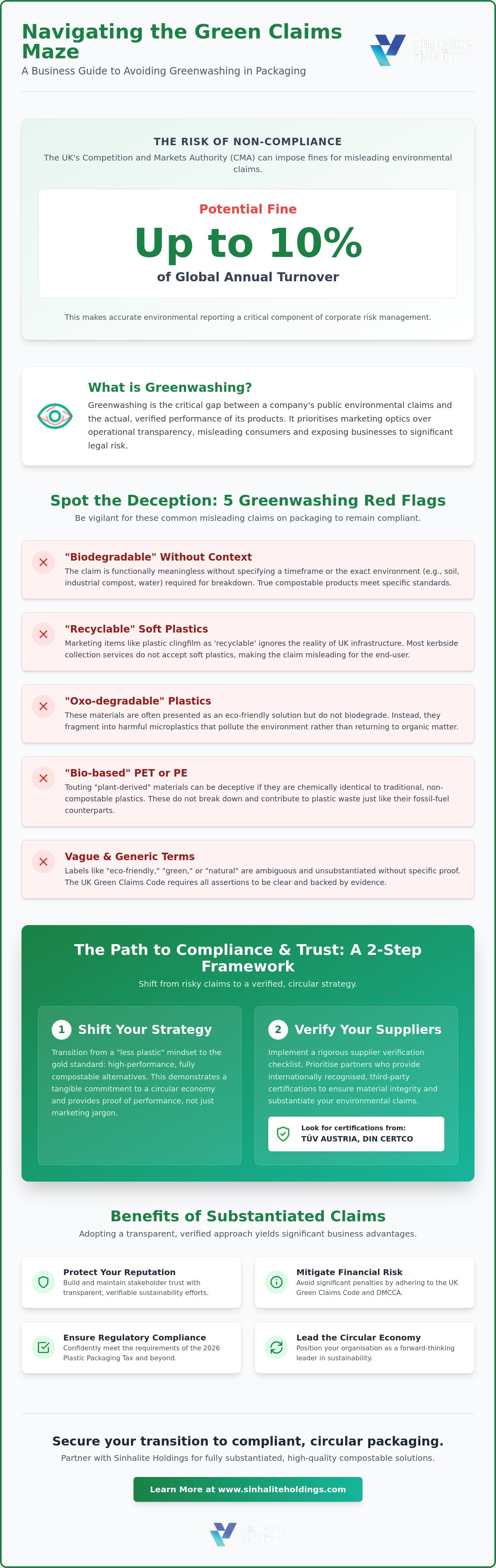
Did you know that the Competition and Markets Authority now has the power to impose fines of up to 10% of your company's global annual turnover for misleading environmental claims? It's a sobering reality for many UK businesses that are striving to do the right thing but feel overwhelmed by shifting regulations. You likely recognize the pressure to transition away from single-use plastics, yet the fear of inadvertently making a false claim remains a significant hurdle. Understanding current greenwashing in packaging examples is no longer just about marketing; it's a vital component of your corporate risk management strategy.
We've designed this guide to help you bridge the gap between environmental intent and verified impact. You'll learn how to identify deceptive eco-claims and protect your business reputation with our expert guide to spotting greenwashing in the packaging industry. We'll provide a clear framework to vet your packaging suppliers, ensuring your move toward compostable solutions like caddy bags or food roller bags meets the stringent requirements of the 2026 Plastic Packaging Tax and the Digital Markets, Competition and Consumers Act. By the end of this article, you'll have the confidence to report your sustainability progress to stakeholders with absolute transparency and integrity.
Key Takeaways
- Navigate the 2026 regulatory landscape by understanding how the UK Green Claims Code and DMCCA enforcement protect your organisation from significant financial penalties.
- Identify deceptive greenwashing in packaging examples, such as generic "eco-friendly" labels and "biodegradable" claims that lack specific environmental context or timelines.
- Learn to distinguish between misleading "recyclable" soft plastics and high-performance compostable alternatives like household clingfilm and food roller bags.
- Implement a rigorous supplier verification checklist that prioritises third-party certifications such as TUV Austria and DIN Certco to ensure material integrity.
- Secure your stakeholder reporting and meet UK environmental regulations with a clear strategy for transitioning to fully substantiated, circular packaging solutions.
Identifying Greenwashing in Packaging: The 2026 UK Landscape
In the 2026 UK commercial market, the integrity of your brand's environmental narrative is paramount. Greenwashing represents the critical gap between public environmental claims and the actual, verified performance of a product. To understand the history and various forms of this practice, businesses should first ask: What is Greenwashing? This discrepancy often arises when marketing teams prioritise optics over operational transparency; however, the legal landscape has shifted. The UK's Green Claims Code, enforced by the Competition and Markets Authority, now demands that every marketing assertion is truthful, clear, and substantiated.
Adopting a stance of industrial pragmatism requires businesses to look beyond aesthetic "green" branding and focus on the functional lifecycle of their materials. It's about ensuring that a product's environmental benefit is as robust as its performance. Within the framework of the UK's 2026 circular economy goals, greenwashing is the presentation of unsubstantiated or disproportionate environmental benefits that masks a product's true ecological impact.
To better understand this concept, watch this helpful video:
The "Seven Sins" of Packaging Greenwashing
Reviewing common greenwashing in packaging examples helps businesses avoid these pitfalls. The Sin of the Hidden Trade-off is particularly prevalent; it occurs when a company highlights a "recycled" attribute while ignoring a larger plastic footprint caused by non-recyclable multi-material layers. The Sin of Vagueness involves using undefined terms like "natural" or "earth-friendly" on plastic-lined products that cannot actually return to the earth. Finally, the Sin of Irrelevance persists when brands claim a product is "CFC-free," a boast that is meaningless because the chemical has been banned for decades. These tactics mislead consumers and expose organisations to significant regulatory risk.
Why Businesses Must Lead the Transition
Deceptive packaging claims do more than just invite fines; they fundamentally undermine corporate ESG strategies and erode stakeholder trust. When businesses use vague terminology, they stall the systemic change required for a sustainable future. Leading organisations are now shifting from "less plastic" to responsible compostable alternatives as the gold standard for integrity. By choosing verified compostable solutions like high-quality garbage bags or food roller bags, businesses provide tangible proof of their commitment to a circular economy. This proactive transition ensures that your environmental claims are backed by scientific performance rather than marketing jargon.
5 Critical Greenwashing in Packaging Examples to Watch For
Identifying deceptive practices requires a keen eye for technical detail and a commitment to operational transparency. Many businesses inadvertently fall into the trap of using suppliers that rely on vague marketing rather than scientific proof. To ensure your organisation remains compliant with the Digital Markets, Competition and Consumers Act, you must be able to recognise common greenwashing in packaging examples that often bypass standard internal audits.
- "Biodegradable" bags without context: Many products claim to be biodegradable but fail to specify a timeframe or the specific environment (such as soil or water) required for breakdown. Without these details, the term is functionally meaningless.
- "Recyclable" plastic clingfilm: While chemically possible to recycle, most UK kerbside collections do not accept soft plastics. Marketing these as recyclable ignores the reality of local waste infrastructure.
- "Oxo-degradable" plastics: These materials are often presented as eco-friendly solutions, yet they merely fragment into harmful microplastics rather than returning to the earth as organic matter.
- Bio-based PET or PE: Some brands tout "plant-derived" materials that are chemically identical to traditional plastics. These "drop-in" bioplastics do not compost and persist in the environment just as long as fossil-fuel alternatives.
- Unsubstantiated "green" imagery: The use of leaves, sprouts, or earthy colour palettes without accompanying third-party certification logos is a classic visual tactic used to imply sustainability without providing evidence.
A 2022 report highlighted several high-profile examples of greenwashing in packaging, proving that even global giants struggle with substantiated claims. It is vital to verify that your chosen materials align with genuine circular economy principles.
Distinguishing Bio-based from Compostable
It's a common misconception that "plant-derived" automatically equates to "compostable." While bio-based materials use renewable feedstocks, they don't always break down in a garden caddy or industrial facility. For a deeper look at material origins, you might ask, Are all bioplastics GMO-free? Understanding these nuances is essential for any responsible innovator.
The "Recyclable" Trap in Soft Packaging
Labels on items like traditional food roller bags often claim they are recyclable, yet these claims are frequently functionally false in the UK due to low collection rates for films. Businesses can bypass this confusion by switching to genuine compostable caddy bags and certified compostable packaging. This shift ensures that organic waste streams remain uncontaminated, providing a scalable and practical solution for waste reduction.
The Business Verification Checklist: Vetting Your Suppliers
Protecting your organisation from the fallout of greenwashing in packaging examples requires a shift from passive trust to active verification. While consumer-facing brands often face public scrutiny, the responsibility for B2B entities lies in the rigour of their procurement process. To ensure your supply chain aligns with the CMA Green Claims Code, you must implement a structured vetting framework that demands technical evidence over marketing promises.
- Step 1: Demand specific certification numbers. Authentic suppliers will provide valid license numbers from recognised bodies like TUV Austria or DIN Certco. Avoid any partner that offers generic "eco-friendly" statements without these verifiable identifiers.
- Step 2: Verify "OK compost HOME" status. For household items such as compostable clingfilm, industrial composting certifications aren't enough. Home-compostable status ensures the material breaks down in lower-temperature environments, providing a practical solution for end-users.
- Step 3: Check for chemical safety. Request explicit PFAS-free declarations. Genuine sustainability includes ensuring that no "forever chemicals" are introduced into the organic waste stream during the breakdown process.
- Step 4: Request a Life Cycle Assessment (LCA). A transparent manufacturer will provide data on the material's journey from feedstock to final disposal. This documentation is essential for your own stakeholder reporting and ESG audits.
Understanding the Gold Standard Certifications
The OK compost HOME certification stands as the ultimate proof of performance for flexible packaging. It guarantees that products like food roller bags will safely biodegrade in domestic composting conditions. You can use the TUV Austria public database to cross-reference a supplier's claim against their certificate number. This step eliminates the risk of relying on outdated or forged credentials, ensuring your business remains on the right side of UK environmental law.
Transitioning to Genuine Solutions
Sinhalite Holdings maintains this integrity through innovations in bioplastic technology 2026, ensuring every SKU is fully compliant with evolving standards. By switching to verified compostable garbage bags and caddy liners, your organisation takes a proactive step toward a circular economy. This transition replaces deceptive greenwashing in packaging examples with tangible, high-performance alternatives. Our commitment to transparency provides the steady, dependable partnership your business needs to meet 2026 sustainability targets with absolute confidence.
Securing Your Sustainable Future
The 2026 UK landscape rewards transparency and penalises ambiguity. By understanding the common greenwashing in packaging examples and implementing a rigorous supplier vetting process, your business can confidently navigate new regulatory requirements. This transition isn't just about avoiding fines; it's about building a legacy of genuine environmental stewardship that resonates with every stakeholder. Choosing verified materials is the most direct route to operational integrity.
We provide the tangible tools needed for this change, offering TUV Austria OK compost HOME certified products that perform under pressure. As specialists in high-performance compostable clingfilm and other essential liners, we maintain a UK-based supply chain focused on complete transparency. This ensures that your sustainability reporting is backed by scientific proof rather than marketing speculation. You have the power to influence the circular economy through every procurement choice you make for your organisation.
We invite you to explore our range of fully certified compostable packaging solutions and join a community of responsible innovators. Together, we can build a commercial future where every environmental claim is a promise kept.
Frequently Asked Questions
What is the UK Green Claims Code and how does it affect packaging?
The UK Green Claims Code is a set of six core principles established by the Competition and Markets Authority (CMA) to ensure all environmental claims are truthful, clear, and substantiated. For the packaging industry, this means every assertion made on a label or in a marketing campaign must be backed by robust, accessible evidence. If a business fails to meet these standards, it risks significant financial penalties and permanent damage to its corporate reputation. This code encourages a shift toward transparency and verified performance rather than vague marketing optics.
Is "biodegradable" the same as "compostable" in the UK?
"Biodegradable" and "compostable" are not interchangeable terms under UK environmental standards. While biodegradable materials eventually break down through natural processes, the term lacks a specific timeframe or environmental context, making it a common source of greenwashing in packaging examples. In contrast, "compostable" implies a material will break down into organic matter within a specific period in a composting environment. This performance is usually verified by rigorous certifications like EN 13432 or OK compost HOME for items like food waste bags.
How can I verify if a packaging certification logo is real?
You can verify the authenticity of a certification logo by requesting the supplier's unique license number and checking it against the issuing body's public database. Organisations like TUV Austria and DIN Certco maintain searchable registries where you can confirm that a product, such as compostable household clingfilm, is legitimately certified. If a supplier cannot provide a specific license number or if the number does not appear in the database, the logo is likely being used without proper authorisation or testing.
What should I do if I suspect a supplier is greenwashing?
If you suspect a supplier is providing misleading information, you should immediately request technical data sheets and third-party certification proofs for their specific claims. A responsible partner will be transparent about their material origins and provide comprehensive lifecycle assessments. If they cannot provide this evidence, it's prudent to transition to a more reliable supplier of verified compostable solutions, such as high-quality garbage bags or food roller bags. Taking these proactive steps protects your organisation from the legal risks associated with greenwashing in packaging examples.


