
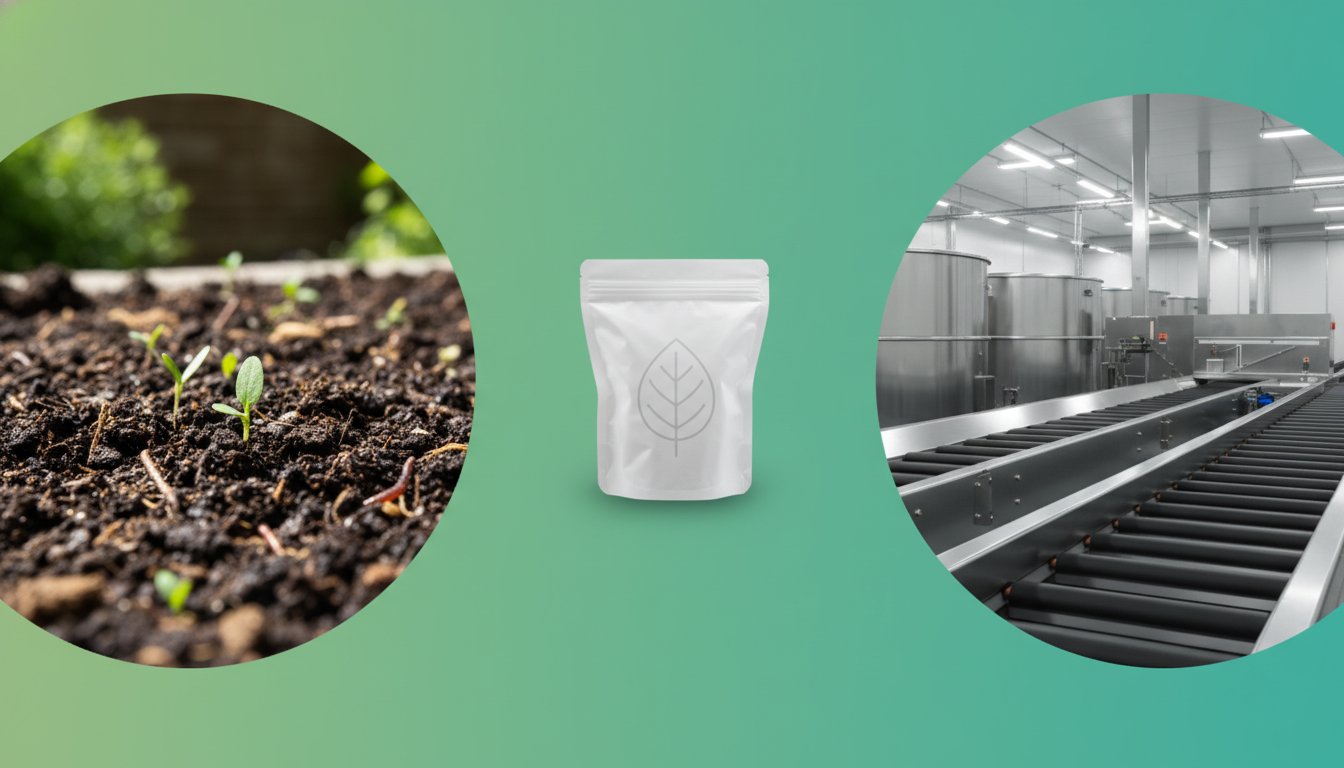
What if the sustainable packaging your business relies on is flagged as greenwashing under the August 2026 Packaging and Packaging Waste Regulation? It's a valid concern for any organisation striving for genuine environmental stewardship. You likely already recognise that high-performance alternatives like compostable clingfilm or shopping bags are essential for a circular future. However, understanding the technicalities of home compostable vs industrial compostable standards is often the difference between a successful ESG strategy and a costly compliance error.
We understand the pressure to meet UK sustainability targets while avoiding products that local councils might reject in food waste collections. This guide provides the clarity you need to distinguish between EN 13432 and OK compost HOME certifications with absolute confidence. You'll learn exactly which materials, from food roller bags to heavy-duty garbage bags, will support your commitment to a plastic-free legacy and ensure your operations remain fully aligned with the evolving UK circular economy.
Key Takeaways
- Recognise how temperature variations between industrial facilities and home heaps dictate the breakdown success of compostable materials.
- Master the technical distinctions between home compostable vs industrial compostable standards to ensure your packaging reaches its intended waste destination.
- Evaluate the four critical criteria of EN 13432 to guarantee that your caddy bags and garbage bags meet rigorous non-toxicity and disintegration requirements.
- Align your procurement strategy with the UK circular economy by selecting home-certified solutions for consumer-facing items like shopping bags and household clingfilm.
- Future-proof your business against 2026 sustainability regulations by implementing verified certifications that eliminate the risk of greenwashing and eco-label confusion.
Understanding the Science: Home vs Industrial Composting Conditions
Composting is an aerobic biological process that recovers organic waste under strictly controlled conditions. It transforms discarded materials into valuable soil enhancers through microbial activity. Understanding the technical nuances of home compostable vs industrial compostable standards is vital for any business committed to a circular economy. A material is defined as 'compostable' when it can biodegrade into nutrient-rich soil without leaving behind toxic residues or microplastics.
To better understand this concept, watch this helpful video:
The Industrial Process: Heat, Humidity, and Scale
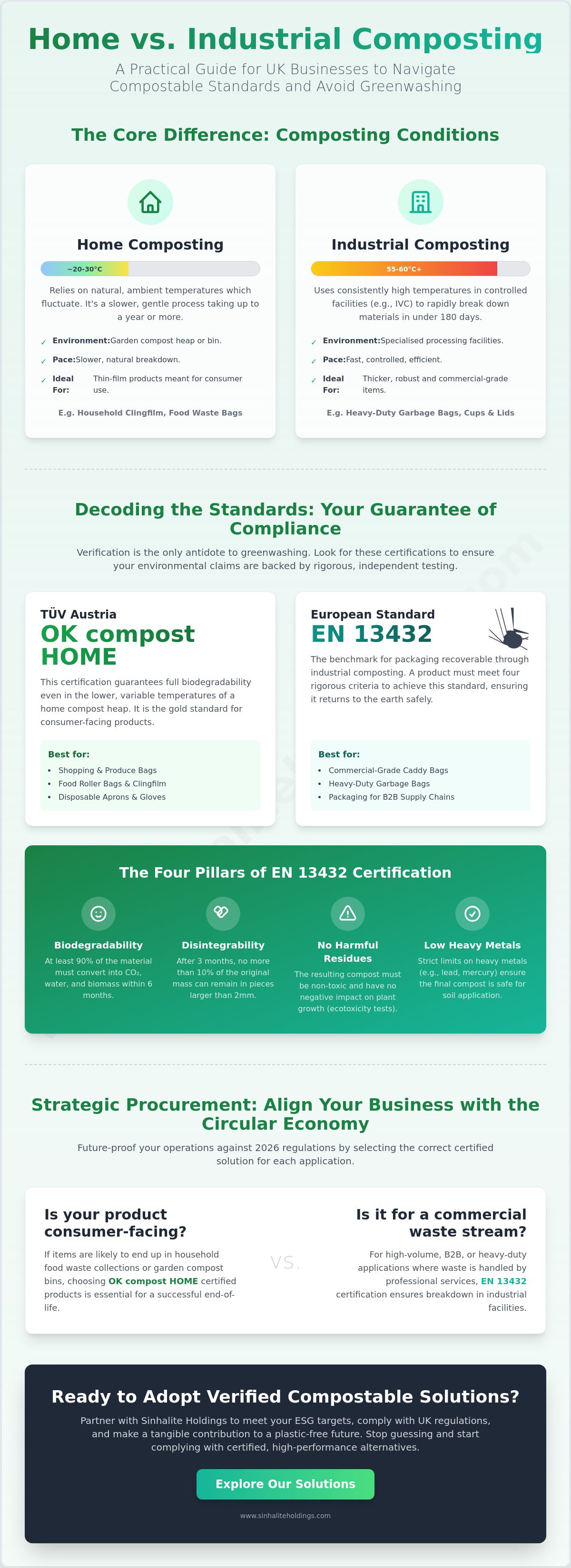
Industrial facilities maintain a consistent temperature of 55-60°C. This intense heat is necessary to break the robust molecular bonds found in thicker items like heavy-duty compostable garbage bags. Within these facilities, the process usually concludes within 180 days. In the UK, methods such as In-Vessel Composting (IVC) and Anaerobic Digestion (AD) are standard. These systems provide the humidity and scale required for rapid waste processing. By Understanding Biodegradable Polymers, procurement teams can better appreciate why high-heat environments are indispensable for certain industrial-grade products. This specialised infrastructure ensures that even resilient materials return to the earth effectively.
Home Composting: The Natural, Ambient Approach
Home composting relies on ambient temperatures that fluctuate with the British weather. It's a slower, natural pace where decomposition happens over a longer period. This environment is ideal for thin-film items such as compostable household clingfilm or food roller bags. A common misconception exists that products certified for industrial facilities will eventually break down in a garden bin. In reality, without the sustained 60°C heat, these items can remain intact for years. They don't simply "biodegrade eventually" in a standard heap. This distinction is why choosing the correct home compostable vs industrial compostable standards is a pillar of responsible business practices. It ensures that the products you supply actually disappear in the environments they are most likely to reach.
Decoding the Standards: EN 13432 and OK compost HOME
Reliable certifications provide the evidence needed to back environmental claims. EN 13432 serves as the harmonised European standard for packaging recoverable through composting and biodegradation. It isn't a vague suggestion; it's a rigorous testing protocol. To meet this benchmark, products must satisfy four distinct pillars: biodegradability, disintegrability, the absence of toxicity, and strict heavy metal limits. These EN 13432 composting conditions ensure that items like commercial-grade garbage bags leave behind no harmful residues or microplastics.
While EN 13432 focuses on industrial heat, the TÜV Austria 'OK compost HOME' certification guarantees breakdown at lower, ambient temperatures. This distinction is critical for the 2026 UK focus on the Circular Economy. By choosing certified materials, businesses can effectively align with food waste collection mandates and navigate the complexities of the Plastic Packaging Tax. Transitioning to verified compostable solutions allows organisations to meet ESG targets while ensuring their waste actually reaches a beneficial end-of-life state.
The Logos to Trust: TUV Austria and DIN CERTCO
Verification is the only antidote to greenwashing. When sourcing caddy bags or shopping bags, you should look for the seedling mark or the OK compost logo accompanied by a valid certificate number. These marks are issued by bodies like TÜV Austria or DIN CERTCO. It's vital to remember that 'biodegradable' is a vague marketing term with no legal weight. In contrast, 'certified compostable' is an enforceable standard. If you're unsure about the chemical makeup of your supplies, our guide on do compostable bags contain plastic provides essential clarity on modern material science.
ASTM D6400 vs EN 13432: A Global Perspective
Businesses operating internationally often encounter the US standard, ASTM D6400. While similar to European protocols, UK organisations should prioritise EN 13432 for local waste compliance. This ensures that products are compatible with the specific machinery used in British industrial composting facilities. Adhering to these commercial compostable cling film UK standards is particularly important in professional kitchens. It ensures that thin-film waste doesn't contaminate recycling streams or end up in landfill due to a lack of proper certification. Understanding the nuances of home compostable vs industrial compostable standards keeps your operations legal and your environmental impact positive.
Strategic Procurement: Which Standard Does Your Business Need?
Procurement decisions in 2026 are no longer just about cost and performance; they are about the intended path of the product. To build a truly sustainable supply chain, you must match the product standard to the most likely waste destination. If an item is destined for a residential setting, home compostable certification is the gold standard. For closed-loop commercial environments, industrial standards offer the consistency and strength required for heavy-duty applications. Sinhalite Holdings provides the tangible tools needed for this transition, offering high-quality solutions across both categories.
The European Bioplastics home composting standards highlight that clear labelling and verified certifications are the only ways to prevent consumer confusion. When you select the correct home compostable vs industrial compostable standards, you ensure that your waste management strategy is practical and scalable. This proactive approach turns environmental responsibility into a distinct commercial advantage.
Case Study: Clingfilm and Caddy Liners
Residential users often lack access to industrial composting, which makes home certification essential for household items. For example, compostable clingfilm uk should be designed to break down in garden heaps to ensure it doesn't end up in landfill. In contrast, the hospitality sector requires robust solutions for high-volume waste. Implementing odour control commercial food waste bags within industrial collection streams allows businesses to manage organic waste without compromising on hygiene or durability.
Maximising ESG Impact in 2026
Choosing the right standard is a fundamental step in reducing Scope 3 emissions. It supports your corporate social responsibility goals by ensuring that the materials you put into the world have a verified, non-toxic end-of-life. This level of transparency is exactly what modern ethical standards demand. We invite you to audit your current packaging against TÜV Austria standards to confirm your operations are fully aligned with the UK circular economy.
Leading the Transition to a Plastic-Free 2026
Aligning your business with the UK circular economy requires more than just a commitment to sustainability; it demands technical precision. We've explored how the success of organic waste recovery depends on matching the right material to its specific environment. Whether you're managing professional kitchens or residential supply chains, the distinction between home compostable vs industrial compostable standards remains the most important factor in your procurement strategy. By prioritising verified certifications, you protect your organisation from greenwashing risks and ensure compliance with upcoming 2026 regulations.
Sinhalite Holdings has been a specialist in high-performance bioplastics since 2018. We provide TUV Austria certified solutions that deliver the durability your operations require without the environmental cost of traditional plastics. With our UK-wide distribution, your business can access reliable caddy bags, shopping bags, and food roller bags that meet the highest ecological benchmarks. It's time to turn your ESG vision into a practical, scalable reality.
Switch to certified compostable solutions with Sinhalite Holdings today and take a decisive step toward a cleaner, more responsible future.
Frequently Asked Questions
Can I put industrially compostable packaging in my home compost bin?
You shouldn't place industrially compostable packaging in a home compost bin because it won't break down effectively. These materials require the sustained 55-60°C temperatures found only in professional facilities to trigger biodegradation. In a garden heap, the process is too slow, and the item might remain intact for years. This highlights why understanding home compostable vs industrial compostable standards is vital for ensuring your waste actually returns to the earth as intended.
What happens if compostable packaging ends up in a landfill?
Compostable packaging that ends up in a landfill fails to provide any environmental benefit. These items are designed for aerobic environments where oxygen and microbes can facilitate decomposition. In the anaerobic, tightly packed conditions of a landfill, compostable materials may remain preserved or break down extremely slowly while releasing methane, a potent greenhouse gas. This underscores the necessity of choosing the right disposal route to support a circular economy.
How can I tell if a product is truly home compostable in the UK?
You can identify a truly home compostable product by looking for the 'OK compost HOME' logo from TÜV Austria or the DIN-Geprüft Home Compostable mark. These certifications guarantee that the material has passed rigorous testing at ambient temperatures. Always verify the presence of a unique certificate number on the packaging. Relying on these verified home compostable vs industrial compostable standards prevents your organisation from falling victim to vague greenwashing claims or misleading labels.
Is EN 13432 the same as being plastic-free?
EN 13432 is a standard for compostability rather than a 'plastic-free' guarantee. It ensures that a material biodegrades, disintegrates, and leaves no toxic residue within a set timeframe. Some certified products are made from plant-based materials like corn starch, while others use compostable polymers. While these items replace traditional single-use plastics, they are technically bioplastics designed to function with professional waste management systems rather than remaining permanent environmental pollutants.


