
Did you know that while the UK's plastic packaging recycling rate reached 53.7% in 2024, many commercial entities still struggle to distinguish between a green investment and a waste contamination risk? It's understandable if your team feels confused by the overlap of 'biodegradable' and 'compostable' labels, especially with new Digital Waste Tracking regulations coming into force in October 2026. You've likely made the conscious choice to switch to compostable caddy bags or food roller bags to protect the planet, but without a clear strategy, those efforts can feel undermined by complex council guidance. Understanding how to properly dispose of bioplastics is now a commercial necessity rather than just an ethical preference.
This guide provides the definitive protocol to ensure your packaging supports a true circular economy rather than ending up in landfill. We'll break down the 2026 Extended Producer Responsibility (EPR) fees and the "Simpler Recycling" mandates that require businesses to separate food waste. By the end of this professional guide, you'll have the confidence to manage your commercial waste streams with total compliance and environmental integrity, ensuring your transition to compostable solutions delivers the impact your organisation intends.
Key Takeaways
- Learn to distinguish between generic 'eco-friendly' claims and verified compostable standards to ensure your material choices meet UK legal requirements.
- Understand how to properly dispose of bioplastics by correctly identifying the specific symbols for home versus industrial composting facilities.
- Establish a clear sorting protocol that prevents compostable items from contaminating traditional plastic recycling streams like PET and HDPE.
- Optimise your circular strategy by auditing waste streams and replacing single-use plastics with high-performance compostable garbage bags and food roller bags.
- Prepare your organisation for the 2026 UK waste regulations, ensuring full compliance with new digital waste tracking and producer responsibility standards.
Identifying the Material: Bioplastic vs. Certified Compostable
Before you can master how to properly dispose of bioplastics, you must first understand exactly what material you are holding. The term is often misunderstood because it serves as a broad umbrella. It refers to materials that are either bio-based, biodegradable, or both. This means a product could be made from plants but remain as persistent as traditional plastic in the environment. This bioplastic overview highlights that while these materials significantly reduce our reliance on virgin fossil fuels, their end-of-life path varies based on their chemical structure.
Businesses often encounter vague marketing terms like 'eco-friendly' or 'green-choice' which lack legal weight. To ensure your sustainability strategy succeeds, you must move beyond these labels and examine the specific certifications. A common point of confusion for procurement and waste managers is whether these materials are entirely plant-derived; asking do compostable bags contain plastic is a vital step in auditing your waste stream before disposal. Clear identification prevents you from accidentally sending non-compostable bio-based plastics into a composting stream where they won't break down.
Decoding UK Certification Marks (EN 13432 and TUV)
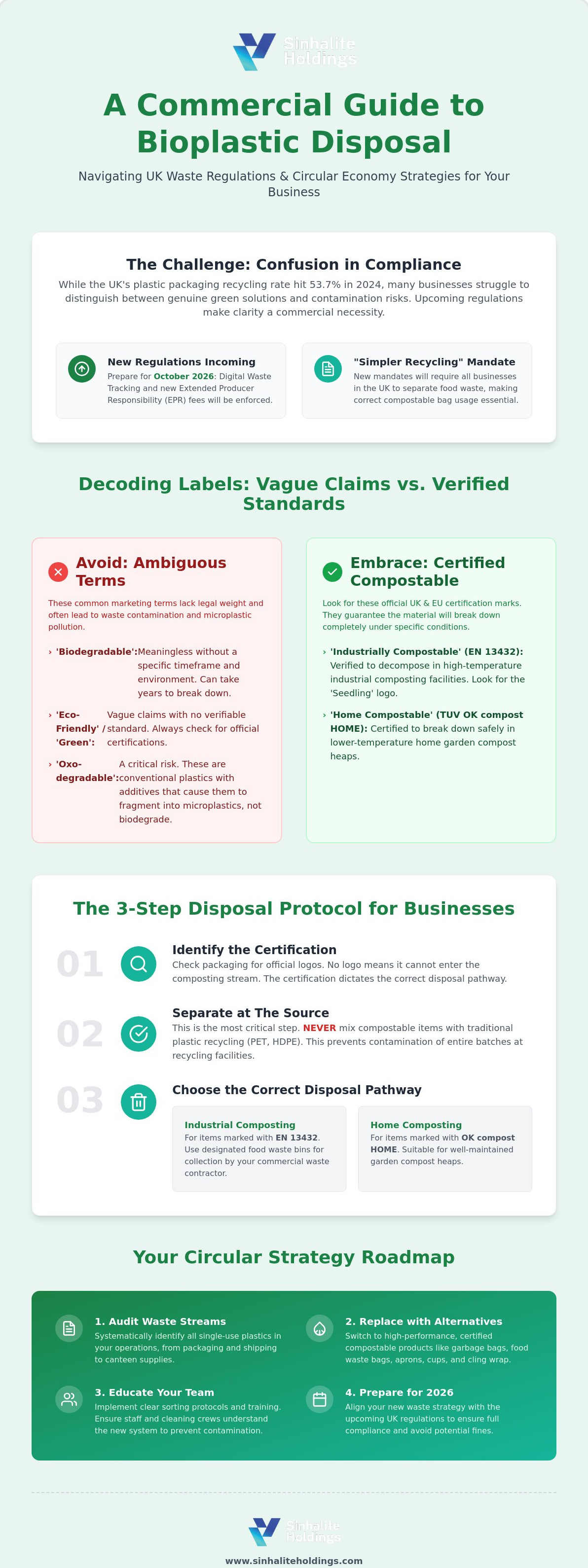
Certification is your primary safeguard against greenwashing. Look for the 'Seedling' logo or the TUV 'OK compost' marks on items like food roller bags or aprons. These symbols provide a guarantee that the item will break down under specific conditions. For items used in office kitchens or residential settings, the OK compost HOME certification explained how certain materials can safely enter garden compost heaps without industrial intervention. EN 13432 is the European standard that defines the specific requirements for packaging to be considered suitable for industrial composting facilities.
The Danger of 'Biodegradable' Ambiguity
Labels that simply say 'biodegradable' are often a red flag for responsible waste managers. Without a verified timeframe or specific environment listed, these materials can take years to break down. This creates a significant risk of microplastic formation, especially with oxo-degradable plastics. These are traditional plastics with additives that cause them to fragment into smaller pieces rather than truly biodegrade. Knowing how to properly dispose of bioplastics requires rejecting these ambiguous products in favour of certified compostable alternatives that support a genuine circular economy.
Step-by-Step: How to Properly Dispose of Bioplastics in the UK
Establishing a clear protocol for waste management is essential for any organisation aiming for net-zero. Understanding how to properly dispose of bioplastics is a multi-step process that begins immediately after the point of use. You must separate these materials from traditional PET, HDPE, and LDPE recycling streams. Mixing these distinct material groups causes batch rejection at recycling facilities; this undermines your sustainability efforts and increases operational costs.
Effective disposal relies on matching the material to its intended end-of-life pathway. For commercial entities, this often involves verifying the specific policies of your waste contractor. Many UK industrial facilities now accept certified compostable liners in food waste bins, provided they meet the BS EN 13432 standard. It's often beneficial to ensure food residues remain with the compostable packaging, as this organic matter facilitates the microbial breakdown process during composting. This approach aligns with the circular plastics economy roadmap, which advocates for material-specific waste streams to maximise carbon recovery.
Option 1: Home Composting for Domestic-Grade Bioplastics
Certain products are specifically engineered for lower-temperature environments. Items like compostable household clingfilm and caddy bags are ideal for garden compost heaps. To succeed, you must maintain consistent moisture levels and adequate heat within the heap. If a home-compostable item isn't breaking down as expected, it often indicates the compost pile is too dry or lacks sufficient nitrogen-rich green material. For businesses looking to implement these solutions at scale, choosing high-quality compostable caddy bags ensures a reliable breakdown in decentralised composting systems.
Option 2: Industrial Composting and AD Pathways
Commercial volumes of bioplastic waste typically require industrial intervention. These facilities use sustained high temperatures to break down complex biopolymers like PLA that home systems cannot process. Anaerobic Digestion (AD) also plays a growing role, specifically in processing bioplastic-contaminated food waste to generate renewable energy. You must ensure bioplastics never enter standard plastic recycling bins. Even a small amount of compostable material can contaminate a whole batch of traditional plastic, rendering it unrecyclable and destined for landfill.
Implementing a Circular Strategy for Your Organisation
Building a circular strategy requires more than just buying better products. It demands a systematic audit of your current waste streams to identify precisely where traditional plastics can be replaced by high-performance compostable alternatives. This isn't a temporary fix; switching business to sustainable packaging represents a long-term commitment to your ESG goals and operational efficiency. When you align your procurement with a clear understanding of how to properly dispose of bioplastics, you ensure that every pound spent on 'green' materials translates into measurable environmental impact.
Staff training serves as the backbone of this transition. Employees must be able to distinguish between compostable aprons or gloves and their traditional plastic counterparts at a glance. Without this visual literacy, even the best-intentioned teams can inadvertently contaminate recycling streams. Partnering with waste contractors who offer dedicated organic waste collections is equally vital. These specialists provide the necessary infrastructure to ensure your compostable packaging reaches a facility capable of processing it correctly. This collaborative approach turns a simple purchase into a functioning closed-loop system.
Procuring for End-of-Life Success
Successful circularity begins with smart procurement. You should select high-quality compostable garbage bags and shopping bags that specifically match your disposal capabilities. Buying from specialist UK providers is essential because they understand the nuances of local waste infrastructure. This alignment ensures that the products you purchase are technically compatible with the industrial composting or AD pathways available to your organisation. It also provides a reliable supply chain of materials that meet the BS EN 13432 standard, simplifying the question of how to properly dispose of bioplastics for your facilities management team.
Reducing Contamination through Clear Signage
Contamination remains the greatest threat to a functional circular economy. You can mitigate this risk by creating bespoke waste station labels that clearly distinguish between 'Compostable Only' and 'General Waste'. Clear signage empowers your team to make the right choice in seconds. Beyond the ecological benefits, transparent procurement and clear bin labelling reduce the financial burden of waste contamination fines. Proper sorting ensures your investment in sustainability isn't lost through batch rejection fees or unnecessary landfill taxes.
Securing Your Place in the UK's Circular Future
The transition to a sustainable waste model is a present operational requirement for any forward-thinking organisation. By mastering how to properly dispose of bioplastics, your business effectively bridges the gap between environmental intention and tangible ecological results. We've established the necessity of identifying EN 13432 certifications and the critical role of dedicated organic waste streams in preventing recycling contamination. These steps ensure that your investment in compostable garbage bags and food roller bags delivers its full environmental potential.
Success in this transition depends on choosing a partner who understands the nuances of the UK's evolving waste infrastructure. As a specialist UK provider of EN 13432 certified products, Sinhalite Holdings offers the industrial expertise needed to scale your sustainability efforts with absolute confidence. It's time to align your operations with the visionary goals of a circular carbon economy. Transition your organisation to certified compostable solutions with Sinhalite Holdings to meet your ESG targets and lead your industry in responsible innovation. Together, we can build a future where high performance and environmental stewardship are inseparable.
Frequently Asked Questions
Can I put bioplastics in my garden compost bin?
You should only place bioplastics in your garden compost bin if they carry a verified 'Home Compostable' certification mark. Most industrial bioplastics require the sustained high temperatures of a professional facility to break down effectively. If you use certified home-compostable clingfilm or caddy liners, these will integrate safely into your garden heap. Without this specific label, the material will likely remain intact for years in a domestic setting.
What happens if bioplastics end up in a landfill?
Bioplastics that end up in landfill fail to provide their intended environmental benefits because these environments lack the oxygen and microbes required for aerobic decomposition. Instead, they may undergo anaerobic breakdown, which releases methane, a greenhouse gas significantly more potent than carbon dioxide. This highlights why understanding how to properly dispose of bioplastics is essential for maintaining the integrity of your organisation's sustainability strategy and carbon reduction goals.
Why can't I recycle bioplastics with normal plastic bottles?
You cannot recycle bioplastics with traditional PET or HDPE bottles because their chemical compositions are fundamentally incompatible. Even a small amount of compostable material can contaminate a whole batch of traditional plastic recycling. This contamination leads to entire loads being rejected by processors and sent to landfill. Maintaining separate waste streams is the only way to preserve the value of both materials and support a functioning circular economy.
How long does it take for certified compostable bioplastics to break down?
Certified industrially compostable bioplastics must meet the BS EN 13432 standard, which requires 90% biodegradation within six months in a controlled industrial environment. For home-compostable items like shopping bags, the timeframe varies based on the temperature and moisture of your compost heap. Generally, these items are designed to disintegrate significantly within 12 months under domestic conditions. Consistency in your composting environment is the primary factor in achieving these results.
Are bioplastics better for the environment even if they are incinerated?
Bioplastics provide environmental advantages during incineration because bio-based materials release biogenic carbon that was recently captured from the atmosphere during plant growth. Unlike fossil-based plastics, which release long-stored carbon into the environment, plant-based alternatives support a more balanced carbon cycle. This makes them a more responsible choice for energy-from-waste pathways. Using compostable garbage bags ensures that even if composting isn't available, the carbon impact remains lower than traditional alternatives.
Is all bioplastic made from plants like corn or sugarcane?
Not all bioplastics are derived from plants; the term also encompasses fossil-based materials that are specifically engineered to be biodegradable. Conversely, some bioplastics are made from renewable sources like sugarcane but are chemically identical to traditional PET and will never compost. This complexity is why organisations must focus on certified compostable products. Learning how to properly dispose of bioplastics begins with identifying these material differences to ensure your waste reaches the correct processing facility.


