
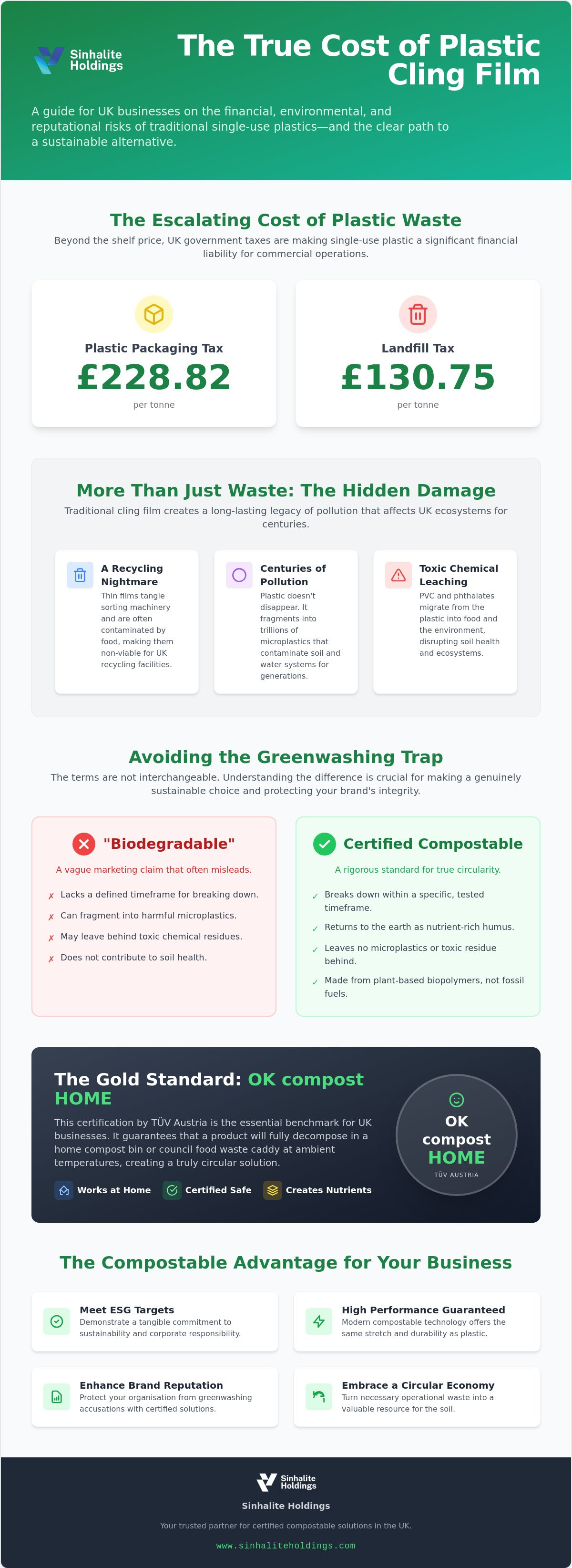
Could that thin layer of transparent wrap be the most expensive material in your commercial kitchen? While it appears low-cost, the environmental impact of plastic cling film has become a significant financial and ethical liability for UK businesses in 2026. With the Plastic Packaging Tax now at £228.82 per tonne and Landfill Tax rising to £130.75, the hidden costs of traditional polymers are finally catching up with the bottom line.
We understand that navigating the shift toward sustainability feels daunting, especially when you're balancing strict food hygiene standards with the pressure to meet ambitious ESG targets. It's frustrating to face a sea of confusing "green" marketing terms that often hide the reality of microplastic pollution. This article provides the clarity you need to distinguish between misleading biodegradable claims and genuine home compostable solutions. We'll explore the specific toxins associated with traditional wrap and provide a practical framework for integrating high-performance, plastic-free storage into your operations. By the end of this guide, you'll have a clear, actionable plan to align your business with a circular economy without compromising on the durability your team requires.
Key Takeaways
- Understand how the environmental impact of plastic cling film extends beyond landfill volume to include the chemical toxicity of PVC and phthalates.
- Identify the critical differences between vague "biodegradable" marketing and certified home compostable standards to protect your brand from the risks of greenwashing.
- Recognise why the OK compost HOME certification is the essential benchmark for businesses seeking truly circular and responsible food storage solutions.
- Discover how 2026 compostable technology provides the same durability and stretch as traditional plastic, ensuring food hygiene and performance are never compromised.
- Access a strategic framework for transitioning to compostable cling wrap as a core pillar of your organisation's ESG commitments and sustainability goals.
The Hidden Environmental Impact of Plastic Cling Film
Traditional plastic wrap is often defended as a necessary tool for food preservation. While it's true that preventing food waste reduces methane emissions in landfills, this short-term benefit is overshadowed by a much longer legacy of pollution. The environmental impact of plastic cling film is defined by its inability to be safely integrated into a circular economy. Unlike organic materials, these thin-film plastics don't disappear; they fragment into trillions of microplastics that remain in UK soil and water systems for centuries. This persistence creates a linear waste trap where a few days of food protection results in hundreds of years of ecological damage.
Why Cling Film is a Recycling Nightmare in the UK
UK recycling centres aren't currently equipped to handle thin-film plastics effectively. These materials frequently tangle in specialized sorting machinery, leading to costly operational delays and mechanical failures. Even when certain films are technically labelled as recyclable, food contamination usually prevents recovery. Organic residues like oils and proteins bond to the plastic, making it economically unviable to clean. Consequently, most plastic wrap isn't turned into new products; it's either incinerated or sent to landfill, where it remains a permanent pollutant.
- Mechanical Tangles: Thin films wrap around rotating sorters, requiring manual removal.
- Organic Contamination: Food residue makes plastic batches "dirty" and unmarketable for recyclers.
- The Downcycling Myth: Most wrap cannot be turned back into food-grade film, breaking the circular loop.
Chemical Leaching and Soil Health
Beyond physical waste, the chemical composition of traditional wrap presents a severe risk to ecosystem health. Many versions rely on polyvinyl chloride (PVC) and various phthalates to achieve their characteristic stretch and "cling." These additives aren't chemically bound to the plastic, which allows them to migrate into the food they protect and, eventually, into the broader environment. Phthalate leaching is a primary concern for long-term soil toxicity because it disrupts the delicate microbial balance required for healthy agricultural land. When plastic fragments enter the agricultural chain, they compromise soil biodiversity and the integrity of the very food systems we aim to protect.
What is the Difference Between Biodegradable and Home Compostable?
Many UK organisations are eager to reduce the environmental impact of plastic cling film, but they often fall into a common greenwashing trap. The term "biodegradable" is frequently used as a vague marketing claim without a defined timeframe or specific environmental conditions. While it's technically true that almost any material will biodegrade over decades or centuries, this doesn't solve the immediate crisis of plastic persistence. True sustainability requires a shift toward materials that return to the earth as nutrients, rather than simply fragmenting into smaller pieces of waste.
The Technical Breakdown: Biodegradable vs Compostable
Biodegradation is a natural process, yet in the context of commercial packaging, it can still leave behind toxic residues or microplastics. Compostability is a far more rigorous and transparent standard. It defines a subset of biodegradation that results in nutrient-rich humus within a specific, documented window. It's helpful to remember a simple rule: all compostable items are biodegradable, but not all biodegradable items are compostable. Choosing a certified compostable product ensures that your waste becomes a resource for the soil.
Identifying Genuine Eco-Friendly Packaging
To ensure true circularity, businesses should look for the TUV Austria "OK compost HOME" mark. For a comprehensive look at these benchmarks, you can read our OK compost HOME certification explained guide. This distinction is critical because many "eco" films only break down in industrial facilities that reach 60°C. If these products end up in a standard home bin or a council food waste caddy, they remain as persistent as traditional wrap. You might also wonder, do compostable bags contain plastic? Genuine compostable solutions are crafted from plant-based biopolymers rather than petroleum-based resins, ensuring they leave no harmful legacy.
Selecting the right material is the only way to genuinely mitigate the environmental impact of plastic cling film in your daily operations. If you're ready to align your supply chain with these higher standards, you can explore our range of certified compostable solutions to find the right fit for your organisation.
Strategic Transition to Compostable Clingfilm for UK Organisations
Transitioning to compostable materials is more than an ethical choice; it's a calculated move for long-term operational viability. By switching business to sustainable packaging, UK organisations can effectively mitigate the environmental impact of plastic cling film while enhancing their corporate reputation. Modern 2026 biopolymer technology has successfully dismantled the myth that eco-friendly wraps lack performance. Today’s compostable cling wrap offers the same industrial-grade stretch and adhesion as its petroleum-based predecessors, ensuring that food safety and freshness are never compromised.
For UK councils and hospitality leaders, removing plastic wrap from the kitchen is a high-visibility win for Corporate Social Responsibility (CSR). This change simplifies the entire waste stream. When film and food waste can be disposed of together in a single organic recycling bin, it removes the friction of manual separation. This seamless integration encourages better recycling habits among staff and ensures that organic matter is never trapped inside a non-breathable plastic liner.
Commercial Advantages of Compostable Solutions
Organisations benefit from significant financial protection when they move away from traditional polymers. Adopting compostable alternatives helps businesses future-proof their operations against the Plastic Packaging Tax, which reached £228.82 per tonne in April 2026. Detailed insights on these shifts can be found in the ultimate guide to compostable clingfilm in the UK. By diverting waste to organic streams, businesses also avoid the standard Landfill Tax rate of £130.75 per tonne, turning a waste liability into a manageable operational cost.
Implementing a Plastic-Free Food Storage Policy
Procurement teams should begin the transition by trialling certified materials in high-use areas to ensure staff become familiar with the handling characteristics. Successful implementation often starts with food wrap but quickly scales to include compostable aprons, gloves, and garbage bags for a unified sustainability policy. This holistic approach signals a deep-seated commitment to environmental stewardship. Transitioning to a circular economy is an achievable goal that protects both the planet and your brand's integrity. By choosing Sinhalite’s certified range, your organisation takes a definitive step toward a cleaner, more responsible future.
Leading the Transition to a Circular Economy
Integrating sustainable practices into your daily operations is no longer just a corporate ideal; it's a strategic necessity. We've explored how the environmental impact of plastic cling film extends from chemical leaching to the permanent persistence of microplastics in our soil. By choosing certified home compostable materials, your organisation can effectively bypass these ecological risks while streamlining food waste collection. This shift doesn't just protect the environment; it future-proofs your business against rising taxes and evolving UK regulations.
As a UK-wide specialist in compostable solutions, Sinhalite Holdings provides the high-performance tools needed for this transition. Our products carry the Certified OK compost HOME and TUV Austria marks, guaranteeing that your food storage solutions meet the highest environmental standards. Whether for commercial kitchens or domestic use, our alternatives deliver the utility you expect without the plastic legacy. It's time to align your operations with a vision of stewardship and responsibility.
Explore Sinhalite's Certified Compostable household Clingfilm and take the first step toward a plastic-free future today. Embracing this change ensures your business remains resilient, responsible, and ready for a greener outlook.
Frequently Asked Questions
Is plastic cling film toxic when used with hot food?
Traditional cling film can pose health risks when exposed to high temperatures. Many conventional wraps contain plasticisers like phthalates which aren't chemically bonded to the polymer. When heated, these chemicals can migrate directly into the food. This leaching is a primary reason why businesses are seeking safer alternatives that don't compromise food safety or contribute to the wider environmental impact of plastic cling film through toxic residues.
Can I put 'biodegradable' cling film in my home compost bin?
You shouldn't put generic "biodegradable" wrap in your home compost bin. Most products labelled this way are designed for industrial facilities that maintain a constant temperature of 60°C. Without that intense heat, the material won't break down effectively and may leave behind persistent fragments. Only products specifically certified as home compostable are suitable for domestic composting systems where temperatures are much lower and more variable.
What happens to plastic wrap if it ends up in the ocean?
Plastic wrap that enters the ocean doesn't disappear; it simply breaks into smaller, more dangerous fragments. These microplastics are often ingested by marine life, entering the food chain and carrying absorbed toxins with them. The thin, flexible nature of the film also poses a significant entanglement risk to sea creatures. This long-term persistence is a critical factor in the overall environmental impact of plastic cling film on global marine ecosystems.
How do I know if a cling film is truly home compostable?
You can identify genuine products by looking for the "OK compost HOME" seedling logo or the TUV Austria certification mark. These labels provide a guarantee that the material has been rigorously tested to break down within a specific timeframe in domestic conditions. Always check the packaging for these official standards rather than relying on vague marketing terms like "eco-friendly" or "green," which lack third-party verification and legal weight.
Does compostable cling film protect food as well as plastic?
Modern compostable cling wrap is designed to meet the same high performance standards as traditional plastic. Advanced biopolymers used in 2026 technology provide the necessary "cling" and "stretch" to create an airtight seal around containers and fresh produce. These high-quality alternatives ensure that food hygiene and moisture retention are maintained, proving that businesses don't need to sacrifice utility to achieve their sustainability goals.
Why don't UK councils recycle plastic cling film?
Most UK councils can't recycle cling film because its thin, stretchy nature causes it to wrap around the rotating parts of sorting machinery. This leads to frequent mechanical breakdowns and expensive downtime at recycling facilities. Additionally, the film is usually contaminated with organic food residue, which lowers the quality of the recycled material. Consequently, it's almost always diverted to landfill or incineration rather than being recovered.


