
By March 31, 2026, every local authority in England must provide weekly food waste collections, marking a definitive shift toward a circular economy. For your organisation, staying ahead of the council food waste bin bags regulations is about more than avoiding the Environment Agency's potential recovery charges; it's about demonstrating a commitment to genuine environmental stewardship. You've likely encountered conflicting advice from different regions or felt concerned that switching to compostable liners might compromise kitchen hygiene through bag splitting. These are valid frustrations in a landscape that's changing rapidly.
We believe that the transition to the Simpler Recycling framework requires practical tools that don't sacrifice performance for purpose. This guide offers a clear path through the new national waste standards to ensure your business remains fully compliant well before the deadlines. You'll discover how to identify high-quality, EN 13432 certified compostable liners that prevent plastic contamination and streamline your waste management. By aligning your operations with these visionary standards, you can transform a regulatory requirement into a scalable opportunity for responsible innovation.
Key Takeaways
- Understand the critical 2026 deadlines for the Simpler Recycling framework to ensure your organisation stays ahead of mandatory collection requirements.
- Master the latest council food waste bin bags regulations to select liners that meet national standards and avoid potential non-compliance charges.
- Learn how to identify genuine EN 13432 certified compostable bags that offer the durability needed for heavy-duty commercial environments.
- Develop a logistical roadmap for scaling waste separation from small kitchen caddies to large 240-litre wheelie bins without increasing contamination.
- Distinguish between vague biodegradable claims and certified compostable solutions to protect your brand's integrity and support a true circular economy.
UK Council Food Waste Regulations: The 2026 Simpler Recycling Framework
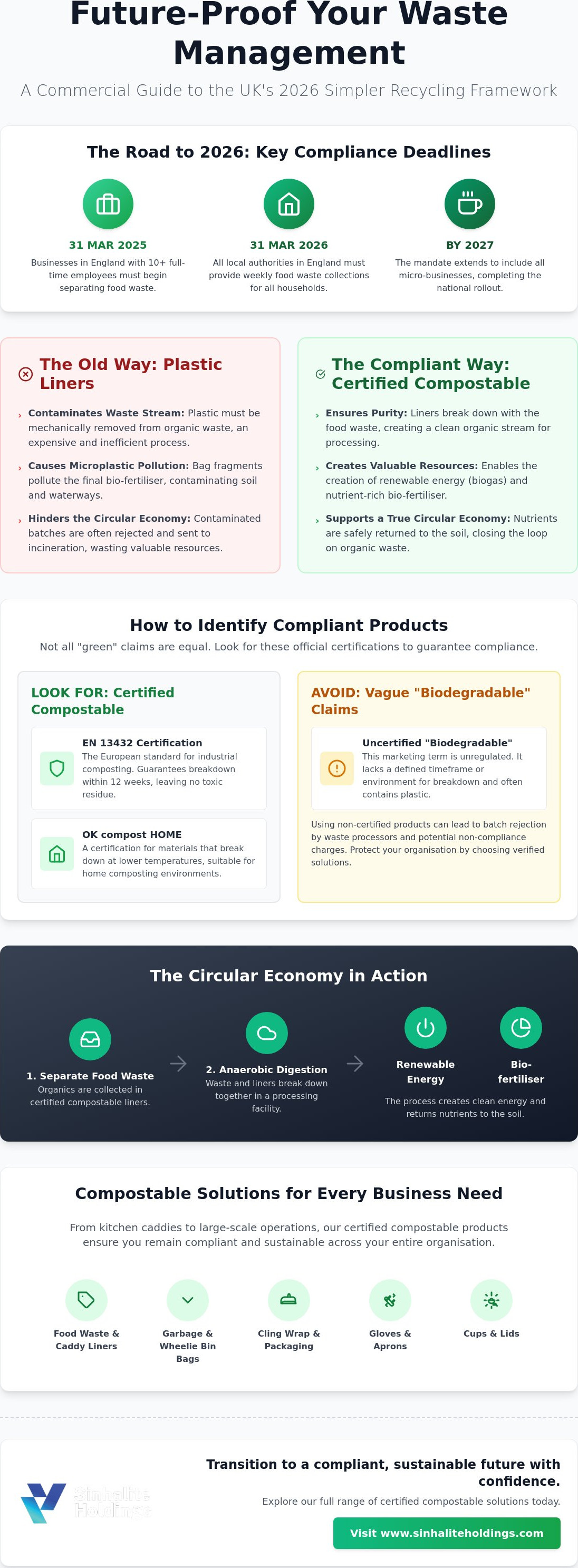
The UK is undergoing a systemic shift in how we manage organic material. By March 31, 2026, the Simpler Recycling reforms will standardise collections across England, requiring all local authorities to provide weekly food waste pickups. This unified approach eliminates the confusion of fragmented local rules, creating a national standard for both households and commercial entities. Adhering to food waste in the United Kingdom guidelines isn't just about legal compliance; it's a strategic move toward a circular economy that treats organic waste as a resource rather than a burden.
Choosing the right solutions is vital because most UK food waste is processed via Anaerobic Digestion (AD) to create renewable energy and bio-fertiliser. Traditional plastic liners are a legacy approach that prioritises containment over recovery. These materials hinder the AD process and often end up being dredged out and sent to incineration at a high environmental cost. When you understand the council food waste bin bags regulations, it becomes clear that using high-quality compostable garbage bags is the only way to ensure organic waste actually reaches its destination without leaving a trail of pollution. Transitioning to these tools supports the UK's net-zero goals by facilitating cleaner energy production.
Mandatory Food Waste Collections for UK Businesses
Compliance isn't a distant goal. Businesses in England with 10 or more full-time equivalent employees were required to separate food waste by March 31, 2025. By 2026, this mandate expands to include all households, with micro-businesses following in 2027. You must ensure your waste contractor's requirements align with these reforms to avoid investigation charges. Using certified compostable food waste bags ensures your organisation meets these standards while simplifying the collection process for staff, making the transition to responsible waste management both practical and scalable.
The Problem with Plastic Liners in the Organic Stream
Using traditional plastic for organic waste creates significant hidden costs for the taxpayer and the environment. Processing plants must spend millions on mechanical separation to remove plastic film before digestion, a process that is never 100% efficient. Microplastic contamination occurs when non-compostable bags shred during processing, leaving tiny fragments that permanently pollute the resulting agricultural digestate. Switching to compostable solutions removes this barrier entirely, ensuring that the nutrients from food waste safely return to the soil.
Choosing Compliant Bin Bags: Standards, Certifications, and Durability
Meeting the council food waste bin bags regulations requires a technical understanding of material science. It's not enough to simply buy "green" bags. You must look for the EN 13432 standard. This European certification ensures that the material breaks down completely in industrial composting facilities within 12 weeks. According to industry guidance from WRAP, using non-certified liners can result in entire batches of organic waste being rejected. Adhering to the latest council food waste bin bags regulations ensures your organisation remains a leader in environmental stewardship while avoiding costly collection failures.
Avoid the trap of "biodegradable" labels. This term is often used as a marketing gimmick because it lacks a defined timeframe or specific environmental conditions for breakdown. In contrast, "certified compostable" means the product has undergone rigorous testing to prove it leaves no toxic residue. Integrating high-quality compostable caddy bags into your prep areas ensures that the waste stream remains pure and ready for energy conversion. This choice protects the integrity of the circular economy from the point of disposal.
Decoding Eco-Labels for Procurement Officers
For businesses managing on-site composting or specific local collections, the OK compost HOME certification explained provides a clear framework for materials that break down at lower temperatures. Third-party verifications from bodies like TUV Austria offer legal protection. They serve as a shield against greenwashing claims, ensuring your ESG reports are backed by industrial truth rather than just intentions. This transparency is essential for maintaining stakeholder trust as national standards tighten.
Eliminating the "Splitting Bag" Problem
Performance is a non-negotiable factor in commercial hygiene. Many organisations fear switching because they've experienced thin liners that fail under the weight of wet organic waste. Selecting puncture resistant compostable garbage bags solves this issue through advanced polymer engineering. These breathable materials allow moisture to escape; this prevents the anaerobic conditions that cause foul odours. Breathability keeps your bins drier and your kitchen environments more hygienic. You can explore our full range of commercial compostable solutions to find the right fit for your facility's specific volume requirements.
Implementing a Sustainable Waste Strategy for Large Organisations
Scaling waste management across a multi-site operation requires more than just bins; it demands a logistical roadmap that aligns with the UK Government's Simpler Recycling Framework. Transitioning from small kitchen caddies to 240-litre wheelie bins involves significant volume, yet the core principles of council food waste bin bags regulations remain the same. Success depends on clear communication with stakeholders and staff to ensure that only organic material enters the stream. When your team understands the rationale behind the separation, contamination rates drop, and the efficiency of your waste processing increases.
This strategic shift is most effective when viewed as part of a broader commitment to environmental stewardship. For example, switching business to sustainable packaging naturally complements your organic waste efforts by reducing the overall volume of non-recyclable material. By adopting these practices, your organisation moves beyond simple compliance, positioning itself as a visionary leader in the UK’s transition to a circular economy. It's about creating a system where high performance and ecological responsibility coexist seamlessly.
The ROI of High-Quality Compostable Liners
Investing in superior bag integrity pays dividends in operational efficiency. High-quality compostable liners reduce the hidden costs of bin cleaning and mitigate pest issues by containing leaks effectively. Beyond the balance sheet, using certified materials enhances your brand reputation. It proves to customers and partners that you've eliminated plastic from your organic waste streams, demonstrating a level of integrity that resonates in a modern, ethical market. Reliable tools make the transition to council food waste bin bags regulations a smooth, professional process.
Partnering for a Greener Future
Sinhalite Holdings acts as a dedicated ally for organisations navigating the complexities of modern waste reforms. We provide scalable, certified compostable solutions tailored to specific industrial needs. Whether you require food roller bags for retail environments or heavy-duty sacks for large-scale catering, our products ensure that high standards of durability are never sacrificed for ecological responsibility. We believe that providing the right tools is the first step toward a cleaner, more sustainable future for all commercial entities.
Securing a Sustainable Legacy for 2026 and Beyond
The Simpler Recycling framework represents a significant milestone in the UK's journey toward zero waste. By understanding the council food waste bin bags regulations today, your organisation can implement a strategy that's both legally sound and operationally superior. We've detailed how identifying the EN 13432 standard and TUV Austria OK compost HOME certifications ensures your waste stream remains uncontaminated, supporting the vital work of Anaerobic Digestion facilities across the country. This transition is a proactive step toward systemic change that benefits both your brand and the environment.
Practical innovation is the key to overcoming legacy challenges like bag splitting and hygiene concerns. Our puncture-resistant technology is designed specifically for high-volume commercial use, providing the reliability required to scale your sustainability efforts with confidence. It's time to move beyond the limitations of single-use plastic and embrace tools that facilitate a true circular economy. Explore our range of certified compostable caddy liners and garbage bags for your organisation to begin your transition today. Together, we can build a future where responsible business practices are the standard, not the exception.
Frequently Asked Questions
Can I use any plastic bag for my council food waste bin in 2026?
No, you shouldn't use traditional plastic bags because they compromise the quality of the final compost and energy production. While some local authorities historically allowed plastic for containment, the move toward unified council food waste bin bags regulations prioritises high-quality compostable liners. These materials ensure that food waste is processed into renewable energy or fertiliser without leaving harmful microplastic residues in the agricultural soil.
What is the difference between home compostable and industrially compostable bags?
Home compostable bags are designed to break down at the lower temperatures found in domestic garden heaps. Industrially compostable bags meet the EN 13432 standard, requiring the controlled, higher temperatures of a professional facility to biodegrade fully within 12 weeks. Most UK councils process waste through Anaerobic Digestion, where industrially compostable liners are the recognised standard for ensuring a clean, efficient conversion process.
Are businesses legally required to separate food waste in the UK?
Yes, most UK businesses are already legally required to separate food waste or will be by the 2026 deadline. In England, organisations with 10 or more employees had to comply by March 31, 2025, while micro-businesses have until 2027. Wales introduced mandatory separation in April 2024 for any workplace producing over 5kg of food waste per week, making compliance a critical part of modern operational standards.
What happens if my compostable bin liners keep splitting or leaking?
Splitting often occurs when using low-quality liners that can't handle the weight and moisture of organic matter. If your bags are failing, you should switch to puncture-resistant compostable garbage bags engineered for commercial durability. These breathable materials allow moisture to evaporate; this prevents the build-up of heat and acidic liquids that typically weaken the integrity of standard liners in busy kitchen environments.


