

Since the 31 March 2026 mandate requiring all UK businesses to separate food waste, the drive toward systemic environmental stewardship has become a legal necessity. You have likely already adopted compostable bags for commercial food waste to streamline your collections and demonstrate your commitment to a circular economy. However, the effectiveness of these tools depends entirely on where they end up. Without a confirmed partnership with a high-heat industrial facility, even the most innovative materials can fail to reach their full ecological potential.
We recognise that navigating the gap between procurement and processing can be complex. You need the confidence that your waste management choices are both compliant and genuinely impactful. This guide provides a structured process for locating local industrial composting facilities and verifying their operational standards. We will provide a professional checklist for interviewing waste contractors and explain how to ensure your bags meet the BS EN 13432 standard. By the end of this article, you'll have a clear path to ensuring your organic waste is responsibly transformed into a valuable resource.
Key Takeaways
- Distinguish between In-Vessel Composting (IVC) and Anaerobic Digestion (AD) to select the most effective processing route for your organic waste.
- Discover how to utilise the REA interactive map to pinpoint local facilities with the high-heat capabilities required for bioplastic disintegration.
- Master the essential questions to ask waste contractors to ensure your compostable bags for commercial food waste reach a certified industrial composter.
- Audit your current plastic usage to create a seamless transition toward sustainable packaging that aligns with 2026 UK recycling regulations.
Understanding the UK Industrial Composting Landscape for Food Waste
The success of a circular economy relies on the synergy between innovative materials and robust waste infrastructure. While many organisations have transitioned to compostable bags for commercial food waste, the final outcome depends on whether these items reach a facility capable of processing them. Unlike domestic heaps, industrial-scale composting utilises controlled heat and aeration to break down complex bioplastics. This high-temperature environment is essential for heavy-duty items like compostable garbage bags or specialised compostable clingfilm. Without these specific conditions, bioplastics cannot effectively return to the earth as safe, nutrient-rich soil.
In-Vessel Composting (IVC) vs. Anaerobic Digestion (AD)
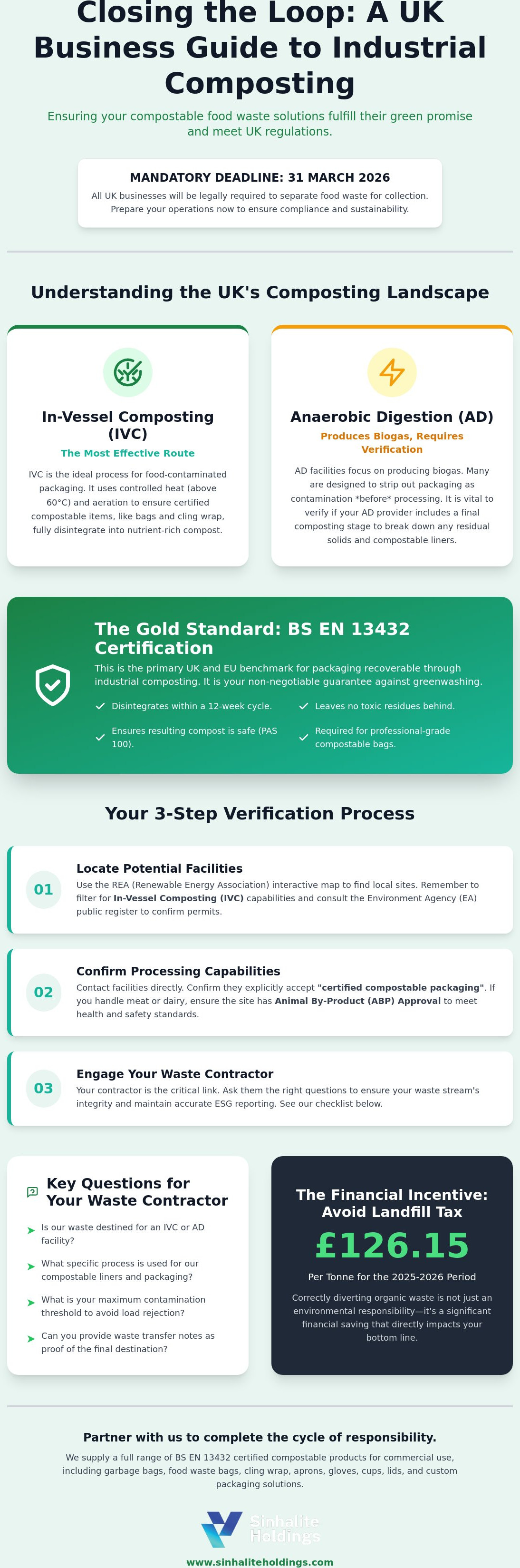
In-Vessel Composting (IVC) is currently the most effective route for food-contaminated packaging because it maintains temperatures above 60°C. This heat ensures that certified compostable liners disintegrate fully. Conversely, many Anaerobic Digestion (AD) facilities are designed to produce biogas and may strip out bags as contamination before processing begins. If your waste goes to AD, you must verify if the provider includes a composting stage for solids. It's also vital to ensure the facility is Animal By-Product (ABP) approved if you're disposing of meat or dairy waste. This certification ensures the facility meets strict health and safety standards for handling organic matter.
The Importance of EN 13432 Standards
The EN 13432 standard is the primary benchmark for packaging recoverable through industrial composting. It guarantees that a product will disintegrate within a 12-week commercial cycle without leaving toxic residues. Facilities often rely on PAS 100 certification to ensure the resulting compost is a high-quality, safe soil conditioner. While some items carry an OK compost HOME certification, commercial operations usually require the industrial standard to handle the sheer volume and strength of professional-grade compostable bags for commercial food waste. Recognising these marks helps your organisation avoid greenwashing and ensures your waste management aligns with UK infrastructure.
How to Locate and Verify a Local Industrial Composter
Identifying a partner for your organic waste is more than a matter of proximity; it's an exercise in technological alignment. With the 2026 mandate requiring separate food waste collections, the demand for transparent processing has never been higher. To ensure your compostable bags for commercial food waste are processed correctly, you must look beyond general waste disposal and find facilities equipped with the right infrastructure. The Renewable Energy Association (REA) provides an interactive map that serves as a vital starting point, allowing you to filter for sites with In-Vessel Composting (IVC) capabilities across the UK.
In addition to industrial maps, you should consult the Environment Agency (EA) public register. This database confirms whether a facility holds the necessary environmental permits to handle commercial-scale organic matter. If you're a smaller organisation or a micro-business, it's worth engaging with your local council. Many now offer commercial food waste collection services specifically designed to help businesses meet new regulatory standards while avoiding the high costs of landfill tax, which is set at £126.15 per tonne for the 2025-2026 period. Equipping your team with reliable compostable solutions is a significant step, but ensuring they reach the right destination completes the cycle of responsibility.
Step-by-Step Facility Verification
- Identify your waste stream: Determine if you're disposing of pure food waste or a mix that includes certified compostable liners and packaging.
- Check for ABP Approval: Search the REA database for facilities with Animal By-Product (ABP) approval. This is mandatory for any site handling food waste to ensure pathogens are destroyed during processing.
- Confirm packaging acceptance: Contact the facility directly to confirm they explicitly accept "certified compostable packaging" rather than just green garden waste.
Questions to Ask Your Waste Contractor
Your waste contractor acts as the bridge between your bins and the composting site. To maintain the integrity of your ESG reporting, you should ask if the waste is destined for an IVC or AD facility and what specific process is used for the liners. Inquire about their maximum contamination threshold to avoid entire loads being rejected. Finally, always request a waste transfer note. This document confirms the final disposal site, providing the verification you need to prove your compostable bags for commercial food waste didn't end up in a landfill.
Aligning Your Procurement with UK Waste Infrastructure
Success in the circular economy depends on your ability to select products that facilities recognise and trust. To effectively switch to sustainable packaging, you should begin with a thorough audit of your current plastic usage. Standardising your internal bins to match the specific requirements of your local industrial facility creates a seamless transition for your team. High-visibility branding on your compostable bags for commercial food waste is equally essential. It prevents sorting errors at the source, ensuring that only organic matter enters the composting stream and reducing the risk of load rejection.
Selecting Facility-Friendly Products
Operational efficiency in a composting facility relies on rapid identification. You should prioritise products that display clear certification logos, such as the "Seedling" or "Compostable" marks. These symbols provide immediate assurance to waste handlers that the material meets the EN 13432 standard. For high-volume environments, puncture resistant compostable garbage bags are the preferred choice for commercial handlers. They offer the necessary strength to contain heavy food waste without compromising hygiene or safety. Ensuring all caddy liners and food-contact items share the same disposal route simplifies your logistics and supports a unified waste management strategy.
Building a Circular Partnership
Moving beyond a transactional waste relationship allows your organisation to become a genuine contributor to soil health. A circular partnership involves active communication with your waste processor to ensure your compostable bags for commercial food waste are fulfilling their ecological purpose. Documenting this verified route is a powerful way to enhance your 2026 ESG reporting. It provides the transparency that modern stakeholders expect from responsible businesses. By choosing the right tools today, you secure a cleaner and more resilient future for your operations.
Explore Sinhalite Holdings’ range of certified compostable solutions for your business.
Securing Your Organisation’s Role in a Circular Future
The transition toward mandatory food waste separation in the UK represents a significant milestone for corporate responsibility. By identifying local In-Vessel Composting facilities and verifying their acceptance of bioplastics, you move beyond mere compliance toward genuine environmental stewardship. This strategic alignment ensures that your waste management choices deliver a measurable impact on soil health rather than contributing to the rising costs of landfill tax. You've now gained the tools to audit your waste stream, verify your partners, and select products that truly integrate with national infrastructure.
Choosing the right materials is the final piece of the puzzle. High-performance, EN 13432 compliant compostable bags for commercial food waste provide the durability needed for professional environments while guaranteeing full disintegration in industrial cycles. As specialists in high-performance compostable clingfilm and sacks, we're dedicated to supporting the UK’s transition to a circular economy with integrity and innovation. Our solutions are designed to meet the rigorous demands of commercial operations while upholding the highest ecological standards.
Switch your business to certified compostable solutions today and join a network of visionary partners committed to a cleaner, more resilient future. Positive change is within reach when purpose meets practical action.
Frequently Asked Questions
Can I put compostable packaging in my commercial garden waste bin?
No, you shouldn't place packaging in dedicated garden waste bins unless your contractor specifically manages a mixed "food and green" waste stream. Most facilities designed purely for garden waste are optimised for organic plant matter and often reject bioplastics to prevent contamination. It's essential to confirm your specific waste stream with your provider to ensure your materials align with their processing technology.
How do I know if a facility near me accepts compostable clingfilm?
You can identify suitable sites by searching the Renewable Energy Association (REA) database for facilities equipped with In-Vessel Composting (IVC) technology. Because films are thinner than rigid bioplastics, they require the sustained high temperatures and controlled aeration found in these industrial environments. Always request written confirmation from your waste contractor that their destination facility accepts films certified under the EN 13432 standard.
What happens if there is no industrial composting facility in my area?
If a local facility is unavailable, you should consult regional waste contractors who may offer transport services to industrial sites further afield. Many organisations find that consolidating waste with neighbouring businesses can make long-haul collection more economically viable. Using high-quality compostable bags for commercial food waste remains a vital part of a future-proof waste strategy as UK infrastructure continues to expand to meet 2026 requirements.
Is anaerobic digestion (AD) the same as industrial composting for bags?
No, anaerobic digestion is a distinct process focused on producing biogas and liquid fertiliser in an oxygen-free environment. Many AD facilities utilise de-packaging machinery that strips out liners before processing to protect their equipment. For compostable bags for commercial food waste to be effectively transformed into nutrient-rich soil, they typically require the aerobic conditions and high heat generated within an In-Vessel Composting (IVC) system.


