
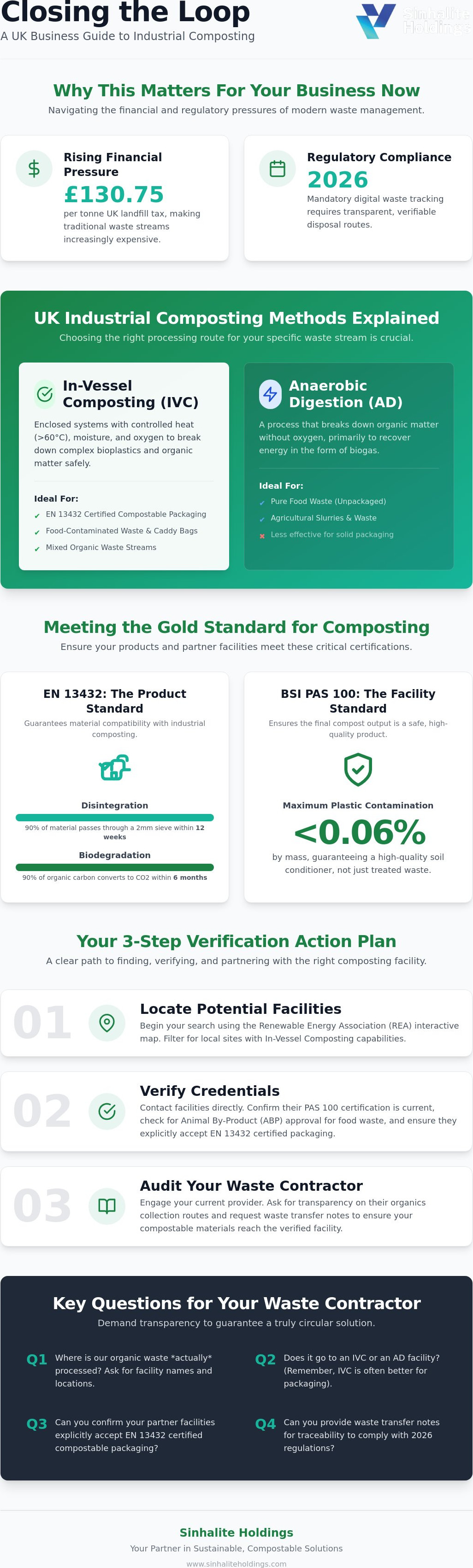
With UK landfill tax reaching £130.75 per tonne this year, sticking to traditional waste streams is no longer just an environmental burden; it's a significant financial one. While your organisation might have already switched to compostable clingfilm or caddy bags, the true impact of these innovations depends entirely on finding your local industrial composting facility. Many businesses feel the pressure of the 2026 mandatory digital waste tracking requirements and worry that their sustainable efforts will simply end up in a landfill despite their best intentions.
It's frustrating to invest in high-quality compostable solutions only to face uncertainty about where they actually go once they leave your site. We understand that the gap between purchasing a certified product and ensuring its circularity can feel wide, especially with the "Simpler Recycling" reforms now in full effect for most UK businesses. This guide provides the exact steps to locate, verify, and partner with facilities that hold the PAS 100 certification. You'll discover a clear strategy for vetting waste contractors and a checklist to ensure your bioplastics are processed correctly, turning your sustainability goals into measurable, transparent results.
Key Takeaways
- Understand the operational differences between In-Vessel Composting and Anaerobic Digestion to select the most effective processing route for your organic waste.
- Master the process of finding your local industrial composting facility by utilising national mapping tools and auditing your current waste contractor’s capabilities.
- Learn how to verify PAS 100 certification to ensure your disposal methods align with 2026 digital waste tracking requirements and avoid the risk of greenwashing.
- Gain a practical checklist for auditing your plastic use and transitioning to trusted compostable solutions like garbage bags and caddy bags.
Understanding the UK Industrial Composting Landscape
Industrial composting is a sophisticated, technology-driven process. Unlike a standard garden heap, it uses controlled heat and aeration to break down complex bioplastics. This is crucial for high-performance items like compostable garbage bags or compostable clingfilm. Without the sustained high temperatures, often exceeding 60°C, maintained in these facilities, industrial-grade materials won't degrade within the necessary commercial timeframe.
The UK infrastructure primarily relies on two methods: In-Vessel Composting (IVC) and Anaerobic Digestion (AD). While AD is excellent for energy recovery from pure food waste, IVC is often the preferred route for compostable packaging because it manages physical structures more effectively. With UK recycling rates for food waste sitting at roughly 19%, expanding the use of these industrial solutions is vital for the circular economy.
Any site you partner with should adhere to the BSI PAS 100:2018 standard. This certification ensures the final output is a high-quality soil conditioner, not just treated waste. It mandates that plastic contaminants stay below 0.06% m/m. This rigorous quality control is a primary factor when finding your local industrial composting facility.
In-Vessel Composting (IVC) vs. Windrow
IVC systems are enclosed environments that regulate temperature, moisture, and oxygen. This level of control is essential for food-contaminated waste and certified packaging. Conversely, open-air windrows are generally reserved for green garden waste. Before sending food-related items like used compostable caddy bags, always verify if the facility is Animal By-Product (ABP) approved. This ensures the process meets legal safety requirements for handling organic matter.
The Importance of EN 13432 Standards
Industrial facilities specifically look for the EN 13432 mark. This is the European standard for packaging recoverable through composting. It guarantees the material will disintegrate within 12 weeks and fully biodegrade within six months in an industrial environment. It's distinct from the OK compost HOME certification, which is designed for lower garden temperatures. Selecting products that meet EN 13432 ensures compatibility with the infrastructure you locate when finding your local industrial composting facility.
How to Locate and Verify a Local Industrial Composter
Identifying the right partner for your organic waste is a critical step in closing the loop on your sustainability strategy. Finding your local industrial composting facility begins with the Renewable Energy Association (REA) interactive map. This tool allows businesses to filter sites by processing type and certification. However, a map is only the starting point. You must verify that a site holds current government waste permits to ensure they operate within legal environmental frameworks and maintain high standards of stewardship.
Your current commercial waste contractor is often the most direct link to these facilities. Ask them specifically about their "Organics" or "Food Waste" collection routes. Many providers have existing partnerships with In-Vessel Composting (IVC) sites that can handle your food-soiled packaging alongside organic matter. Utilising high-quality compostable caddy bags makes this collection process cleaner and more efficient for your staff and the contractor alike. If your waste provider doesn't currently offer an organics route, local councils often have information on commercial food waste services available in your borough.
Step-by-Step Facility Verification
- Identify your waste stream: Determine if you're disposing of pure food waste or a mix that includes compostable liners and food-service packaging.
- Check for ABP Approval: Search the REA database for facilities with Animal By-Product (ABP) approval. This is a legal requirement for any site handling food waste.
- Confirm packaging acceptance: Contact the facility directly to ensure they accept "certified compostable packaging" like EN 13432 liners rather than just green garden waste.
Questions to Ask Your Waste Contractor
Transparency is essential for responsible waste management. When negotiating with a waste provider, ask where your waste is actually going. Does it head to an IVC or an AD facility? While AD is common, IVC is often better suited for breaking down certified compostable items. Ask for a waste transfer note that names the final disposal site. This document isn't just a formality; it's your primary evidence for the mandatory digital waste tracking coming into effect in April 2026.
Aligning Your Procurement with UK Waste Infrastructure
Identifying a site is only half the battle. Your operational success depends on using products that facilities recognise and trust. Once you've succeeded in finding your local industrial composting facility, your procurement strategy must evolve to support that specific infrastructure. We recommend starting with a comprehensive audit of your current plastic use. This allows you to position your organisation for a purposeful switch to sustainable packaging that avoids the pitfalls of contamination.
Systemic change requires consistency. According to the Local Government Association, councils and waste contractors prioritise streams that are easy to identify and sort. By standardising your internal bins to match the requirements of your local facility and using high-visibility branding on compostable items, you reduce sorting errors. This transparency builds confidence with your waste partner and ensures your materials are actually processed rather than diverted to landfill.
Selecting Facility-Friendly Products
Handlers at industrial sites look for clear certification logos like the "Seedling" or "Compostable" mark. These symbols act as a visual guarantee of compliance with EN 13432 standards. Beyond certification, physical performance matters. Many facilities prefer puncture resistant compostable garbage bags because they maintain hygiene and prevent leaks during transit. Ensuring your clingfilm, shopping bags, and caddy liners all share the same disposal route simplifies training for your staff and creates a more reliable waste stream for the composter.
Building a Circular Partnership
The transition to a circular economy is a collaborative effort. Move away from a transactional waste relationship and toward a circular partnership. By documenting your composting route and verifying the final destination of your organic waste, you significantly improve your 2026 ESG reporting. This data driven approach provides the transparency that stakeholders now demand. It's time to align your business with the future of British waste management. Explore Sinhalite Holdings’ range of certified compostable solutions for your business and take the final step in finding your local industrial composting facility partnership today.
Leading the Transition to a Circular Future
The transition to a circular economy is no longer a distant goal; it's an operational necessity for modern UK organisations. By mastering the technical landscape of In-Vessel Composting and ensuring your waste contracts provide full transparency, you protect your business from the rising costs of landfill. Success in finding your local industrial composting facility serves as the catalyst for a truly sustainable waste strategy that meets 2026 regulatory standards.
Aligning your procurement with the specific requirements of UK infrastructure ensures that every item reaches its full environmental potential. As specialists in high-performance compostable clingfilm and EN 13432 compliant liners, we provide the tools needed to support the UK transition to a circular economy without sacrificing durability. It's about making a responsible choice that benefits both your bottom line and the planet.
It's time to move beyond plastic and embrace practical, scalable innovation. Switch your business to certified compostable solutions today and join a network of leaders committed to a cleaner outlook. We're here to help you navigate this change with confidence and integrity.
Frequently Asked Questions
Can I put compostable packaging in my garden waste bin?
No, you shouldn't place compostable packaging in standard municipal garden waste bins unless your local council explicitly permits it. Most garden waste is processed through open-air windrows, which don't reach the sustained high temperatures necessary to break down industrial-grade bioplastics. To ensure items like compostable garbage bags are fully processed, they must be sent to an In-Vessel Composting (IVC) facility that handles food-contaminated organics.
How do I know if a facility near me accepts compostable clingfilm?
You can verify this by consulting the Renewable Energy Association (REA) database or asking your waste contractor for a list of their processing sites. When finding your local industrial composting facility, it's vital to confirm the site has Animal By-Product (ABP) approval. This certification ensures the facility is legally equipped to handle food-related items, including high-performance compostable clingfilm, within a controlled, hygienic environment.
What happens if there is no industrial composting facility in my area?
If a local site isn't immediately available, you should partner with a commercial waste contractor that operates regional collection routes. These providers often transport organic waste to larger, centralised hubs specifically designed for industrial processing. Some organisations also choose to invest in on-site composting machines to manage food waste and compostable caddy bags internally, which can significantly reduce long-term logistics costs and carbon footprints.
Is anaerobic digestion (AD) the same as industrial composting?
No, these are different technologies with distinct environmental outputs. Anaerobic digestion breaks down organic matter without oxygen to create biogas for energy, whereas industrial composting is an aerobic process that produces nutrient-rich soil conditioner. Finding your local industrial composting facility is particularly important if your waste stream includes solid materials like liners or packaging, as AD systems often remove these items as contaminants before processing begins.


