

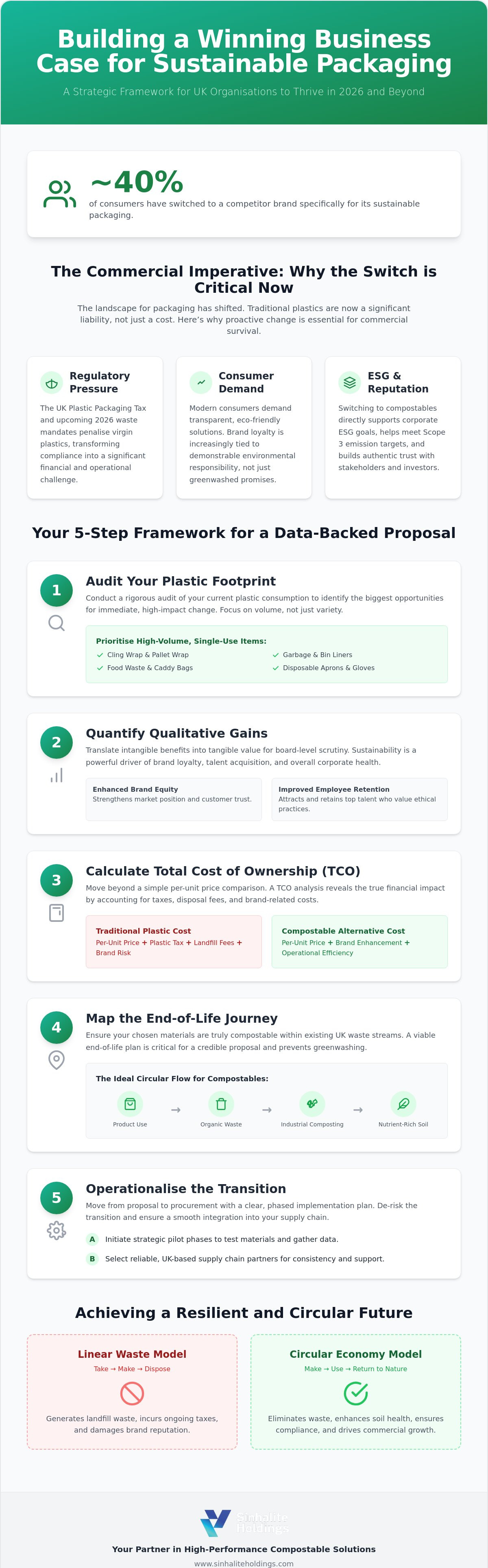
Almost 40% of consumers have already switched to a competitor specifically because that brand offered more sustainable packaging. When you're presenting a business case for sustainable packaging in 2026, you aren't just making an environmental plea; you're proposing a vital strategy for commercial survival. It's understandable if you feel the weight of the UK Plastic Packaging Tax or struggle to quantify the long-term ROI of switching to high-performance compostable materials. You know that the transition is necessary, yet the gap between visionary goals and industrial pragmatism often feels wide.
We've designed this guide to help you bridge that gap with confidence. You'll master a framework for justifying the move to compostable solutions, such as high-strength clingfilm and caddy bags, by aligning your ecological responsibility with clear commercial gains. We'll show you how to build a data-backed proposal that satisfies board-level scrutiny while ensuring full compliance with 2026 regulations. This article provides a clear roadmap to turn sustainability into a tangible driver of brand equity and operational excellence, moving your organisation toward a more resilient and circular future.
Key Takeaways
- Understand how the 2026 UK regulatory landscape transforms traditional plastic from a standard operational cost into a significant financial liability.
- Master a structured framework for presenting a business case for sustainable packaging that successfully balances environmental goals with long-term commercial ROI.
- Learn how to conduct a comprehensive audit of your current plastic footprint, identifying high-volume items like clingwrap and bin liners for immediate, scalable replacement.
- Discover proven methods for quantifying qualitative benefits, such as enhanced brand equity and improved employee retention, to satisfy board-level scrutiny.
- Gain practical insights into operationalising the transition through strategic pilot phases and selecting reliable, UK-based supply chain partners.
Building the Strategic Context for Sustainable Packaging in 2026
The 2026 regulatory environment has fundamentally shifted the status of traditional plastic from a low-cost convenience to a significant commercial liability. When presenting a business case for sustainable packaging, you must demonstrate that "forever plastics" now represent a profound risk to both the balance sheet and brand reputation. Organisations that rely on non-recyclable films and single-use plastics face increasing scrutiny from stakeholders who demand transparency in the supply chain. By aligning your packaging strategy with corporate ESG goals, you can show how compostable alternatives directly contribute to achieving Scope 3 emission targets.
A successful proposal highlights the transition from a linear waste model to one of systemic responsibility. For those seeking a broader sustainable packaging overview, it's clear that the focus has moved from simple recyclability to holistic life-cycle assessments. Using certified compostable materials, such as high-performance clingfilm or caddy bags, allows your business to build authentic trust and bypass the growing consumer backlash against greenwashing. This strategic alignment ensures that your operations are not just compliant, but are leading the way in environmental stewardship.
To better understand the commercial incentives behind this shift, watch this helpful video:
The Regulatory Driver: Plastic Packaging Tax and Beyond
By switching business to sustainable packaging, organisations proactively mitigate the impact of the UK Plastic Packaging Tax, which continues to penalise the use of virgin plastics. The upcoming 2026 waste management mandates will require UK councils and businesses to implement more rigorous separation of organic waste. Adopting compostable garbage bags and food roller bags now ensures your procurement strategy remains ahead of these compulsory changes, turning a potential tax burden into a streamlined operational advantage.
Consumer Sentiment as a Commercial Mandate
UK consumer loyalty is increasingly tethered to brands that provide transparent, plastic-free end-of-life solutions for their products. Shoppers are no longer satisfied with vague promises; they want tangible proof that packaging won't linger in the environment for centuries. In the context of commercial food waste, a circular economy refers to a system where organic materials and their packaging are returned to the soil as nutrient-rich compost rather than being lost to landfill.
A Step-by-Step Framework for Your Business Case
Moving from a strategic vision to operational reality requires a methodical approach. The first step involves a rigorous audit of your current plastic footprint. Focus your efforts on high-volume, single-use items such as clingwrap and bin liners, as these often represent the most significant opportunity for immediate impact. Once you've established the volume, you must quantify the qualitative. Assigning a clear value to brand reputation and employee retention is critical when presenting a business case for sustainable packaging. Modern workforces and consumers alike prioritising ethical practices, which lead to tangible business benefits such as increased loyalty and reduced recruitment costs.
Effective procurement requires a Total Cost of Ownership (TCO) analysis rather than a simple per-unit price comparison. This perspective accounts for the entire lifespan of the material, including disposal and regulatory compliance. You must also map the end-of-life journey for every SKU. Proving that a "compostable" claim is actionable within existing UK waste streams ensures your proposal remains grounded in reality. Exploring high-quality compostable alternatives can serve as the foundation for this transition, providing the performance you need without the plastic legacy.
Calculating the Financial ROI of Compostables
Financial justification often hinges on calculating the ROI of switching to sustainable packaging by looking beyond the invoice. Factor in the savings found in reduced waste disposal fees and the avoidance of plastic taxes. Contrast the cost of compostable liners against the hidden labour costs of cleaning contaminated bins. When organic waste is managed in compostable bags, the cleaning cycle is shortened, allowing staff to focus on higher-value tasks.
Performance Benchmarking: Proving the Tech Works
Durability concerns are common during stakeholder reviews. Address these by referencing technical specifications for items like puncture resistant compostable garbage bags. Providing a "proof of concept" that details material strength and shelf-life helps dismantle objections. When stakeholders see that compostable films match the utility of plastic, the transition moves from a perceived risk to a logical progression.
Operationalising the Switch: From Proposal to Procurement
Transitioning from a boardroom approval to an operational reality requires a partner who understands the nuances of the UK market. Selecting a supplier with a UK-based supply chain ensures the transparency and reliability needed to maintain consistent operations. When you're presenting a business case for sustainable packaging, demonstrating that your chosen partner can meet industrial-scale demand without compromising on ethical standards is vital. This local focus reduces lead times and provides the logistical agility necessary for a seamless transition.
A successful rollout often begins with a pilot phase. Recommending a departmental rollout, such as within commercial kitchens or for office waste management, allows you to gather performance data in a controlled environment. This phase provides the evidence needed to scale the transition across the entire organisation. Success in presenting a business case for sustainable packaging depends on these practical implementation details, as they prove the strategy is both scalable and effective.
Employee engagement serves as the bridge between procurement and positive environmental impact. Training staff to use compostable alternatives correctly is essential to avoid contamination in organic waste streams. When employees understand the "why" behind the switch, they become active participants in your sustainability journey. Positioning this final transition as a visionary move toward a cleaner, greener future reinforces your organisation's role as a responsible innovator.
Integrating High-Utility Compostable Solutions
Operational efficiency is maintained by selecting products that offer a direct, high-performance swap for traditional plastics. You can highlight the ease of replacing standard wrap with commercial compostable cling film UK, which provides excellent cling performance for food preservation. Similarly, using compostable caddy bags in hospitality and healthcare settings streamlines food waste collection, ensuring that organic materials are captured efficiently for composting without the risk of microplastic pollution.
Verifying Certifications for Stakeholder Peace of Mind
Stakeholders require verifiable proof that new materials will perform as promised within waste processing systems. Understanding the OK compost HOME certification explained is vital for de-risking your proposal and ensuring long-term compliance. Verifying that your products meet TUV Austria standards provides a clear safeguard against greenwashing accusations, giving your board the confidence that your procurement choices are backed by internationally recognised environmental benchmarks.
Securing Your Organisation’s Sustainable Future
The transition from traditional plastics to compostable alternatives is no longer a peripheral green initiative; it's a fundamental requirement for commercial resilience. Success in presenting a business case for sustainable packaging depends on your ability to align environmental responsibilities with tangible brand growth and operational efficiency. By auditing your current footprint and conducting a thorough total cost of ownership analysis, you ensure that your procurement strategy remains robust against the UK Plastic Packaging Tax and evolving waste mandates.
Sinhalite Holdings stands as a visionary partner for UK businesses navigating this shift toward a circular economy. As a specialist provider of UK-certified compostable films, we're dedicated to delivering high-performance, industrial-strength eco-solutions that don't compromise on utility. Whether you're implementing compostable caddy bags in commercial kitchens or switching to responsible shopping bags, we provide the tangible tools needed for a cleaner future. Download our Strategic Guide to Sustainable Procurement at Sinhalite Holdings to begin your transition today. Taking proactive steps now ensures your organisation remains competitive, compliant, and deeply committed to a healthier planet.
Frequently Asked Questions
How do I justify the price difference between compostable and plastic packaging?
Justifying the price difference requires a shift from per-unit costs to a Total Cost of Ownership model. While initial procurement may appear higher, you must factor in the avoidance of the UK Plastic Packaging Tax and the reduction in contaminated waste disposal fees. Presenting a business case for sustainable packaging becomes much more persuasive when you account for these hidden savings and the long-term growth in brand equity that eco-conscious consumers reward.
Can compostable packaging actually handle heavy-duty commercial waste?
Modern compostable packaging is engineered to meet the same high performance standards as traditional plastics. High-quality compostable garbage bags and caddy bags feature industrial-strength puncture resistance and wet-strength durability, making them perfectly suitable for heavy-duty commercial food waste. These products are specifically designed to withstand the rigours of professional kitchens and industrial environments, ensuring that utility is never sacrificed for environmental responsibility.
What is the impact of the UK Plastic Packaging Tax on my 2026 budget?
The UK Plastic Packaging Tax acts as a direct financial penalty for organisations that continue to rely on virgin plastic materials. By 2026, these costs will significantly impact procurement budgets as the government continues to incentivise the transition toward circular materials. Incorporating compostable alternatives into your operations helps de-risk your budget by removing your exposure to these recurring tax liabilities and potential future increases in waste management levies.
Do I need different bins to implement a compostable packaging strategy?
You generally don't need entirely new bin infrastructure, but clear signage is essential for successful implementation. Compostable caddy bags and liners are designed to work within existing organic waste collection systems, streamlining the separation of food waste from general refuse. When presenting a business case for sustainable packaging, emphasise that the primary change is in material procurement rather than a costly overhaul of your physical waste management equipment.


