
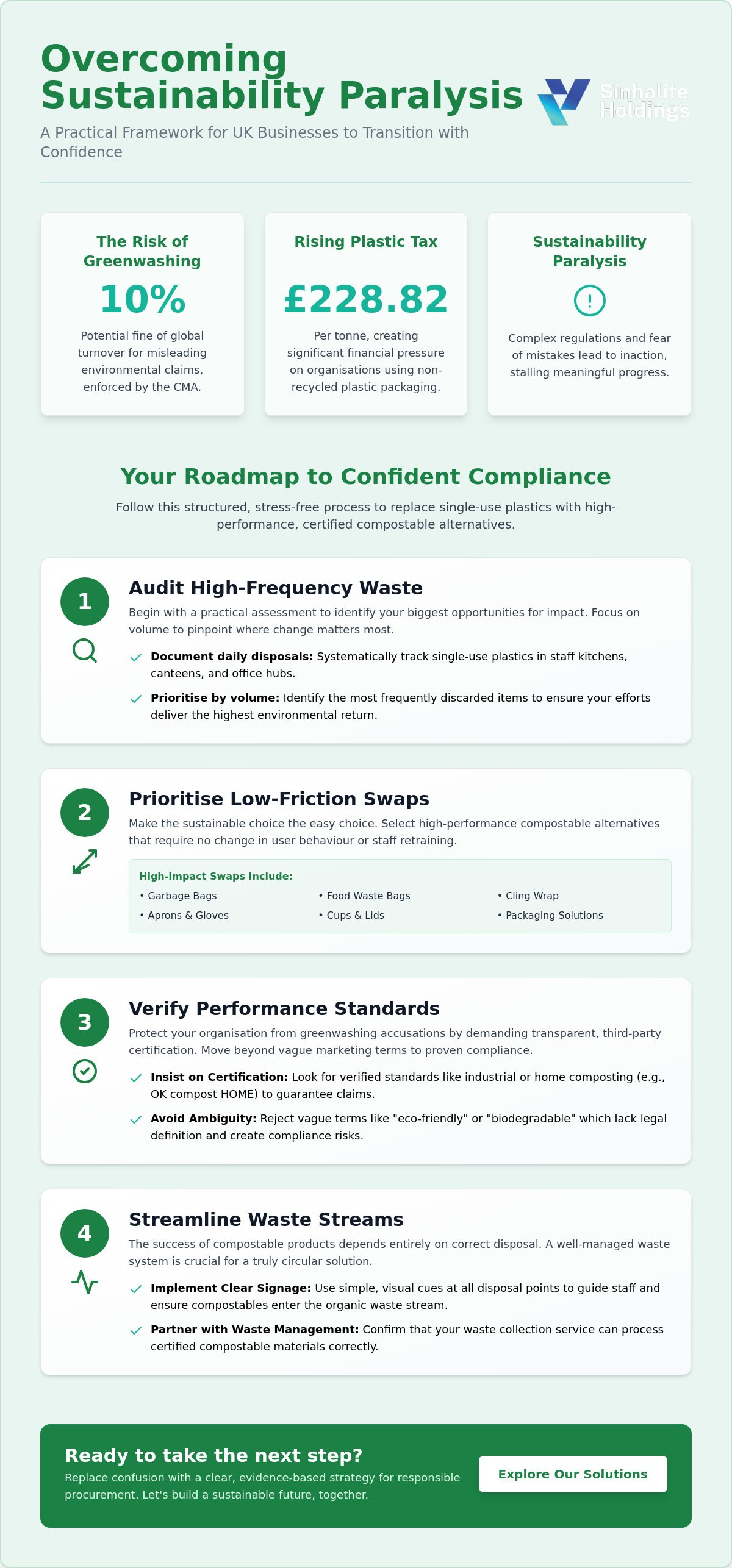
With the Competition and Markets Authority now empowered to levy fines of up to 10% of global turnover for greenwashing, the risk of choosing the wrong eco-alternative has never been higher for UK businesses. As the Plastic Packaging Tax rate rises to £228.82 per tonne this April, many organisations find themselves caught between rising costs and the logistical complexity of waste management. We believe that making sustainable choices feel less overwhelming shouldn't require sacrificing operational efficiency or commercial viability. It's about replacing confusion with a clear, evidence-based strategy for responsible procurement.
You probably feel the weight of these new 2026 regulations and the urgent need for transparency in your supply chain. This article offers a structured, stress-free framework to help your organisation transition toward sustainable practices with confidence. We will provide a clear roadmap of high-impact swaps, focusing on high-performance compostable alternatives like caddy bags and food roller bags that protect both your reputation and the planet.
Key Takeaways
- Understand how to bypass "sustainability paralysis" by addressing the cognitive load and perfectionism that often stall organisational progress.
- Learn how to conduct a high-frequency waste audit to identify the specific areas where single-use plastics can be most effectively phased out.
- Discover the power of low-friction swaps, focusing on high-performance compostable alternatives like caddy bags and food roller bags, which assist in making sustainable choices feel less overwhelming.
- Establish a methodical roadmap for integrating sustainable packaging into your core business strategy, ensuring long-term compliance and enhanced brand integrity.
Understanding Sustainability Paralysis: Why Eco-Choices Feel Heavy
Many UK procurement managers and directors experience a distinct sense of dread when reviewing their supply chains. This cognitive load, often described as analysis paralysis, occurs when the sheer volume of data, conflicting eco-claims, and regulatory deadlines makes decisive action feel impossible. When every choice feels like a potential reputation risk, it's natural for organisations to stall. This "sustainability paralysis" isn't a lack of commitment; it's a rational response to a complex environment where the cost of a mistake is high.
The "perfection trap" further complicates this issue. Many businesses believe they must overhaul every department simultaneously to be considered truly responsible. This all-or-nothing mindset often prevents meaningful incremental changes that could provide immediate benefits. By prioritising making sustainable choices feel less overwhelming, your organisation can shift from a state of frozen indecision to one of proactive, solution-oriented progress.
To better understand how to move forward when the path seems unclear, watch this helpful video:
The 2026 landscape is defined by a shift from voluntary reporting to mandatory compliance. With the Plastic Packaging Tax now at £228.82 per tonne and the Competition and Markets Authority intensifying its focus on environmental claims, the pressure is tangible. However, sustainability is best viewed as a series of manageable operational swaps rather than an overnight revolution. Transitioning high-frequency items, such as switching to compostable garbage bags or food waste bags, provides a clear win without disrupting core business functions.
The Burden of Greenwashing in UK Procurement
Mistrust in the commercial sector often stems from the use of vague terms like "eco-friendly" or "biodegradable" which lack legal definitions. These labels create uncertainty for buyers who fear being accused of greenwashing. To remove the guesswork from your purchasing decisions, it's essential to rely on verified, third-party standards. Understanding the nuances between different labels is key; for instance, you can find a detailed breakdown in our OK compost HOME certification explained guide. By focusing on certified compostable products, you ensure that your waste management strategy is built on a foundation of transparency and integrity.
The Essential Checklist for Making Sustainable Choices Feel Less Overwhelming
Transitioning an organisation toward a circular economy requires a methodical approach that prioritises clarity over complexity. By breaking down high-level environmental goals into actionable steps, your leadership team can begin making sustainable choices feel less overwhelming while maintaining operational momentum. This checklist serves as a practical framework for identifying where plastic can be replaced with high-performance, compostable alternatives without disrupting daily workflows.
- Step 1: Audit high-frequency waste. Start by documenting the single-use plastics discarded daily in staff kitchens, canteens, and office hubs. Focus on volume rather than variety to identify the items with the highest environmental footprint.
- Step 2: Prioritise low-friction swaps. Select replacements that function exactly like their plastic predecessors. This ensures that staff don't need to change their habits or undergo extensive retraining.
- Step 3: Verify performance standards. Confirm that all new procurement items meet specific certifications, such as industrial or home composting requirements, to avoid the greenwashing risks discussed earlier.
- Step 4: Streamline waste streams. Success depends on disposal. Implement clear, visual signage to ensure that compostable caddy bags and bin liners end up in the correct organic waste stream.
Aligning these steps with the UK Government's Sustainability Reporting Guidance ensures that your operational changes are also building toward long-term compliance. Following a structured path is the most effective way of making sustainable choices feel less overwhelming for your procurement team. You may find it helpful to explore our range of compostable solutions to see how these certified products fit into a professional procurement strategy.
Prioritising High-Impact Packaging Swaps
In many commercial kitchens and food preparation areas, plastic film is a significant contributor to waste. Switching to compostable clingfilm represents a "drop-in" replacement that maintains the necessary cling and barrier properties without the environmental cost. For technical details on thickness and temperature resilience, refer to the ultimate guide to compostable clingfilm. Additionally, using compostable food roller bags in delis and canteens can significantly reduce the volume of non-recyclable film entering your waste stream.
Simplifying Waste Management with Caddy Bags
A common barrier to food waste collection is the "mess factor" associated with leaks and tears. Utilising puncture resistant compostable garbage bags ensures that waste management remains hygienic and efficient for your facilities team. To ensure consistency, provide a simple checklist for staff: "If it's compostable, it goes in the green liner." This clarity reduces contamination and reinforces the organisation’s commitment to responsible waste disposal.
Scaling Your Impact: Integrating Sustainability into Organisational Strategy
Scaling your environmental impact requires moving from isolated product replacements to a unified strategy for sustainable packaging. This transition is essential for ensuring that your environmental commitments are deeply embedded within your operational DNA. When sustainability is viewed as a core business driver, it strengthens the business case for sustainability, proving that ethical choices are also economically sound. By aligning your procurement with long-term ecological goals, you create a resilient framework that withstands regulatory shifts.
Communicating these shifts to stakeholders should focus on transparency and shared responsibility rather than moral superiority. By explaining how compostable products contribute to a circular economy, you educate your audience on the tangible benefits of returning nutrients to the soil instead of sending plastic to landfill. Sinhalite Holdings acts as a steady, dependable ally in this journey, providing the certified tools necessary to meet your 2026 environmental goals with confidence. Our focus on performance ensures that your transition is both responsible and practical.
Measuring Success Beyond the Bin
Tracking the reduction of traditional plastic volume is a powerful metric for annual ESG reports. Organisations that implement certified compostable solutions in customer-facing roles, such as using compostable shopping bags, often see a marked improvement in brand loyalty. These visible choices serve as a silent testament to your commitment to environmental stewardship, making sustainable choices feel less overwhelming for your customers and staff alike. Data-driven reporting on waste diversion provides the evidence needed to satisfy both investors and the public.
The Future of Sustainable UK Operations
The 2026 market is increasingly defined by the adoption of advanced plant-based materials like Mater-Bi. These innovations offer the durability required for industrial use while ensuring complete compostability. To begin this transformation, we recommend taking immediate action in one specific category, perhaps food storage or waste disposal. Starting with a single high-impact area, such as switching to compostable garbage bags, allows you to refine your processes before scaling across the entire organisation. This methodical expansion is the most reliable way of making sustainable choices feel less overwhelming while securing a cleaner, greener future for your business.
Securing a Resilient Future Through Practical Stewardship
Transitioning your organisation toward a circular economy does not require an overnight overhaul of your entire supply chain. By identifying high-frequency waste and implementing low-friction swaps, you can achieve immediate environmental wins while maintaining operational excellence. Focusing on these manageable, evidence-based steps is the most effective method for making sustainable choices feel less overwhelming for your procurement team. These incremental changes build the foundation for a robust strategy that meets both current regulatory demands and future consumer expectations.
Sinhalite Holdings is dedicated to supporting UK organisations with high-performance, certified alternatives that do not compromise on durability. As specialists in compostable clingfilm and caddy bags, we provide UK-wide distribution for commercial entities seeking reliable, scalable solutions. Our products carry OK compost HOME and TUV Austria certifications, ensuring your waste management practices are transparent and audit-ready. We invite you to explore our range of professional compostable solutions and take a decisive step toward a plastic-free operation. Together, we can build a more responsible and sustainable future for your organisation.
Frequently Asked Questions
What is the simplest first step for a business to become more sustainable?
The simplest first step is conducting a targeted audit of high-frequency, single-use items within your daily operations. Identifying the volume of plastic garbage bags or food roller bags used in your facilities allows you to target high-impact swaps immediately. This focused approach is a key part of making sustainable choices feel less overwhelming for your staff. By starting with one specific category, you create a manageable success story that builds momentum for broader organisational change.
Are compostable products as strong as traditional plastic ones?
Modern compostable alternatives are engineered to match the performance standards of traditional plastics in terms of strength and durability. High-quality products, such as puncture-resistant garbage bags and heavy-duty caddy bags, are specifically designed for demanding commercial environments. These plant-based solutions maintain their integrity under load and provide the same barrier properties required for food hygiene. You can transition to these responsible materials without sacrificing the utility or reliability your operations depend on daily.
How do I know if a sustainable product is actually eco-friendly or just greenwashing?
You can verify a product's environmental claims by looking for reputable, third-party certifications such as OK compost HOME or TUV Austria. These labels guarantee that the item has undergone rigorous testing to ensure it breaks down safely in specific composting conditions. Avoid products that use vague terms like "biodegradable" without a corresponding certification number. Relying on verified standards is the most reliable way of making sustainable choices feel less overwhelming while protecting your organisation from potential greenwashing penalties.
Will switching to compostable packaging significantly increase my operational costs?
While the initial unit cost of compostable items may vary compared to traditional plastic, the total operational cost is increasingly offset by regulatory savings. With the Plastic Packaging Tax rate reaching £228.82 per tonne in April 2026, switching to certified compostables helps avoid these specific financial penalties. The long-term value of an enhanced corporate reputation and alignment with the circular economy provides a distinct competitive advantage. This strategic shift transforms a procurement expense into a long-term investment in organisational resilience.


