

As of April 2026, the UK Plastic Packaging Tax has climbed to £228.82 per tonne, making traditional single-use plastics a liability that directly erodes your bottom line. For many commercial entities, the financial pressure of eco-modulated EPR fees and the threat of CMA fines have turned sustainability from a marketing "extra" into a core operational necessity. You've likely felt the tension between escalating waste disposal costs and the skepticism of stakeholders who demand a clear path to profitability. We understand that transitioning your supply chain isn't just about ethics; it's about making a sound commercial decision that protects your margins. Successfully presenting a business case for sustainable packaging requires more than just environmental passion; it demands a rigorous, data-driven strategy that aligns with 2026 regulatory standards.
This guide provides you with the tangible tools needed to secure board-level buy-in for high-quality compostable alternatives. You'll learn how to calculate a realistic ROI while navigating the complexities of the Digital Markets, Competition and Consumers Act. We'll explore how switching to compostable caddy bags, food roller bags, and shopping bags can actually improve your ESG scores and brand reputation. By the end of this article, you'll have a clear framework to move your organisation toward a circular economy, ensuring you remain compliant and competitive in a rapidly evolving market.
Key Takeaways
- Understand how the 2026 UK Plastic Packaging Tax and eco-modulated fees transform traditional plastics into significant financial liabilities for your organisation.
- Discover a data-driven framework for presenting a business case for sustainable packaging that aligns environmental stewardship with measurable ROI and stakeholder expectations.
- Evaluate the durability and performance of compostable essentials, such as clingfilm and caddy bags, to ensure operational efficiency is maintained during the transition.
- Learn how to implement a successful closed-loop waste system through specialist partnerships and effective staff training on correct disposal methods.
The Strategic Rationale: Why Plastic is a Business Liability in 2026
Successfully presenting a business case for sustainable packaging requires viewing environmental stewardship through the lens of financial resilience. It's no longer just a moral choice; it's a strategic alignment where ecological goals directly bolster your balance sheet. In the current market, traditional plastic has shifted from a cheap commodity to a significant fiscal risk. By treating sustainability as a performance metric, you can transform your supply chain into a hedge against rising operational costs.
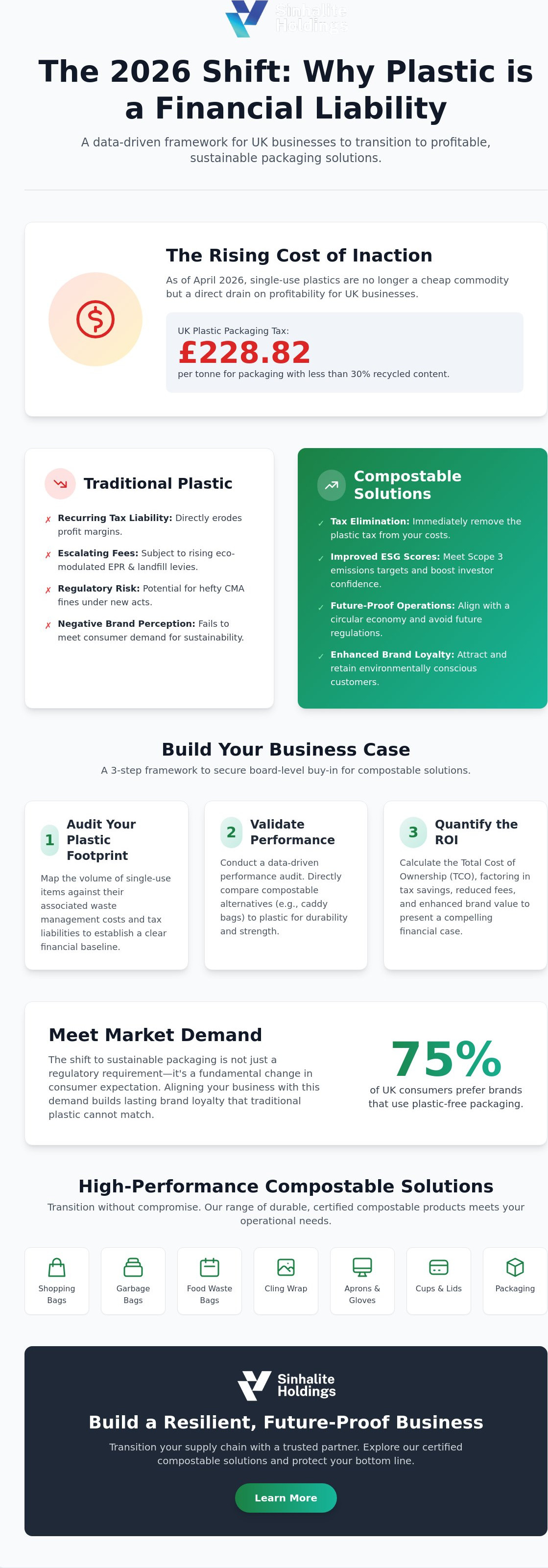
As of April 2026, the UK Plastic Packaging Tax stands at £228.82 per tonne for packaging with less than 30% recycled content. This isn't just a tax; it's a recurring drain on profitability that compounds with every shipment. By switching business to sustainable packaging, you effectively eliminate this liability. This proactive move shields your organisation from the volatility of plastic-related regulations and the escalating costs of traditional waste disposal.
To better understand this concept, watch this helpful video:
While some stakeholders fear a "green premium" on compostable materials, the real danger is the "liability cost" of inaction. Waiting to transition means absorbing higher landfill levies and the risk of CMA fines under the Digital Markets, Competition and Consumers Act. Integrating sustainable packaging principles early allows your organisation to build a supply chain that is resilient and future-proof.
Navigating UK Regulatory Compliance and ESG Mandates
Compostable solutions are vital for hitting ambitious Scope 3 emissions reduction targets. Adopting OK compost HOME certification explained provides the transparency required for rigorous ESG reporting. It's important to recognise that non-compliance with environmental benchmarks can lead to downgraded corporate credit ratings, directly increasing your organisation's cost of capital.
Meeting the Demands of the Conscious UK Consumer
Market data suggests that approximately 75% of UK consumers prefer brands that utilise plastic-free packaging. This preference isn't a passing trend; it's a fundamental shift in market demand. Moving toward a circular economy model by using compostable garbage bags and food roller bags builds lasting brand loyalty that traditional plastic simply cannot match.
How to Build the Business Case: A Step-by-Step Framework
Building a persuasive argument for internal stakeholders requires a shift from qualitative benefits to quantitative data. When presenting a business case for sustainable packaging, your first priority is a comprehensive audit of your current "Plastic Footprint." This involves mapping the volume of single-use items, such as garbage bags and shopping bags, against their associated waste management costs. By identifying these hidden expenses and the tax liabilities mentioned earlier, you can establish a clear baseline for financial improvement.
A successful transition relies on a performance audit to ensure utility isn't sacrificed. Compare compostable alternatives directly against plastic equivalents for durability and strength. If a compostable caddy bag handles the same load as a traditional liner without tearing, the operational risk vanishes. This data-driven approach is a cornerstone of a strong business case for sustainable packaging, as it addresses stakeholder skepticism regarding product reliability.
Quantifying the ROI of Sustainable Packaging
Calculating the Total Cost of Ownership (TCO) is essential for board-level buy-in. While the initial cost-per-unit might differ, the cost-per-disposal often tells a more compelling story. For instance, using commercial compostable cling film UK can significantly reduce food waste contamination costs by allowing organic waste to be processed more efficiently. To track success, focus on Key Performance Indicators (KPIs) such as your waste diversion rate and the total reduction in Plastic Packaging Tax liabilities.
Selecting High-Impact, Low-Friction Swaps
Start with "low-hanging fruit" to demonstrate immediate value. High-volume items like food roller bags for delis or compostable caddy bags for staff kitchens provide a high-visibility proof of concept. These swaps allow you to gather internal data through a pilot program before a full-scale roll-out. If you're ready to begin your audit, exploring our compostable product range can help you identify the best starting points for your organisation.
Implementing Compostable Solutions: From Strategy to Operational Reality
Moving from a conceptual strategy to operational reality requires a fundamental shift in your procurement philosophy. It's essential to transition from generalist plastic suppliers toward specialists who understand the unique properties of compostable materials. This shift isn't merely about swapping one SKU for another; it's about building a partnership that supports a robust, closed-loop waste system. Training your staff on correct disposal is a critical component of this transition. When employees understand exactly how a compostable caddy bag or food roller bag should enter the organic waste stream, the integrity of your circular economy model is preserved.
Clear communication with stakeholders is the final piece of the implementation puzzle. When presenting a business case for sustainable packaging, you must ensure your marketing claims are evidence-based to avoid the legal and reputational risks of greenwashing. Transparency regarding certifications and material composition builds the trust necessary for making a strong business case for sustainable packaging that resonates with both investors and consumers. Authentic storytelling about your transition journey can turn a regulatory necessity into a powerful brand narrative.
Operational Integration: Swapping Plastic for Performance
Many procurement managers worry that plant-based materials won't hold up in high-pressure environments. However, materials like Mater-Bi have proven their technical reliability in professional settings, offering the strength required for industrial use. Modern compostable garbage bags often exhibit superior puncture resistance compared to thin, recycled plastic alternatives. For a deeper dive into these technical specifications, refer to our 2026 guide to puncture resistant compostable garbage bags. This reliability is equally vital in hygiene-sensitive sectors like healthcare and hospitality, where switching to compostable consumables like aprons and gloves can significantly reduce a facility's environmental footprint without compromising safety.
Positioning Sustainability as a Competitive Advantage
Transitioning to a plastic-free supply chain is a powerful brand differentiator that opens new commercial doors. In 2026, an increasing number of public sector tenders and council contracts explicitly reward organisations that demonstrate a commitment to responsible waste management. By integrating compostable shopping bags and roller bags into your daily operations, you position your organisation as a leader in industrial pragmatism. This visionary approach ensures you remain the preferred partner for clients who value systemic change and long-term impact.
Securing a Resilient Future Through Circular Innovation
Transitioning to a circular economy is no longer a peripheral goal; it's a fundamental requirement for commercial longevity. By identifying your plastic footprint and implementing high-performance swaps like compostable garbage bags and caddy bags, you shield your organisation from escalating regulatory costs. Presenting a business case for sustainable packaging allows you to turn these external pressures into a clear competitive advantage while enhancing your brand’s reputation. It's about moving from a model of waste to a model of renewal without sacrificing the utility your daily operations demand.
As a UK-based specialist in compostable solutions, Sinhalite Holdings is dedicated to helping you navigate this transition with confidence. Our products carry full OK compost HOME and TUV Austria certifications, providing the transparency required for modern ESG reporting. We've become a trusted partner for UK councils and large commercial entities because we prioritise both environmental integrity and industrial strength. Download our 2026 Corporate Guide to Compostable Implementation to start building a more responsible, profitable future today. Together, we can create a cleaner, greener outlook for your business and the planet.
Frequently Asked Questions
How does sustainable packaging affect the bottom line for UK SMEs?
Sustainable packaging protects your bottom line by eliminating financial liabilities associated with the UK Plastic Packaging Tax. For SMEs that manufacture or import over 10 tonnes of packaging, switching to compostable alternatives removes the £228.82 per tonne levy effective from April 2026. This proactive shift also reduces the risk of significant fines under the Digital Markets, Competition and Consumers Act by ensuring your environmental claims are fully substantiated.
Is compostable packaging really more expensive than traditional plastic in 2026?
When presenting a business case for sustainable packaging, it's essential to evaluate the Total Cost of Ownership rather than just the unit price. While traditional plastics might seem cheaper initially, they now incur eco-modulated EPR fees. Packaging rated as "Red" under the Recyclability Assessment Methodology currently carries a fee 1.2 times the base rate, making high-quality compostable garbage bags and shopping bags a financially competitive choice.
How can I verify the sustainability claims of a packaging supplier?
You can verify a supplier's integrity by requesting evidence of independent, third-party certifications such as OK compost HOME or TUV Austria. These certifications provide the technical proof that items like compostable cling film or caddy bags meet rigorous biodegradation standards. Authentic suppliers will provide clear documentation that aligns with the CMA’s Green Claims Code, ensuring your organisation isn't exposed to the reputational risks of greenwashing.
What happens if our local council does not collect commercial compostable waste?
If your local council lacks dedicated collection, opting for "home-compostable" certified products allows for greater disposal flexibility. Items like certified food roller bags and caddy bags are designed to break down in lower-temperature environments, making them suitable for on-site composting or specialist organic waste streams. This ensures you're still presenting a business case for sustainable packaging that functions effectively even within infrastructure constraints.


