

Is your current packaging strategy a strategic asset or an escalating financial liability? With the UK Plastic Packaging Tax now at £228.82 per tonne, the cost of sticking with traditional plastics is no longer just an environmental concern; it's a direct hit to your bottom line. You're likely facing the challenge of presenting a business case for sustainable packaging that balances these rising regulatory costs with the need for high-performance utility. It's a complex shift, but one that offers a profound opportunity to align your operations with the future of the circular economy.
We understand that stakeholder skepticism regarding ROI often stalls necessary innovation. This guide provides the tangible tools you need to bridge that gap, offering a clear framework for ROI calculation and compliance with 2026 UK environmental standards. You'll learn how to transition to compostable solutions, such as high-strength caddy bags and food roller bags, that meet both industrial standards and brand expectations. By the end of this article, you'll have a roadmap to enhance your ESG scores while securing a more resilient, profitable future for your organisation.
Key Takeaways
- Understand why traditional plastic has become a strategic financial liability due to escalating UK Plastic Packaging Tax rates and eco-modulated EPR fees.
- Master a structured framework for presenting a business case for sustainable packaging that effectively aligns fiscal performance with environmental responsibility.
- Learn how to conduct a performance audit to verify that compostable alternatives, such as high-strength garbage bags and clingfilm, meet your industrial durability requirements.
- Discover practical methods for transitioning to specialist suppliers and training your team to maintain a successful, closed-loop waste management system.
- Identify the specific pathways to enhancing your brand's ESG scores while securing a resilient, long-term ROI through 2026-compliant solutions.
The Strategic Rationale: Why Plastic is a Business Liability in 2026
In the current commercial environment, a business case is no longer a simple cost-benefit analysis of materials. It's a strategic alignment where environmental stewardship directly supports financial performance. By 2026, the definition of Sustainable packaging has evolved from a corporate social responsibility "extra" into a fundamental hedge against systemic risk. Successfully presenting a business case for sustainable packaging requires a shift in perspective, viewing responsible materials as a safeguard for your future balance sheet.
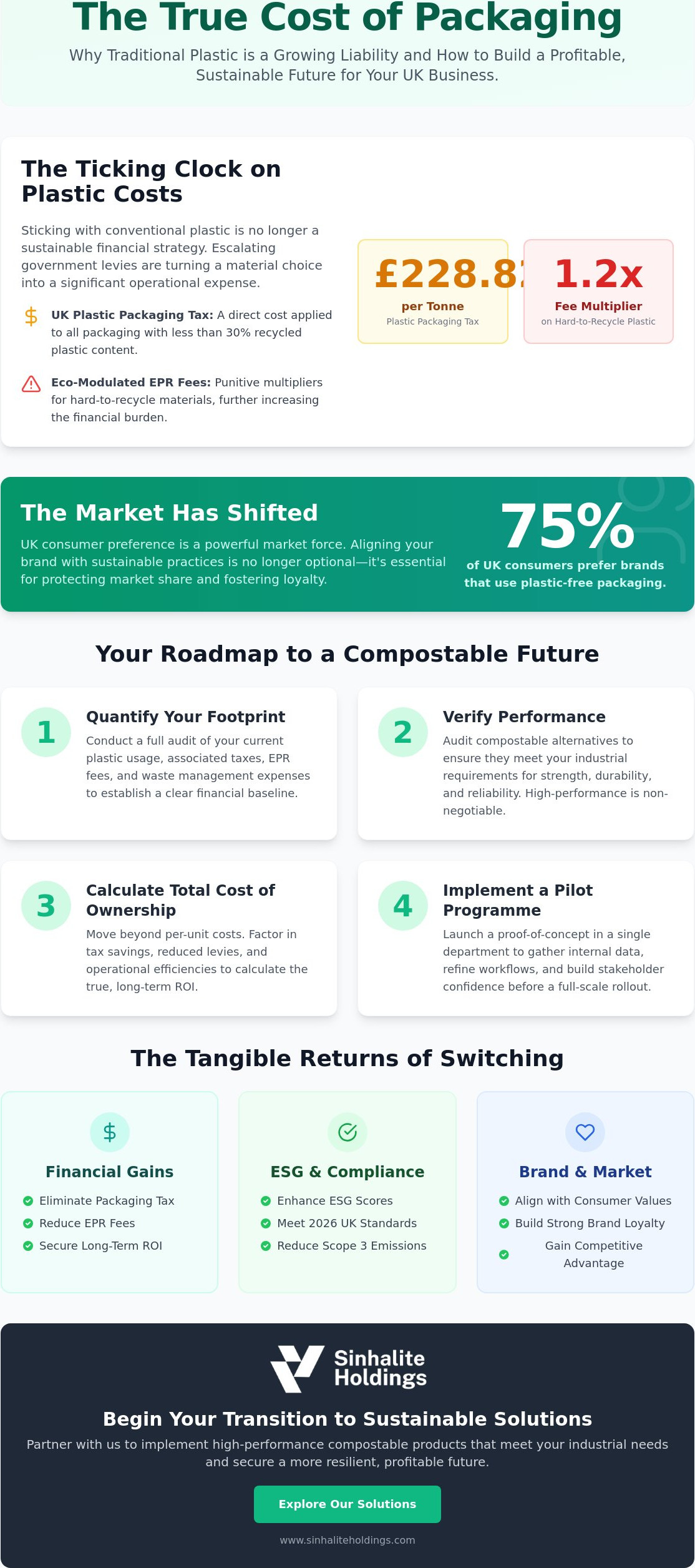
The financial burden of traditional plastic is accelerating at an unprecedented rate. As of April 1, 2026, the UK Plastic Packaging Tax stands at £228.82 per tonne for packaging with less than 30% recycled content. When you factor in the new eco-modulated Extended Producer Responsibility (EPR) fees, which apply a 1.2x multiplier to "Red-rated" hard-to-recycle materials, the perceived "Green Premium" of compostable alternatives effectively vanishes. Proactively switching business to sustainable packaging isn't just an ethical choice; it's a move to eliminate these growing liabilities before they erode your margins.
To better understand the financial advantages of this transition, watch this helpful video:
Navigating UK Regulatory Compliance and ESG Mandates
Adopting compostable solutions allows organisations to make measurable progress toward Scope 3 emissions reduction targets by removing fossil-fuel-based polymers from the supply chain. Utilising products with OK compost HOME certification explained ensures your ESG reporting is transparent and verifiable. This level of compliance is critical. Failing to meet environmental benchmarks can now negatively impact corporate credit ratings as lenders increasingly weigh climate risk into their assessments.
Meeting the Demands of the Conscious UK Consumer
The market has shifted decisively. Industry data indicates that approximately 75% of UK consumers now prefer brands that utilise plastic-free packaging. This preference isn't merely a trend but a fundamental change in purchasing behaviour. By integrating compostable garbage bags or food roller bags into your operations, you demonstrate a commitment to the circular economy. This alignment fosters deep brand loyalty and protects your market share against more agile competitors.
How to Build the Business Case: A Step-by-Step Framework
Constructing a robust argument requires moving beyond qualitative benefits toward a rigorous, data-led methodology. When presenting a business case for sustainable packaging, you must first quantify your organisation's current plastic footprint and the associated waste management expenses. This baseline allows you to see the true weight of plastic on your operations. Following this, conduct a performance audit to ensure that compostable alternatives, such as high-density garbage bags, match the durability of their plastic predecessors. Reliability is paramount in industrial settings; therefore, testing for strength and puncture resistance is a vital first step.
Next, calculate the Total Cost of Ownership (TCO). This calculation must account for the £228.82 per tonne tax savings and reduced landfill levies. Before a full-scale roll-out, implement a pilot program in a single department. This proof-of-concept provides the internal data necessary to satisfy skeptical stakeholders and refine operational workflows. For more in-depth guidance on the nuances of this process, building the business case through expert frameworks can provide the necessary rigour for board-level approval.
Quantifying the ROI of Sustainable Packaging
A common pitfall is focusing solely on the cost-per-unit. Instead, evaluate the cost-per-disposal. For instance, using commercial compostable cling film UK solutions significantly reduces food waste contamination costs. When plastic film enters organic waste streams, the entire batch is often rejected, leading to high disposal fees. By switching to compostable film, you enable a seamless, lower-cost organic waste collection. Track your success using KPIs like the waste diversion rate and the reduction in Plastic Packaging Tax liability.
Selecting High-Impact, Low-Friction Swaps
Focus on "low-hanging fruit" to demonstrate immediate value. Compostable caddy bags for staff kitchens and food roller bags for delis represent high-volume items where the financial impact of environmental taxes is most concentrated. These swaps require minimal staff training but yield significant reductions in your plastic footprint. You can explore our full range of compostable business solutions to identify the most effective starting point for your organisation.
Implementing Compostable Solutions: From Strategy to Operational Reality
Moving from a boardroom-approved strategy to a functional, plastic-free workplace requires a methodical approach to procurement. When presenting a business case for sustainable packaging, it's essential to partner with specialists who understand the nuances of the circular economy. Transitioning away from traditional generalist suppliers ensures you receive high-quality materials designed for specific waste streams. This shift is particularly vital for organisations managing large-scale food waste, where the integrity of your compostable caddy bags and food roller bags directly impacts the success of your recycling efforts.
Operational success hinges on staff engagement. Clear training on correct disposal methods is necessary to prevent contamination and maintain a closed-loop system. In hygiene-sensitive sectors like hospitality or healthcare, integrating compostable essentials such as aprons and gloves alongside waste management tools creates a consistent, responsible infrastructure. Once your systems are in place, you can confidently market these green credentials. Transparent communication about your transition avoids the pitfalls of greenwashing and reinforces your brand's commitment to genuine environmental stewardship.
Operational Integration: Swapping Plastic for Performance
Performance concerns are often the biggest hurdle to internal adoption. Modern plant-based materials, including Mater-Bi, offer the technical reliability required for high-use commercial settings. For example, high-quality compostable garbage bags now provide puncture resistance that rivals or exceeds that of traditional recycled plastic. You can find detailed technical specifications in our 2026 guide to puncture resistant compostable garbage bags. These innovations ensure that your switch to sustainable materials doesn't compromise the safety or efficiency of your daily operations.
Positioning Sustainability as a Competitive Advantage
A plastic-free supply chain is a powerful differentiator during procurement processes. Many councils and public sector bodies now prioritise environmental performance when awarding tenders. By demonstrating a fully integrated use of compostable solutions, from shopping bags to industrial waste liners, your organisation stands out as a responsible innovator. This long-term vision not only satisfies current 2026 UK standards but also positions your brand as a steady, dependable ally in the global movement toward a cleaner future.
Securing a Resilient Future Through Circular Innovation
The transition to compostable materials is no longer a choice of preference but a necessity for long-term financial resilience. By addressing the escalating costs of the Plastic Packaging Tax and leveraging the industrial performance of Mater-Bi materials, your organisation can turn a regulatory burden into a distinct competitive advantage. You've seen that presenting a business case for sustainable packaging involves a rigorous comparison of total ownership costs against the growing liabilities of traditional plastic waste. This strategic shift protects your margins while aligning your operations with the essential requirements of the circular economy.
Success in this transition requires a steady and dependable partner. As a UK-based specialist in compostable solutions, Sinhalite Holdings provides fully certified OK compost HOME and TUV Austria products designed for the rigorous demands of modern industry. We're a trusted partner for UK councils and commercial entities, providing the high-quality garbage bags, caddy liners, and cling films needed for systemic change. Download our 2026 Corporate Guide to Compostable Implementation to begin your journey toward a cleaner, more profitable future. Together, we can build a legacy of responsibility and innovation.
Frequently Asked Questions
How does sustainable packaging affect the bottom line for UK SMEs?
Sustainable packaging directly improves the bottom line by eliminating exposure to the UK Plastic Packaging Tax, which applies to businesses manufacturing or importing 10 or more tonnes of plastic annually. When presenting a business case for sustainable packaging, SMEs can demonstrate how switching to compostable shopping bags and garbage bags reduces long-term tax liabilities. These choices often lead to lower waste disposal fees as organic waste streams become more accessible and less contaminated.
Is compostable packaging really more expensive than traditional plastic in 2026?
When viewed through the lens of Total Cost of Ownership, compostable packaging is often more cost-effective than traditional plastic. While the unit price for items like compostable clingfilm may be higher, the cumulative savings from avoiding the £228.82 per tonne plastic tax and eco-modulated EPR fees provide a significant financial advantage. Transitioning early allows your organisation to hedge against future regulatory price hikes while securing a more resilient supply chain.
How can I verify the sustainability claims of a packaging supplier?
You should verify sustainability claims by requesting evidence of recognised third-party certifications, such as OK compost HOME or TUV Austria. Under the 2026 EU Empowering Consumers Directive and the UK's Green Claims Code, vague terms like "eco-friendly" are legally risky. Reliable suppliers will provide transparent data on material composition and breakdown timelines, ensuring your ESG reporting remains accurate and beyond reproach.
What happens if our local council does not collect commercial compostable waste?
If your local authority lacks commercial compostable collection, you should prioritise OK compost HOME certified products that break down in lower-temperature environments. The "Simpler Recycling" legislation in England now requires businesses with 10 or more employees to separate food waste from general waste. This mandate encourages the use of compostable caddy bags, which facilitate cleaner organic waste streams that private contractors can often process more efficiently than mixed waste.


