

Did you know that as of July 2026, the typical household energy price cap has risen to £1,862 per year, making the transition to efficiency a matter of both environmental and fiscal necessity? While UK greenhouse gas emissions are now 50% below 1990 levels, the challenge of reducing your household carbon footprint remains a significant hurdle for many who feel overwhelmed by "greenwashed" products. It's understandable to feel frustrated when trying to distinguish between genuine innovation and mere marketing, especially as new regulations like the Simpler Recycling legislation change how we manage waste at a local level.
We believe that taking ownership of environmental impact should be a transparent and rewarding process for both individuals and the organisations that support them. This 2026 guide promises to demystify the complexities of home emissions by providing a science-backed roadmap for auditing energy use and managing waste effectively. We will explore a prioritised list of high-impact actions, from leveraging the latest government grants to selecting truly compostable alternatives like caddy bags and food packaging that support a circular economy. By the end of this article, you'll have the confidence to choose solutions that move the needle and align with a sustainable future.
Key Takeaways
- Understand the critical role residential energy and waste play in the UK’s 2026 climate neutrality targets.
- Learn how to identify heat loss and appliance inefficiencies through a structured home energy audit.
- Discover science-backed methods for reducing your household carbon footprint by integrating renewable energy and solar technology.
- Explore how to replace traditional single-use plastics with certified compostable alternatives like garbage bags and food roller bags.
- Gain a clear understanding of how shifting to a circular kitchen ecosystem significantly lowers the carbon impact of food waste.
Understanding Your Household Carbon Footprint: The UK Context in 2026
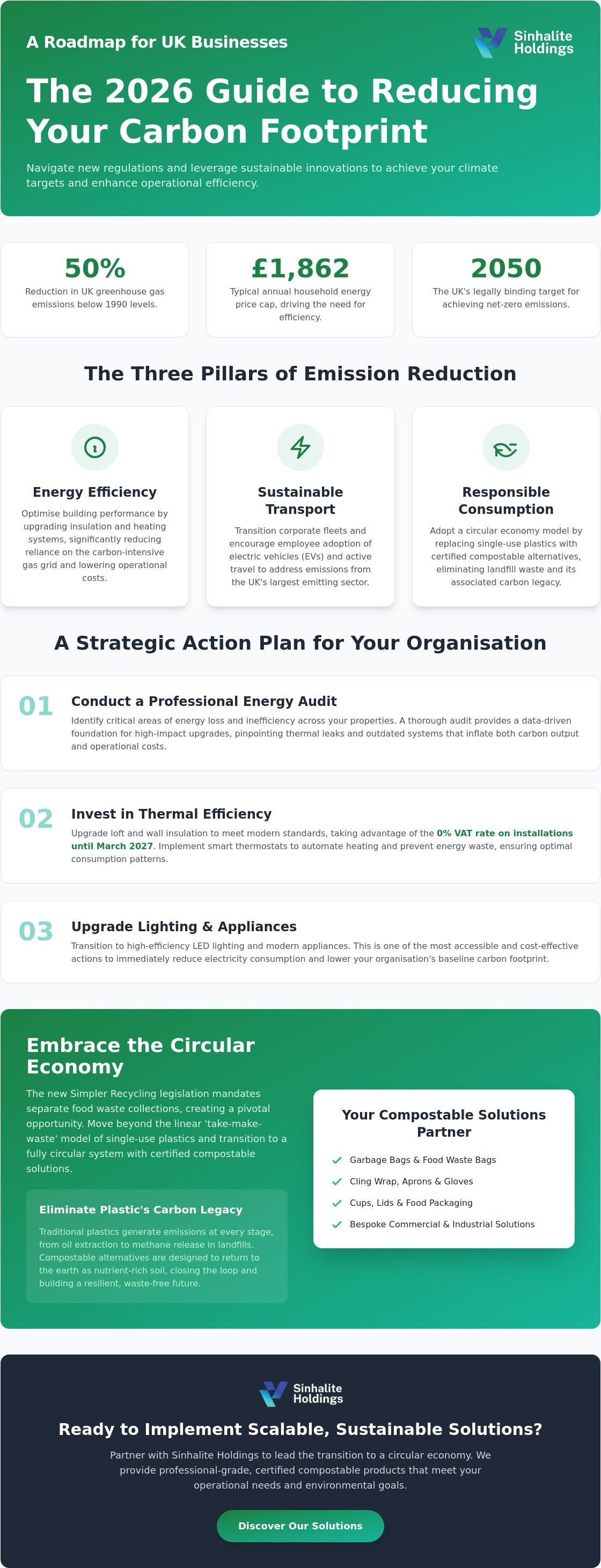
A household carbon footprint represents the cumulative greenhouse gas emissions generated by your energy consumption, transport habits, and waste management choices. In 2026, the challenge of reducing your household carbon footprint is now a vital component of the UK's legally binding commitment to reach net-zero by 2050. As national greenhouse gas emissions sit approximately 50% below 1990 levels, the focus has shifted intensely toward residential buildings, which remain one of the nation's largest emitting sectors. This year is particularly pivotal. The Simpler Recycling legislation is now in full effect, mandating separate food waste collections across England and fundamentally reshaping how we perceive domestic outputs.
We must also consider the "invisible" carbon cost of daily operations. Traditional single-use plastics generate emissions at every stage, from petroleum extraction to the methane produced when they languish in landfills. Transitioning to professional-grade compostable alternatives, such as compostable garbage bags or food roller bags, addresses this lifecycle impact directly. By choosing materials that return to the earth, we eliminate the persistent carbon legacy of synthetic polymers while supporting a cleaner, more resilient future.
Why Household Action Drives Systemic Change
Individual decisions serve as powerful market signals that accelerate industrial innovation. When organisations and households prioritise sustainable procurement, they provide the financial justification for greener supply chains. Research into individual action on climate change demonstrates that domestic energy efficiency also supports national grid stability. By reducing peak demand through smarter consumption, we lower the need for carbon-intensive backup power plants, facilitating a smoother transition to a fully renewable energy infrastructure.
The Three Pillars of Home Emission Reduction
Effective strategies for reducing your household carbon footprint generally focus on three core pillars:
- Energy Efficiency: Optimising heating systems and insulation to reduce reliance on the gas grid.
- Sustainable Transport: Transitioning to electric vehicles or active travel to cut emissions from the UK's largest emitting sector.
- Responsible Consumption: Moving toward a circular economy by replacing plastics with compostable caddy bags and packaging.
Success in these areas requires a shift from temporary fixes to professional, scalable solutions. Whether you're a business leader auditing a corporate housing portfolio or a homeowner seeking long-term impact, these pillars provide the framework for meaningful environmental stewardship.
A Step-by-Step Guide to Reducing Energy and Transport Emissions
Achieving a measurable impact on emissions requires a methodical approach to how we power our homes and move between them. With the energy price cap rising to £1,862 per year for direct debit customers in July 2026, the financial incentive for reducing your household carbon footprint is now an urgent priority. A professional-grade home energy audit is the essential first step. It identifies thermal leaks and inefficient systems that drive up both costs and carbon output. By addressing these gaps, you prepare your property for domestic solar integration, which drastically reduces reliance on carbon-intensive grid electricity.
Step 1: Thermal Efficiency and Insulation
Thermal efficiency is the foundation of a low-carbon home. You should verify that loft and wall insulation meets modern standards to prevent energy leakage; this is currently supported by a 0% VAT rate on professional installations until March 2027. Pairing these upgrades with smart thermostats allows you to manage domestic heat demand with precision, ensuring energy is only consumed when it provides direct utility. These systems learn your habits and adjust temperatures automatically, preventing the waste associated with heating empty rooms.
Transport remains the UK's largest emitting sector, making it a critical area for audit. The transition to electric mobility is accelerating, driven by the 2030 ban on new petrol and diesel vehicles. While new EV owners now face a standard VED rate of £200 from their second year as of April 2026, the lifecycle carbon savings remain significant. For shorter journeys, active travel provides a zero-emission alternative that supports both personal health and environmental goals.
Step 2: Lighting and Appliance Upgrades
Upgrading to LED lighting is often the most accessible way to lower electricity demand. When replacing larger systems, always select appliances with high performance ratings for long-term reliability. Adopting high-quality compostable solutions for other household needs ensures that your commitment to sustainability is reflected in the materials you use every day. Choosing durable, energy-rated appliances reduces the frequency of replacement, further lowering the embodied carbon of your household operations.
Minimising Waste: Transitioning to a Plastic-Free, Circular Kitchen
The kitchen is often the primary source of domestic waste, yet it offers the greatest opportunity for reducing your household carbon footprint. When organic matter is sent to landfills, it decomposes anaerobically and releases methane, a greenhouse gas significantly more potent than carbon dioxide. By contrast, a circular kitchen prioritises composting, which returns nutrients to the soil and sequesters carbon. Transitioning away from traditional single-use plastics is a critical part of this evolution. Petroleum-based products carry a heavy carbon debt from extraction to disposal, making their replacement a priority for any responsible organisation or household.
The Problem with Traditional Kitchen Plastics
Standard petroleum-based clingfilm and bin liners are problematic because they cannot be recycled and persist in the environment for centuries. Their production is energy-intensive, and their end-of-life phase often involves incineration or landfilling. To ensure your kitchen operations are genuinely sustainable, it's essential to understand the OK compost HOME certification explained in the context of UK standards. This certification guarantees that materials will break down safely in domestic composting environments without leaving toxic residues behind. It provides the transparency needed to avoid "greenwashed" alternatives that fail to deliver on their environmental promises.
Implementing a Circular Waste Strategy
A streamlined food waste system is the backbone of a low-carbon home. You can achieve this by using compostable caddy bags to collect scraps for the separate food waste collections now mandated by councils across England. For food preservation, switching to compostable household Clingfilm removes the need for persistent plastic wrap while maintaining high standards of food hygiene. For non-recyclable streams, heavy-duty compostable garbage bags provide a durable, professional-grade solution that aligns with a circular economy. Viewing every discarded item as a potential resource rather than "rubbish" is the final step in reducing your household carbon footprint. This visionary approach ensures that our daily habits support a cleaner, greener future for everyone.
Leading the Transition to a Circular Future
The path toward a net-zero society is built on the cumulative impact of intentional, science-backed choices. We've seen how auditing thermal efficiency and embracing electric mobility can drastically lower domestic emissions. However, the true shift occurs when we address the lifecycle impact of our consumption. By replacing traditional plastics with certified compostable materials, you close the loop on waste and ensure that your daily habits support rather than hinder the circular economy.
Reducing your household carbon footprint is an achievable goal when you have access to the right tools. Sinhalite Holdings is a UK-based supplier of sustainable household essentials and a visionary partner for those committed to plastic-free living. As specialists in certified OK compost HOME packaging, we provide the high-performance alternatives needed to replace single-use plastics without compromising on utility or strength. Our commitment to environmental stewardship ensures that every product facilitates a measurable reduction in carbon output.
Explore Sinhalite’s range of compostable solutions to start your low-carbon journey today. The transition to a more responsible future is well within reach, and it begins with the choices we make in our own homes.
Frequently Asked Questions
How much can the average UK household reduce its carbon footprint in one year?
A typical UK household can achieve substantial reductions by focusing on the primary emitting sectors: heating and transport. By transitioning from a gas boiler to a heat pump and moving to an electric vehicle, a family could potentially reduce their direct operational emissions by several tonnes of CO2e annually. These systemic shifts, combined with conscientious waste reduction, represent the most effective path toward reducing your household carbon footprint in a single calendar year.
What is the difference between "biodegradable" and "compostable" in terms of carbon impact?
The primary difference lies in transparency and end-of-life outcomes. While "biodegradable" is often a vague term for materials that break down over an indefinite period, "compostable" refers to products certified to disintegrate into nutrient-rich organic matter within a specific timeframe. From a carbon perspective, certified compostable items support a circular economy. This prevents the methane emissions associated with petroleum-based plastics that languish in anaerobic landfill conditions without returning any value to the soil.
Does switching to compostable clingfilm really make a difference to my footprint?
Yes, because it replaces a high-volume, single-use petroleum product with a circular alternative. Traditional clingfilm is manufactured from fossil fuels and cannot be recycled, meaning every roll contributes to long-term plastic pollution and lifecycle emissions. Switching to compostable household Clingfilm eliminates this persistent waste stream. When you pair this with compostable caddy bags for food scraps, you create a systemic change in your kitchen that reduces the overall embodied carbon of your consumption.
How can I reduce my carbon footprint if I live in a rented property with limited control over energy?
Renters can focus on high-impact consumption and lifestyle choices that don't require structural modifications. You can switch to a renewable energy supplier, install LED bulbs, and use heavy-duty compostable garbage bags to manage waste responsibly. Focusing on reducing your household carbon footprint through transport choices, such as active travel or using public infrastructure, also provides a significant impact. These actions prove that environmental stewardship is achievable regardless of property ownership or permanent infrastructure.


