

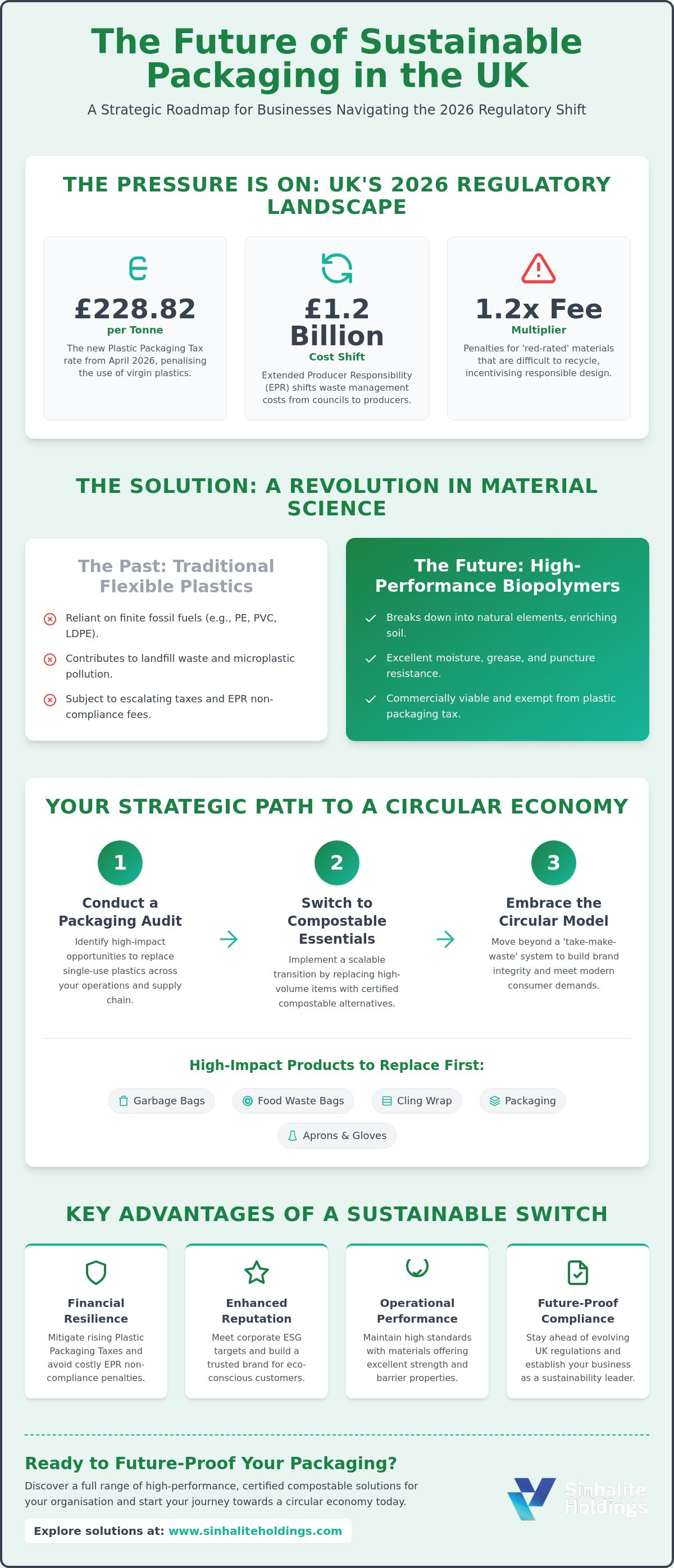
Did you know that the UK government estimates a £1.2 billion annual shift in waste management costs from local authorities to producers under the Extended Producer Responsibility (EPR) scheme? This systemic realignment serves as a primary driver for the future of sustainable packaging in the uk as we navigate the complexities of 2026. For many commercial leaders, the rise of the Plastic Packaging Tax to £228.82 per tonne creates a sense of urgency that's often met with uncertainty over how to adapt without sacrificing industrial performance.
It's understandable to feel the weight of these evolving regulations, especially when searching for reliable alternatives to flexible plastics that align with your corporate ESG targets. This article provides a clear roadmap for your packaging procurement, detailing the regulatory shifts, material innovations, and circular economy strategies currently shaping the British landscape. You'll gain a thorough understanding of how to future-proof your operations through a strategic transition to high-quality compostable solutions, ensuring your business remains both compliant and environmentally responsible.
Key Takeaways
- Learn how 2026 eco-modulated fees under Extended Producer Responsibility (EPR) impact procurement and help your organisation avoid unnecessary financial penalties.
- Discover technical advancements in biopolymers that offer high-performance moisture and grease resistance while replacing traditional polyethylene films.
- Identify practical steps for conducting a packaging audit to uncover high-impact opportunities for reducing plastic waste across your commercial operations.
- Understand the operational advantages of switching to compostable essentials such as garbage bags and caddy bags to support a scalable circular economy.
- Gain a strategic perspective on the future of sustainable packaging in the uk to ensure your business remains resilient against evolving plastic taxes and regulations.
The Regulatory Landscape and Market Evolution in 2026
The 2026 regulatory framework represents a decisive pivot in how British organisations manage their carbon footprint. With the Plastic Packaging Tax rising to £228.82 per tonne as of April 1, 2026, the financial incentive to move away from virgin plastic has never been more pronounced. This fiscal pressure forces procurement teams to look beyond traditional materials toward high-performance alternatives that mitigate tax liabilities while upholding operational standards. It's a clear signal that the era of low-cost, high-waste plastic is coming to an end.
Simultaneously, the implementation of Extended Producer Responsibility (EPR) eco-modulated fees introduces a new layer of accountability. Packaging deemed difficult to recycle now incurs a fee 1.2 times the base rate, effectively penalising "red-rated" materials. This shift is fundamental to the future of sustainable packaging in the uk, as it encourages a holistic view of a product's life cycle. By internalising the true cost of waste, the government is making responsible innovation the only path to commercial longevity.
To better understand this concept, watch this helpful video:
Beyond compliance, consumer sentiment in the UK has reached a tipping point where transparency in the supply chain is a non-negotiable expectation. Modern buyers are increasingly wary of "greenwashing" and demand tangible proof of plastic reduction. This has led to a transition where being "recyclable" is no longer considered the gold standard. Instead, businesses are adopting sustainable packaging principles that prioritise regenerative materials that actively support a healthier ecosystem.
The Impact of the 2026 Plastic Packaging Tax
The tax acts as a powerful lever, making certified compostable materials a commercially viable choice for high-volume items like shopping bags and food roller bags. By choosing materials that naturally return to the earth, businesses can bypass the escalating costs associated with plastic waste management. The 2026 regulatory shift serves as a vital catalyst for industrial innovation, driving the development of materials that perform as well as plastic without the environmental legacy.
From Linear to Circular: The UK Market Shift
Moving from a "take-make-waste" model to a closed-loop system is essential for long-term resilience. Organisations that embrace this change aren't just complying with laws; they're building a brand identity rooted in integrity. For those ready to lead, switching business to sustainable packaging provides a structured path toward total circularity as we define the future of sustainable packaging in the uk.
Emerging Material Trends: The Rise of High-Performance Compostables
While the regulatory landscape provides the "why," material science provides the "how." The future of sustainable packaging in the uk depends on replacing flexible plastics that traditional recycling systems simply cannot process. Biopolymers like PBAT and Mater-Bi are no longer niche experiments; they're becoming the industrial standard for replacing polyethylene. These materials offer the structural integrity required for heavy-duty applications, such as puncture-resistant garbage bags and commercial sacks, while ensuring they leave no toxic residue behind.
One of the most significant breakthroughs involves overcoming the barrier challenge. Historically, compostable films struggled with moisture and grease resistance. Modern innovations have solved this, allowing for high-performance compostable shopping bags and food roller bags that maintain their strength even in demanding environments. This progress aligns perfectly with the UK Government's packaging strategy, which prioritises the reduction of problematic plastics through smarter material choices.
The Science of Compostable Flexible Packaging
Traditional PVC and LDPE clingfilms rely on phthalates and other plasticisers to achieve their stretch and stick. Modern biopolymer technology has engineered a way to replicate this performance using plant-based resins. You can now source compostable cling film that actually clings, providing a seamless transition for catering and household use without the chemical load of traditional plastics. This innovation ensures that performance is never sacrificed for the sake of sustainability.
Why Home Compostability is the 2026 Gold Standard
As we look at the future of sustainable packaging in the uk, the distinction between industrial and home composting is critical. Industrial composting requires high-heat facilities that aren't always accessible to every local authority. By contrast, home-compostable materials break down in garden heaps or food waste bins at ambient temperatures. Understanding the OK compost HOME certification explained helps businesses choose products that truly support a circular economy. If you're ready to upgrade your supply chain, exploring a range of certified compostable solutions is a practical first step toward a plastic-free future.
Building a Circular Strategy: Implementation for UK Organisations
Implementing a circular strategy requires moving beyond theoretical commitments toward practical, measurable actions. A comprehensive packaging audit serves as the essential first step for any UK organisation. By mapping out every plastic touchpoint, from the warehouse to the end-user, businesses can identify high-impact opportunities for reduction. Often, the most significant gains are found in replacing everyday essentials like food roller bags or caddy bags with high-quality compostable alternatives that integrate naturally into existing organic waste streams.
The financial rationale for this transition is becoming increasingly clear. While initial procurement costs for specialised biopolymers may differ from legacy plastics, the long-term ROI is found in reduced tax liabilities and enhanced brand loyalty. Aligning with the Food & Drink Federation packaging goals ensures that your organisation remains at the forefront of industry standards, securing a competitive advantage in a market that rewards environmental integrity. This proactive approach is a cornerstone of the future of sustainable packaging in the uk.
Operationalising Sustainability in Commercial Environments
Introducing compostable solutions like aprons and gloves into hospitality or healthcare settings requires clear communication. It's vital to educate staff on the rationale behind the change to ensure proper disposal and prevent contamination of traditional recycling bins. When stakeholders understand that these items are part of a broader commitment to a plastic-free future, adoption becomes a shared mission rather than a top-down mandate. Partnering with specialist suppliers ensures these tools are scalable and reliably available.
The Future of Compostable Food Packaging
As we look toward 2027 and beyond, the integration of compostable materials will likely become the default for the food service sector. The future of sustainable packaging in the uk will see even more sophisticated barriers and textures that rival traditional plastics in every functional metric. For a deeper look at what lies ahead, explore our analysis of the future of compostable food packaging uk. Success in this landscape depends on adopting the tangible tools needed to reach a truly circular economy today.
Leading the Transition to a Plastic-Free Britain
The 2026 regulatory landscape has fundamentally shifted the commercial environment, making the transition to regenerative materials a strategic necessity. By embracing rising taxes and evolving EPR fees as drivers for innovation, organisations can move beyond simple compliance toward true environmental leadership. The future of sustainable packaging in the uk relies on the widespread adoption of high-performance materials that align with natural processes without compromising on industrial utility.
Success in this new era requires a commitment to materials that meet the gold standard of home compostability. As a dedicated partner for UK businesses, Sinhalite Holdings provides the expertise and tangible tools needed to facilitate this shift. We offer proven performance in essential items, including puncture-resistant garbage bags and high-cling films, ensuring your operations remain efficient while supporting a cleaner, greener outlook. Our specialist range of OK compost HOME certified solutions provides a scalable roadmap for organisations seeking total circularity.
Now is the time to align your procurement with the values of the circular economy. Explore Sinhalite Holdings’ range of professional compostable solutions today to secure your place in a sustainable future. Together, we can build a resilient supply chain that respects the planet and rewards responsible innovation.
Frequently Asked Questions
What is the most sustainable packaging material in the UK for 2026?
The most sustainable choice for 2026 involves certified compostable biopolymers that return to the earth as organic matter. While fibre has its place, high-performance compostables are essential for the future of sustainable packaging in the uk because they replace hard-to-recycle flexible plastics. Products like compostable shopping bags and clingfilm provide a scalable solution that supports a truly circular economy without leaving toxic residues behind.
How does the UK Plastic Packaging Tax affect small businesses in 2026?
The UK Plastic Packaging Tax applies to any business manufacturing or importing 10 tonnes or more of plastic packaging. As of April 1, 2026, the rate is £228.82 per tonne for packaging with less than 30% recycled content. Small producers with an annual turnover between £1 million and £2 million must meet their first reporting deadline in April 2026, making it vital to transition to exempt compostable alternatives now.
Can compostable packaging be recycled with traditional plastics?
Compostable packaging cannot be recycled with traditional plastics and must be kept separate to avoid contaminating the waste stream. These materials are designed to break down in organic environments, such as a food waste bin or a home compost heap. By using compostable garbage bags and caddy liners, businesses ensure that their waste management practices align with natural cycles rather than adding to the plastic crisis.
What certifications should I look for in sustainable packaging?
You should prioritise the OK compost HOME certification and the EN 13432 industrial standard. These labels provide the technical assurance that your packaging will biodegrade safely without leaving microplastics behind. Seeking these certifications is a critical step in navigating the future of sustainable packaging in the uk, as it guarantees that your products meet the rigorous environmental standards required for a circular economy.


