
As of April 2026, the UK Plastic Packaging Tax has risen to £228.82 per tonne, transforming sustainable procurement from an ethical choice into a strict financial mandate. Many UK organisations find themselves caught between these rising levies and the "Simpler Recycling" reforms that now require mandatory food waste separation. If you've struggled to distinguish between vague "biodegradable" claims and genuine EN 13432 certification, sourcing the right compostable bags for food storage uk is likely your top operational priority. We recognise that in a professional kitchen or warehouse, a split bag doesn't just cause a mess; it compromises your hygiene standards and systemic efficiency.
You deserve a transition that's both seamless and strategically advantageous. This 2026 commercial guide provides a professional framework to help you navigate complex packaging standards, ensure tax compliance, and reduce your Scope 3 emissions. We'll explore how high-performance bioplastics offer the durability required for professional food storage while aligning your business with the circular economy. From heavy-duty caddy liners to specialist food roller bags, this overview ensures your infrastructure is ready for the regulatory landscape ahead.
Key Takeaways
- Understand the critical legal distinction between generic 'biodegradable' claims and EN 13432 compliance to ensure your organisation meets mandatory 2026 UK commercial recycling standards.
- Discover how to mitigate the financial impact of the £228.82 per tonne Plastic Packaging Tax by strategically integrating certified compostable solutions into your procurement framework.
- Learn to evaluate material performance by identifying the roles of PBAT and corn starch in creating durable, industrial-grade bioplastics that resist splitting and leaking.
- Identify the specific certifications required to verify high-quality compostable bags for food storage uk, ensuring your supply chain remains transparent and entirely microplastic-free.
- Implement a phased transition strategy that improves site hygiene and operational efficiency through the use of breathable liners designed to reduce food waste odours.
Navigating the UK Regulatory Landscape for Food Storage in 2026
The UK regulatory framework for waste management has reached a decisive turning point. For years, commercial entities used the term "biodegradable" as a catch-all descriptor, yet this lack of precision often led to environmental contamination. In 2026, the focus has shifted toward strict EN 13432 compliance. This standard ensures that biodegradable and compostable materials actually break down in industrial facilities without leaving toxic residues or microplastics behind. Sourcing compostable bags for food storage uk is no longer just a green preference; it's a requirement for participating in a transparent, circular economy that returns vital nutrients to our soil.
To better understand how these materials perform in real-world scenarios, watch this helpful comparison:
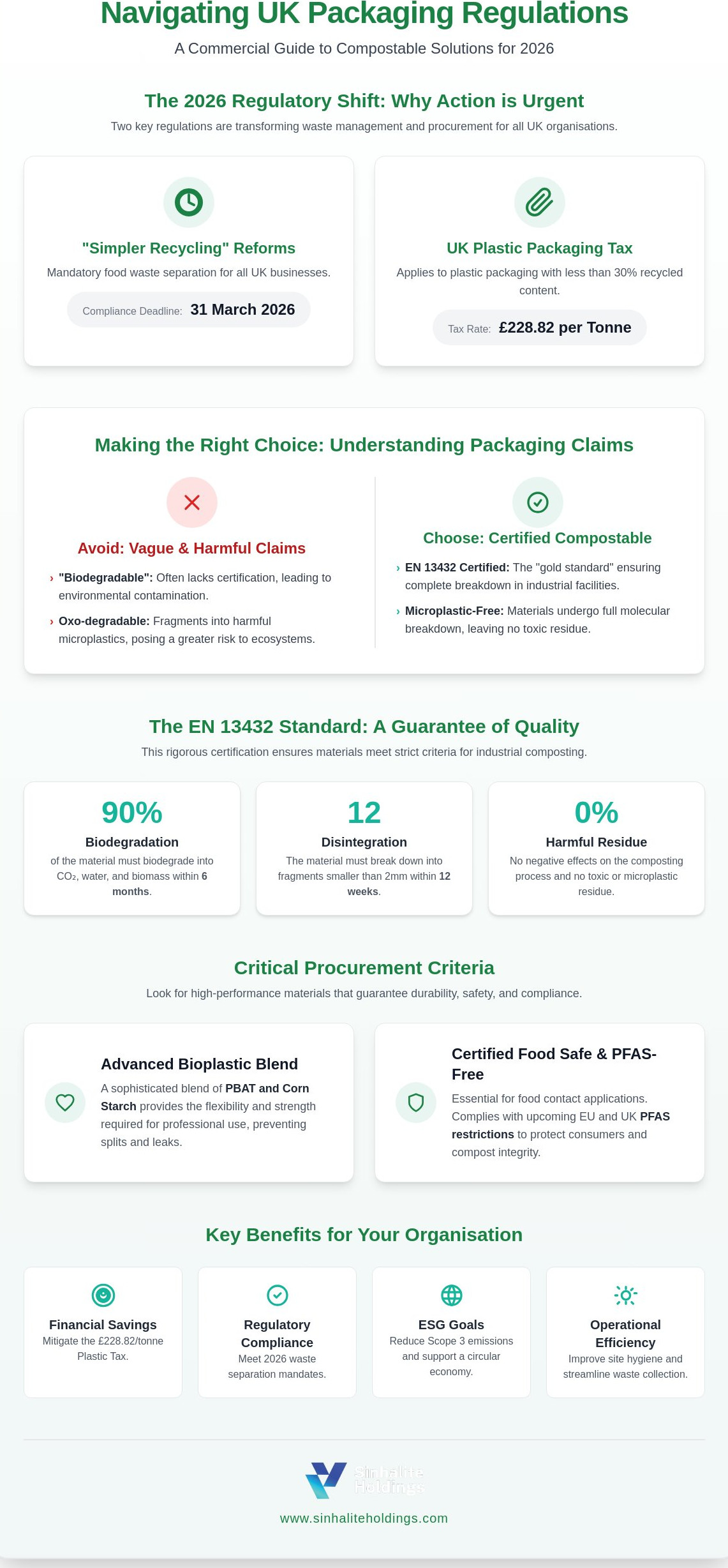
The financial landscape has changed just as rapidly as the environmental one. As of April 1, 2026, the UK Plastic Packaging Tax is set at £228.82 per tonne for packaging with less than 30% recycled content. Because compostable polymers are subject to this tax unless they meet specific recycled content thresholds, procurement teams must balance tax liabilities against the operational benefits of compostable systems. By choosing certified compostable bags, organisations bypass the complexities of traditional plastic waste streams and support the national goal of recycling 65% of municipal waste by 2035.
Regulatory Drivers for UK Organisations
The "Simpler Recycling" reforms mandated that all UK businesses separate food waste by March 31, 2026. This legislation effectively ended the era of macerators and co-mingled waste disposal. Switching business to sustainable packaging now serves as a primary hedge against rising disposal costs. It streamlines ESG reporting, as certified compostable liners facilitate the clean collection of organic matter required by modern waste contractors. This alignment ensures your organisation remains compliant with national waste separation mandates while reducing the carbon footprint of your supply chain.
The EN 13432 Standard Explained
This "gold standard" certification requires that 90% of the material biodegrades within six months in a controlled industrial environment. It also mandates that the product disintegrates into fragments smaller than 2mm within 12 weeks. Professional organisations must distinguish these industrial standards from home composting labels, such as OK compost HOME. While industrial bags require high-heat facilities to break down, they provide the superior tensile strength needed for high-volume compostable bags for food storage uk. Understanding this technical distinction prevents material failure and ensures that your waste is processed correctly by commercial composting partners.
Critical Procurement Criteria for Compostable Bags and Liners
Procurement leads must look beyond basic labels to ensure their supply chain is resilient and compliant with the 2026 regulatory landscape. High-quality compostable bags for food storage uk rely on a sophisticated blend of PBAT (polybutylene adipate terephthalate) and corn starch. This combination provides the essential flexibility of traditional plastic without the associated environmental cost. Unlike oxo-degradable alternatives that merely fragment into microplastics, these materials undergo a complete molecular breakdown, ensuring that your organisation's waste doesn't leave a toxic legacy.
Safety is paramount in any environment involving food contact. With the EU banning PFAS (per- and polyfluoroalkyl substances) in food packaging as of August 12, 2026, and the UK government signalling domestic restrictions through its "PFAS Plan," your choice of liners must be rigorously non-toxic. Ensuring that your storage solutions are PFAS-free protects both the consumer and the integrity of the compost produced from your organic waste. It's a proactive step that aligns your operations with the highest safety standards while preparing for forthcoming domestic REACH restrictions.
Verification and Certification Standards
Auditing a supplier requires more than a cursory glance at a green logo. You should verify that products carry the TUV Austria or Din Certco marks to guarantee authenticity. Understanding OK compost HOME certification explained helps procurement teams differentiate between bags that require industrial heat and those that break down in smaller-scale systems. Referencing established UK compostable certification standards ensures your organisation avoids the reputational risks of greenwashing and stays within the legal definitions of compostability.
Performance Metrics for Food Storage
Commercial kitchens demand high tensile strength and puncture resistance. A caddy liner that splits under the weight of wet food waste doesn't just create a mess; it disrupts the methodical flow of a professional kitchen and creates hygiene risks. When evaluating compostable clingfilm uk, look for superior oxygen barriers and adhesion properties that rival traditional PVC. High-performance bioplastics now offer the durability needed for heavy-duty garbage sacks and delicate food roller bags alike. For organisations seeking to align their daily operations with these rigorous standards, choosing a specialist supplier ensures material reliability across every SKU.
Implementing Compostable Solutions Across Your Organisation
Integrating compostable bags for food storage uk requires more than a simple procurement switch; it demands a structured, phased transition strategy. Organisations should begin by replacing traditional LDPE plastics in high-traffic areas such as staff kitchens and food preparation zones. This shift ensures that the most significant volumes of organic waste are captured early. Because bioplastics are breathable, they offer a distinct advantage over conventional plastic. This permeability allows moisture to evaporate, which is the primary secret of how to keep a food waste bin from smelling in professional environments.
Successful implementation relies heavily on employee engagement and the elimination of waste stream contamination. Clear, colour-coded signage and brief training sessions help staff distinguish between compostable liners and traditional refuse sacks. For back-of-house operations where weight and volume increase, switching to puncture resistant compostable garbage bags prevents the operational delays caused by leaks or splits. When your team trusts the material performance, they're more likely to adhere to new sustainability protocols.
Scaling Sustainable Procurement
Moving from single-site pilots to national supply chain integration requires a data-driven approach. By tracking plastic reduction metrics during your annual sustainability audits, you can quantify the reduction in Scope 3 emissions. This transparency is vital for UK organisations looking to demonstrate leadership in the circular economy. Scaling your efforts ensures that every department, from regional offices to central warehouses, operates under a unified environmental mandate.
Partnering with Sinhalite Holdings
Specialist expertise is essential when selecting high-performance bioplastics for commercial use. Sinhalite Holdings provides the technical reliability required for UK-wide distribution, offering a specialist inventory that includes compostable clingfilm and food roller bags. These products are engineered for the rigours of professional food prep, ensuring that hygiene and durability are never sacrificed for sustainability. Partnering with a dedicated supplier allows your organisation to transition with confidence, knowing your infrastructure is supported by a steady, dependable ally.
Securing Your Organisation’s Sustainable Future
The transition toward a circular economy in 2026 represents a significant opportunity for UK businesses to lead with integrity. By prioritising EN 13432 compliance and understanding the technical nuances of bioplastics, you protect your organisation from the rising costs of the Plastic Packaging Tax. Integrating compostable bags for food storage uk is a practical step that streamlines waste management while meeting mandatory food waste separation requirements. It ensures that your operational choices align with the highest environmental standards and long-term ESG goals.
Sinhalite Holdings stands as a steady, dependable ally in this journey. As a specialist provider of high-performance compostable clingfilm and food roller bags, we offer the technical reliability required for national distribution and commercial-scale operations. Our commitment to the 2026 circular economy transition ensures that your procurement choices support a cleaner, greener outlook without sacrificing industrial-grade durability or strength. We provide the tangible tools needed to reach your sustainability targets with calm confidence.
We invite you to explore Sinhalite Holdings’ certified range of compostable food storage solutions today. Together, we can build a future where responsible business practices and operational excellence go hand in hand.
Frequently Asked Questions
Do certified compostable food bags still contain traditional plastics?
Certified compostable bags for food storage uk are entirely free from traditional, petroleum-based plastics like polyethylene or polypropylene. They're manufactured using advanced biopolymers such as PBAT and corn starch, which are engineered to undergo a complete molecular breakdown. This process ensures that the material returns to the earth as nutrient-rich biomass; it doesn't leave behind microplastics or toxic residues that could contaminate the food chain or soil.
How does the 2026 Plastic Packaging Tax affect compostable material procurement?
As of April 2026, the UK Plastic Packaging Tax of £228.82 per tonne applies to compostable packaging unless it meets the 30% recycled content threshold. While this creates a direct procurement cost, it's essential to view this within the context of your total waste management budget. Using certified bags often reduces overall expenditure by facilitating the clean separation of food waste, helping your organisation avoid the significantly higher landfill levies and disposal fees associated with contaminated general waste.
Can commercial compostable bags be used for long-term freezer storage?
Many high-performance bioplastics, including those used in food roller bags, are designed to remain stable and flexible at sub-zero temperatures. Unlike some traditional plastics that become brittle and crack when frozen, these materials maintain their structural integrity in professional freezer environments. We recommend checking the specific puncture resistance of your chosen SKU to ensure it can handle the rigours of your specific cold-storage workflow without compromising hygiene.
What is the difference between home compostable and industrially compostable food bags?
Industrial compostability, governed by the EN 13432 standard, requires the high-heat environment of a commercial facility to break down within a specific timeframe. Home compostable products, often carrying the OK compost HOME label, are designed to degrade at the lower temperatures found in a standard garden bin. For most UK organisations, industrially certified compostable bags for food storage uk are the practical choice; they're engineered for the durability needed in commercial settings and align with the processing capabilities of national waste contractors.


