

By 2026, the financial penalty for a "Red" rated packaging choice isn't just a mark on your CSR report; it's a 20% surcharge on your Extended Producer Responsibility fees. Most commercial leaders agree that the current landscape of environmental certifications feels like a maze of overlapping symbols and technical jargon. You've likely felt the frustration of trying to distinguish between industrial standards like EN 13432 and the newer EN 17427 for home compostable carrier bags while fearing the reputational sting of greenwashing. Understanding how to read eco-labels on packaging is no longer a niche skill. It's a core requirement for any organisation committed to systemic change and operational integrity.
We'll empower you to master the art of decoding these certifications to eliminate ambiguity and secure a truly sustainable supply chain. This guide provides a clear framework for vetting suppliers and explaining complex labels to your stakeholders with confidence. You'll learn how to identify high-quality, compostable alternatives like clingfilm, aprons, and caddy bags that actually perform in a circular economy. We'll also preview the 2027 mandatory labelling deadlines and show you how to choose products that support a cleaner, greener future without sacrificing durability or strength.
Key Takeaways
- Distinguish between self-declared marketing claims and independent, third-party certifications to ensure your sustainability efforts are backed by verifiable data.
- Master how to read eco-labels on packaging by identifying the hierarchy of symbols for compostability, recyclability, and sustainable sourcing.
- Verify the authenticity of industrial standards like EN 13432 for items such as compostable garbage bags and food roller bags to prevent operational non-compliance.
- Establish a robust "Certification First" procurement policy that focuses on tracking specific license numbers rather than relying on visual logos alone.
- Strengthen your organisation's reputation by learning to communicate complex environmental certifications clearly to stakeholders and supply chain partners.
Understanding the Difference Between Marketing Claims and Verified Eco-Labels
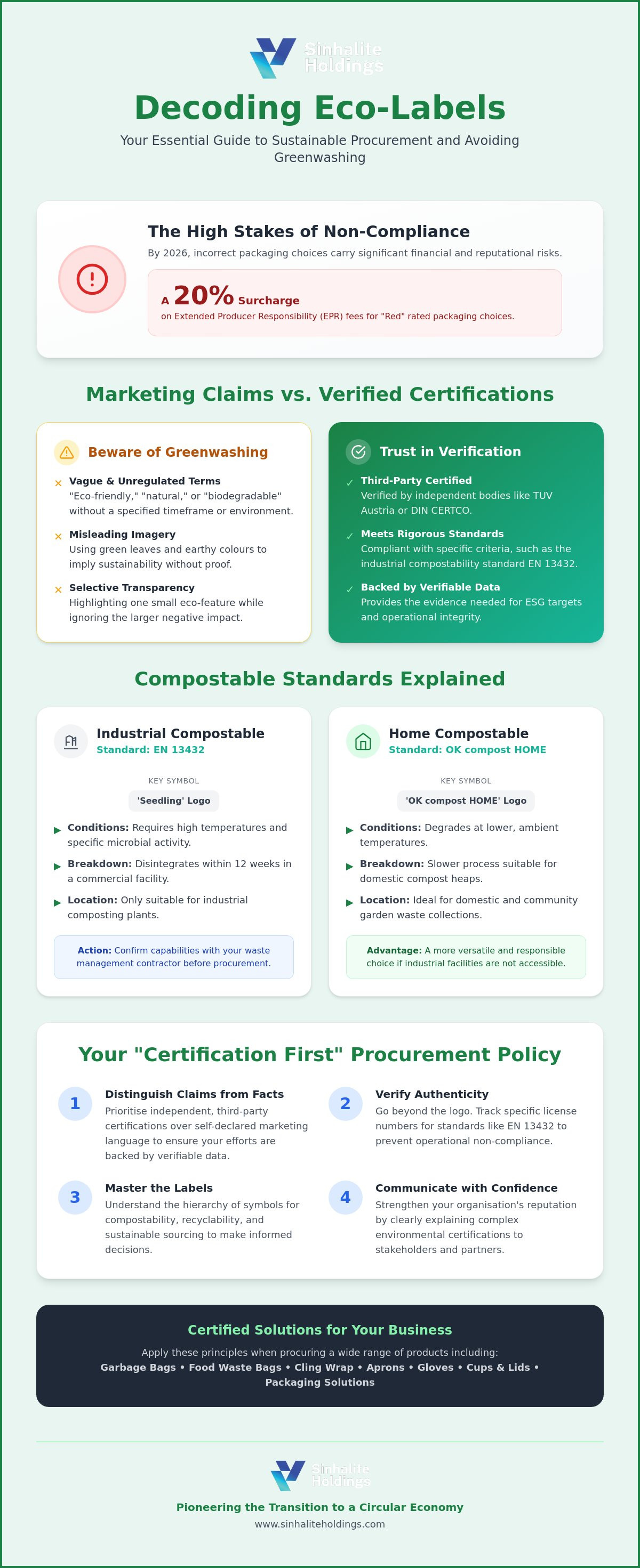
An eco-label is a voluntary mark of environmental performance that has been verified by an independent third party. It serves as a beacon of transparency in a crowded market, providing a reliable baseline for sustainable procurement. Developing a deep Understanding Eco-Labels allows procurement officers to separate factual performance from creative copywriting. Greenwashing is the practice of making unsubstantiated or misleading claims about the environmental benefits of a product. While self-declared claims like "natural" or "eco-friendly" lack regulatory oversight, verified certifications provide the evidence needed to meet 2026 ESG targets. When you learn how to read eco-labels on packaging, you shift from a position of uncertainty to one of professional authority.
Identifying Red Flags in Vague Packaging Claims
Generic imagery, such as green leaves or earthy colour palettes, is often used to distract from a lack of genuine certification. One of the most significant risks involves the term "biodegradable." Without a specified timeframe or environment, this claim is functionally meaningless for industrial waste management. Businesses should also be wary of selective transparency. This occurs when a supplier highlights one sustainable feature, like a recycled handle on a traditional plastic bag, while ignoring the non-recyclable nature of the primary material. True sustainability requires a holistic approach that covers the entire lifecycle of the item.
The Role of Third-Party Verification in 2026
For UK organisations, certifications from bodies like TUV Austria and DIN CERTCO are the gold standard. These marks ensure that products, such as compostable clingfilm or food roller bags, meet rigorous testing criteria like EN 13432. Relying on these verified labels protects your organisation from the legal risks associated with misleading advertising. It also ensures that your transition to compostable solutions is both scalable and ethically sound. Mastering how to read eco-labels on packaging is the first step toward a truly circular supply chain that prioritises long-term impact over short-term marketing wins.
A Step-by-Step Guide to Decoding Compostable and Sustainable Symbols
Efficiently managing a commercial waste stream requires a clear hierarchy of symbols. At the top sit compostable marks, followed by recyclable symbols and sustainably sourced certifications. Learning how to read eco-labels on packaging starts with identifying the "Seedling" logo. This mark signifies that a product meets the EN 13432 industrial standard, meaning it will break down in high-heat composting facilities within 12 weeks. Using these certified items helps organisations remain compliant with the UK's Extended Producer Responsibility (EPR) regulations, which increasingly penalise non-recyclable or non-compostable waste.
While industrial standards are common, the OK compost HOME certification explained provides a more versatile solution for councils and businesses with garden waste collections. It's also vital to understand that "compostable" refers to functional breakdown rather than a complete absence of polymers in a chemical sense. You can explore the technical nuances of material composition in our guide on do compostable bags contain plastic to ensure your procurement team can answer stakeholder questions accurately.
Distinguishing Between Industrial and Home Compostable Standards
EN 13432 is the baseline for industrial compostability. It requires specific temperatures and microbial activity found only in commercial plants. In contrast, the OK compost HOME standard ensures that items like compostable food waste bags will degrade in a domestic compost heap at lower temperatures. Businesses must confirm their waste contractor's capabilities before purchasing industrial-only products. If your facility lacks access to industrial processing, home-certified options are the more responsible choice. You can find a range of these high-performance, certified solutions at Sinhalite Holdings.
Forestry and Material Origin Labels (FSC and PEFC)
Sustainable sourcing labels like the FSC "Tick-tree" are essential for paper-based packaging and certain compostable films. FSC 100% means all materials come from well-managed forests, while FSC Mix indicates a blend of virgin and recycled fibres. FSC Recycled confirms the item is made entirely from reclaimed materials. These labels provide the traceability required for modern corporate responsibility, ensuring that your switch from plastic doesn't inadvertently contribute to deforestation elsewhere in the supply chain.
Implementing a Sustainable Procurement Strategy for Your Organisation
Establishing a "Certification First" policy ensures that environmental integrity is embedded into every contract from the outset. Procurement teams should be trained to look beyond the aesthetic appeal of a logo. Instead, they must focus on the specific license numbers that underpin these claims. This methodical approach protects your organisation from the risks of non-compliance and greenwashing discussed earlier. Collaborating with partners who provide dedicated support for switching business to sustainable packaging can streamline this transition. It turns a complex regulatory requirement into a clear competitive advantage while supporting systemic change.
Regularly auditing the supply chain is essential to ensure that certifications remain current and valid. Mastering how to read eco-labels on packaging is the technical foundation for this broader corporate strategy. By verifying the data behind every claim, you ensure that your investment in compostable solutions actually delivers the environmental impact your stakeholders expect. This proactive stance positions your organisation as a leader in the transition toward a circular economy.
Verifying Certification Validity via Online Databases
Public databases are the most effective tool for verifying a supplier's claims. For instance, the TUV Austria "Certificate Search" allows you to enter a license number to confirm its current status. You should always request the specific "7P" or "TA" license number associated with a product like a compostable caddy bag or food roller bag. If a supplier can't provide this data, it's a clear signal to look elsewhere. These digital checks prevent the accidental purchase of non-compliant stock.
Transitioning to Certified Compostable Solutions
Moving away from single-use plastics requires high-performance alternatives that don't compromise on utility. Sourcing from specialists like Sinhalite Holdings provides access to innovations like puncture resistant compostable garbage bags. These products meet the rigorous standards you've learned to identify. Once implemented, communicate these choices clearly to your end-users. Explaining how to read eco-labels on packaging to your staff and customers builds brand trust and reinforces your commitment to a greener future.
Securing Your Organisation’s Sustainable Future
Transitioning to a circular economy requires more than just good intentions; it demands technical precision and a commitment to transparency. By mastering how to read eco-labels on packaging, your organisation can effectively dismantle the risks of greenwashing and build a supply chain rooted in verifiable performance. We've explored how distinguishing between industrial and home compostable standards ensures that your waste management practices align with actual environmental outcomes. Implementing a rigorous procurement policy further solidifies this foundation, turning regulatory compliance into a clear demonstration of corporate responsibility.
As a dedicated partner to UK councils and businesses, we provide the tangible tools needed to reach these ethical standards without sacrificing utility. Our solutions are TUV Austria Certified and utilise FSC sourced materials to guarantee systemic impact. Whether you're sourcing high-strength garbage bags or food roller bags, choosing verified excellence is the most direct path to a plastic-free future. We're here to support your journey with products that deliver on their promises.
Explore our range of fully certified compostable packaging for your business and take the next step toward a cleaner, greener outlook today. Positive change is entirely achievable when you have the right expertise and the right materials at your disposal.
Frequently Asked Questions
What is the most reliable eco-label for compostable packaging in the UK?
The most authoritative marks are the "Seedling" logo and TUV Austria’s "OK compost" certifications. These labels confirm that products, such as compostable garbage bags or food roller bags, have undergone rigorous third-party testing to meet the EN 13432 standard. When you're learning how to read eco-labels on packaging, these marks provide the highest level of assurance for UK organisations seeking to integrate their operations into a circular economy.
Does the "Recycle" symbol mean a product will be recycled by my local council?
A "Recycle" symbol indicates that the material is technically capable of being recycled, but it doesn't guarantee your local council has the infrastructure to process it. While all households in England are required to separate recyclable materials and food waste as of March 31, 2026, businesses should still consult the On-Pack Recycling Label (OPRL) framework. Always check with your specific waste contractor to confirm local collection capabilities for various packaging solutions.
How can I tell if an eco-label is fake or self-made by the company?
Authenticity is verified through a unique license number, typically starting with "7P" or "TA," which must accompany the certification logo. If a supplier presents a generic green leaf or a vague "eco-safe" claim without a license number, it's likely an unverified marketing claim. You can use the TUV Austria online certificate search to validate these numbers, ensuring your procurement strategy remains resilient against greenwashing and potential legal risks associated with misleading advertising.
Can I put "industrially compostable" packaging in my home compost bin?
No, you shouldn't place industrially compostable items in a home compost bin because they require the sustained high temperatures of a commercial facility to break down. While home composting is ideal for items like certified caddy liners, industrial-only packaging will remain intact in a garden heap for years. Understanding how to read eco-labels on packaging helps you distinguish between these two standards, preventing contamination in domestic and commercial organic waste streams.


