

In 2026, a single misinterpreted symbol on your supply chain packaging is no longer just a marketing oversight; it's a financial and reputational risk. With the UK's Modulated EPR fees now penalising difficult-to-recycle materials with surcharges of up to 20%, mastering how to read eco-labels on packaging has become a core operational necessity for every responsible organisation. You've likely felt the frustration of sorting through overlapping certifications or the fear of being accused of greenwashing when a compostable claim doesn't hold up under professional scrutiny.
We believe that transparency is the foundation of environmental stewardship. This guide provides the clarity you need to decode complex environmental certifications and secure a truly sustainable supply chain. You'll gain a practical framework for vetting suppliers and the confidence to explain these choices to your stakeholders. We will examine the Recyclability Assessment Methodology (RAM) ratings, distinguish between home and industrial compostability for items like food waste bags and clingfilm, and provide the tools to ensure your transition to a circular economy is both compliant and advantageous.
Key Takeaways
- Learn to distinguish between vague marketing buzzwords like "eco-friendly" and verified, third-party certifications that ensure operational integrity.
- Master how to read eco-labels on packaging by understanding the hierarchy of symbols, from recyclability to the essential Seedling logo for EN 13432 compliance.
- Discover how to implement a "Certification First" procurement policy that prioritises verified license numbers over simple visual logos to eliminate the risk of greenwashing.
- Gain the ability to verify truly compostable items, such as clingfilm and food waste bags, ensuring they meet the specific standards required for industrial or home composting systems.
- Understand how aligning your supply chain with transparent eco-labels can reduce your exposure to modulated EPR fees while supporting the transition to a circular economy.
Understanding the Difference Between Marketing Claims and Verified Eco-Labels
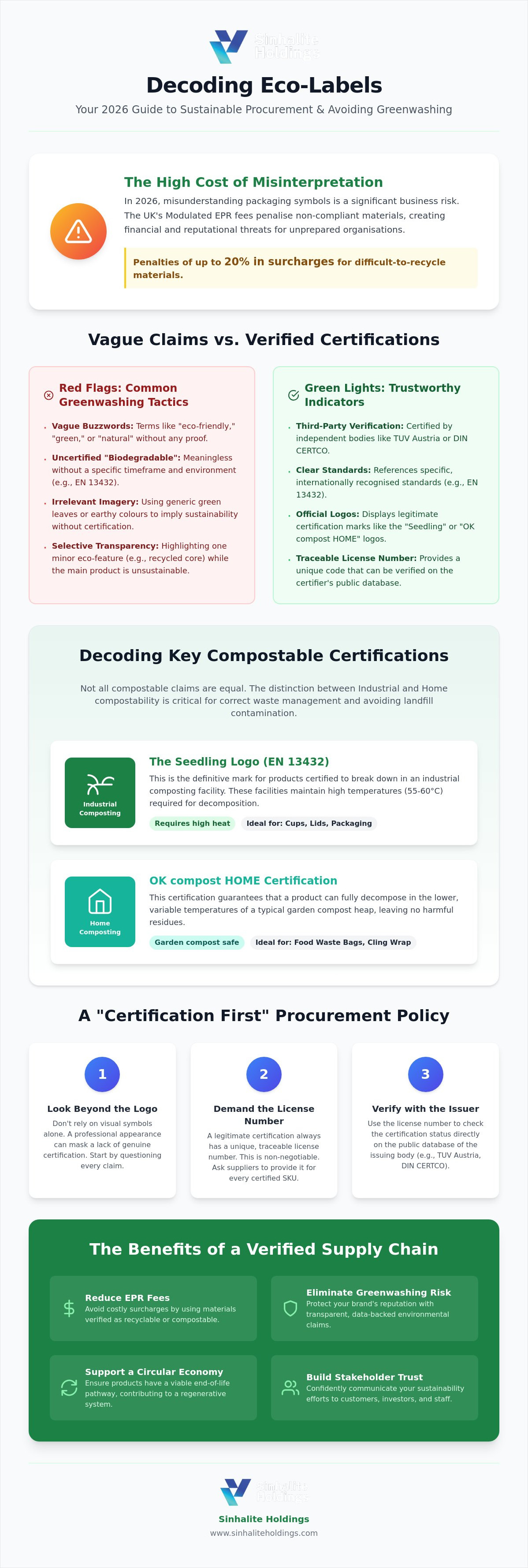
An eco-label is a voluntary mark of environmental performance that's been verified by an independent third party. It acts as a definitive seal of integrity for organisations aiming to decarbonise their operations. Unlike self-declared claims such as "natural" or "eco-friendly," which are often internal marketing terms lacking oversight, verified certifications are bound by rigorous international eco-label standards. Mastering how to read eco-labels on packaging is a critical skill for procurement officers who must hit strict ESG targets in 2026. Greenwashing is the practice of making unsubstantiated or misleading claims about the environmental benefits of a product.
Identifying Red Flags in Vague Packaging Claims
Visual distractions are a common tactic used to mask a lack of genuine certification. Generic green leaves and earthy colour palettes are frequently employed to create an "aura" of sustainability without providing any data. One of the most significant dangers is the term "biodegradable" when it's used without a specified timeframe or environment. Without a standard like EN 13432, a product might take decades to break down, whereas a certified compostable garbage bag or food waste bag is engineered to return to the earth safely within months. You should also watch for "selective transparency." This occurs when a supplier highlights one small eco-friendly feature, such as a recycled cardboard core, while the actual product remains a non-recyclable plastic.
The Role of Third-Party Verification in 2026
In the current UK market, bodies like TUV Austria and DIN CERTCO provide the necessary technical oversight to validate environmental claims. These organisations conduct laboratory tests to ensure that items like compostable clingfilm or aprons perform as promised in industrial or home composting conditions. Relying on these verified labels protects your organisation from the legal risks associated with misleading advertising. When you choose products with a clear, traceable license number, you aren't just buying a SKU; you're investing in a verified solution that supports a circular economy and reinforces your brand's commitment to transparency.
A Step-by-Step Guide to Decoding Compostable and Sustainable Symbols
Understanding the hierarchy of symbols is the first step in mastering how to read eco-labels on packaging. We categorise these marks into three primary tiers: Compostable, Recyclable, and Sustainably Sourced. Each tier serves a distinct purpose within the circular economy, yet they are often conflated in marketing materials. To ensure your organisation remains compliant with the UK Green Claims Code, you must verify the specific standards behind each icon. The "Seedling" logo, for instance, is the definitive mark for EN 13432 compliance, signifying that the material will break down in industrial composting conditions without leaving toxic residues.
Distinguishing Between Industrial and Home Compostable Standards
The distinction between industrial and home composting is critical for effective waste management. EN 13432 is the industrial standard, requiring the high-heat environment of a professional facility to facilitate decomposition. Conversely, the OK compost HOME certification explained provides the gold standard for items intended for garden composting. This is particularly relevant for compostable food waste bags used in office or hospitality settings. If your waste contractor does not have access to industrial composting facilities, choosing "Industrial Only" items may inadvertently lead to landfill waste. It's also vital to understand that "compostable" refers to functional performance rather than a total absence of polymers; you may wish to investigate whether do compostable bags contain plastic to clarify these technical nuances for your stakeholders.
Forestry and Material Origin Labels (FSC and PEFC)
Sustainable procurement also requires a close look at the origin of raw materials, especially for paper-based packaging and compostable films. The FSC "Tick-tree" logo indicates that the wood or paper used is sourced from responsibly managed forests. There are three main variants: FSC 100%, where all materials come from FSC forests; FSC Mix, which is a blend of FSC and controlled sources; and FSC Recycled. PEFC serves a similar purpose, focusing on international forest management standards. By verifying these labels alongside compostability marks, you secure a supply chain that is responsible from origin to end-of-life. If you're ready to transition your business, exploring our range of compostable garbage bags is a practical first step toward systemic change.
Implementing a Sustainable Procurement Strategy for Your Organisation
To move beyond surface-level compliance, organisations must embed environmental standards into the very fabric of their purchasing departments. Establishing a "Certification First" policy ensures that all new packaging tenders are evaluated based on verified data rather than aesthetic claims. This approach involves training procurement teams on the technicalities of the On-Pack Recycling Label (OPRL) scheme, which provides a reliable baseline for UK-wide recyclability. By educating staff on how to read eco-labels on packaging with a critical eye, you eliminate the risk of accidental greenwashing within your supply chain.
Verifying Certification Validity via Online Databases
Authentic stewardship requires more than just spotting a logo on a box. To truly verify a supplier’s claim, your team should utilise tools like the TUV Austria "Certificate Search" or the DIN CERTCO database. Always request the specific "7P" (for Seedling) or "TA" (for OK compost) license numbers associated with the product. A valid certificate will match the supplier's name and the specific SKU, such as compostable aprons or caddy liners. Regular audits of these certifications ensure that your partners maintain high standards over time, protecting your organisation from liability as regulations evolve.
Transitioning to Certified Compostable Solutions
Successful implementation often depends on collaborating with partners who offer specialised switching business to sustainable packaging support. Sourcing from experts like Sinhalite Holdings allows you to access high-performance items, including puncture resistant compostable garbage bags, without sacrificing operational efficiency. Once these solutions are in place, communicate the choice of certified packaging to your end-users. Clear messaging regarding your use of high-quality compostable materials builds profound brand trust and encourages collective responsibility. This strategic alignment not only reduces plastic waste but also positions your organisation as a visionary leader in the 2026 circular economy.
Securing Your Supply Chain for a Circular Future
Transitioning to a sustainable operation requires moving beyond visual cues to rigorous technical verification. You've learned that mastering how to read eco-labels on packaging involves checking license numbers against independent databases and matching specific standards like EN 13432 to your local waste infrastructure. By implementing a "Certification First" policy, your organisation can confidently eliminate greenwashing and align with the UK's evolving environmental regulations. This proactive approach ensures that every caddy liner or piece of clingfilm you procure supports a genuine circular economy.
As a dedicated partner to UK councils and businesses, Sinhalite Holdings provides the transparent data you need to reach your ESG targets. We invite you to explore our range of fully certified compostable packaging for your business. Our products are TUV Austria Certified and utilise FSC Sourced Materials to ensure high performance without compromise. The shift toward a plastic-free future is achievable when you have the right tools. Together, we can turn environmental commitments into a measurable, lasting legacy for the next generation.
Frequently Asked Questions
What is the most reliable eco-label for compostable packaging in the UK?
The most reliable eco-labels for compostable packaging in the UK are the "Seedling" logo and the "OK compost" marks issued by TUV Austria or DIN CERTCO. These symbols confirm that the product meets the EN 13432 European standard for compostability. When you understand how to read eco-labels on packaging, you'll notice these marks include a unique license number. This traceability ensures that items like compostable garbage bags or aprons are independently verified for safety and performance.
Does the "Recycle" symbol mean a product will be recycled by my local council?
The presence of a "Recycle" symbol, such as the Mobius loop, doesn't guarantee that your local council will collect or process the item. It simply indicates that the material is technically capable of being recycled under specific conditions. To avoid confusion, organisations should look for the On-Pack Recycling Label (OPRL) scheme markings, which provide clearer instructions based on current UK infrastructure. This distinction is vital for businesses aiming to reduce waste and avoid modulated EPR surcharges.
How can I tell if an eco-label is fake or self-made by the company?
You can identify a self-made or misleading claim by the absence of a third-party license number and a specific certification body's name. Authentic eco-labels always feature a unique code, such as a "7P" or "TA" number, which you can verify through online databases like TUV Austria’s certificate search. If a package only uses generic green icons or vague terms like "earth-friendly" without a traceable code, it's likely a self-declared marketing claim rather than a verified standard.
Can I put "industrially compostable" packaging in my home compost bin?
You shouldn't place "industrially compostable" packaging in a home compost bin because it requires the sustained high temperatures of a professional facility to break down. Home compost heaps rarely reach the 55 to 60 degrees Celsius needed to trigger the decomposition process for EN 13432 certified items. For office food waste bins or garden composting, you must specifically source products with the "OK compost HOME" certification. This ensures that items like caddy bags or food waste bags will degrade safely in lower-temperature environments.


