

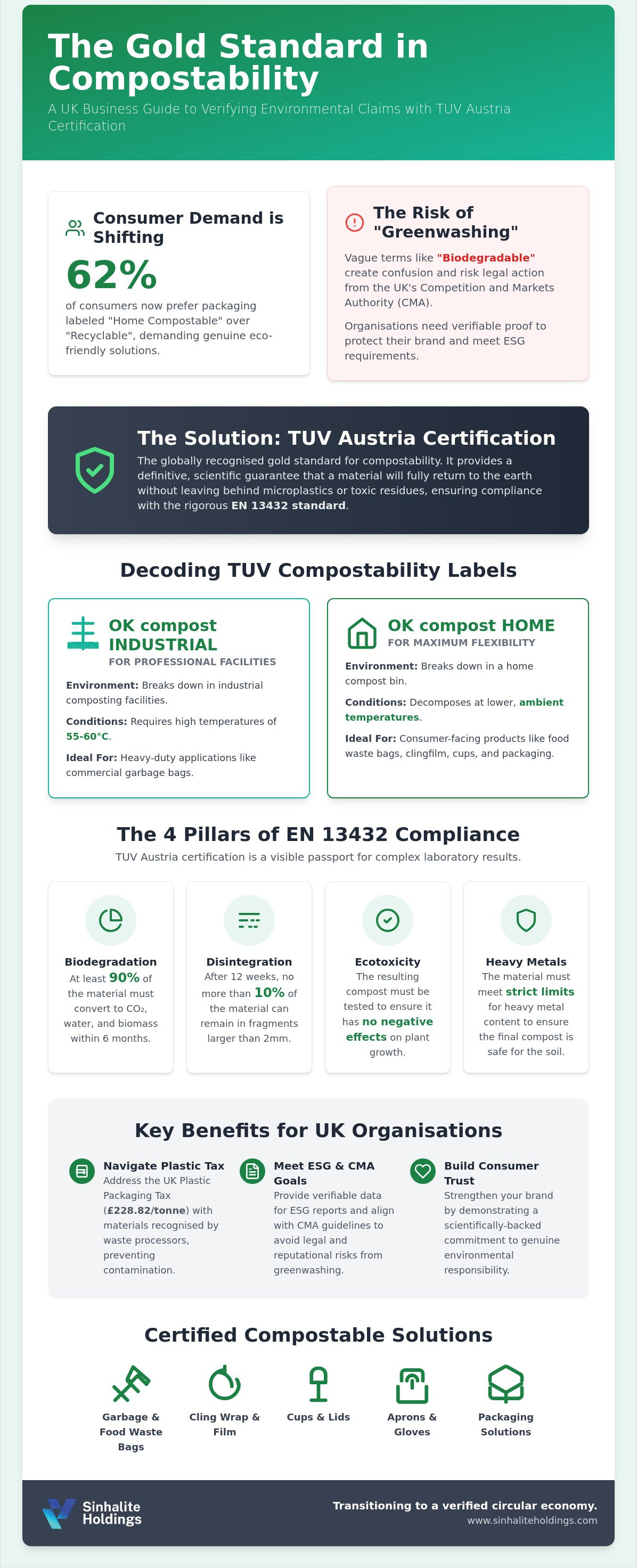
62% of consumers now prefer packaging labeled "Home Compostable" over "Recyclable", yet many UK organisations remain paralyzed by the fear of accidental greenwashing. As we move through 2026, the pressure to adopt genuine circular solutions has never been higher. Securing a TUV Austria certification for compostables isn't just about adding a logo to your packaging; it's about establishing a scientifically verified foundation for your environmental claims. This gold standard ensures that products like compostable garbage bags or food waste liners actually return to the earth without leaving toxic residues behind.
We understand that transitioning from traditional plastics to responsible alternatives can feel like a regulatory minefield, especially with the UK Plastic Packaging Tax now at £228.82 per tonne. You want to lead with integrity, but the distinction between "biodegradable" and "compostable" often feels blurred by the market. This guide provides the clarity you need to protect your brand and meet your ESG requirements with total confidence. We'll explore the latest 2026 standards, break down the framework for evaluating suppliers, and show you how to turn compliance into a powerful advantage for your business.
Key Takeaways
- Understand the critical distinction between vague "biodegradable" marketing and the rigorous scientific validation provided by a TUV Austria certification for compostables.
- Protect your organisation from legal and reputational risks by aligning with EN 13432 standards to satisfy UK CMA requirements and ESG reporting metrics.
- Learn how to select the appropriate certification for specific applications, ensuring items like compostable clingfilm meet HOME standards for maximum disposal flexibility.
- Navigate the 2026 UK Plastic Packaging Tax and international regulations by integrating high-performance, certified alternatives into your procurement strategy.
- Discover how verifiable environmental claims can strengthen your brand’s position as a responsible innovator within the emerging circular economy.
Understanding TUV Austria Certification: The Gold Standard for Compostability
TUV Austria is an independent, globally recognised certification body that provides the scientific rigour needed to validate modern environmental claims. While many products use the vague term "biodegradable" to suggest eco-friendliness, this label often lacks a defined timeframe or specific conditions for breakdown. In contrast, a TUV Austria certification for compostables provides a definitive guarantee that a material will fully return to the earth without leaving behind microplastics or toxic residues. This distinction is vital for organisations seeking to implement compostable bioplastics in a way that aligns with genuine circular economy principles. Simply put, TUV Austria certification is the verification that a product meets the EN 13432 standard for compostability.
OK compost INDUSTRIAL vs. OK compost HOME
UK businesses must distinguish between these two labels to ensure their waste management planning is effective. The OK compost INDUSTRIAL mark signifies that a product, such as heavy-duty garbage bags, will break down in professional facilities at temperatures between 55-60°C. However, the OK compost HOME mark is often more versatile for office or residential settings because it guarantees breakdown at ambient temperatures. You can find a deeper technical breakdown in our OK compost HOME certification explained guide. Selecting the right label ensures that products like compostable caddy bags actually reach the correct end-of-life destination rather than contaminating recycling streams.
The Science of EN 13432 Compliance
TUV certification acts as a visible passport for complex laboratory results. To achieve compliance, materials undergo testing across four critical pillars: biodegradation, disintegration, ecotoxicity, and heavy metal content. For example, a material must achieve at least 90% biodegradation within six months and leave no more than 10% of its original mass after 12 weeks of composting. These tests ensure that compostable food roller bags or clingfilm don't just disappear from sight but actually contribute to healthy soil. By securing a TUV Austria certification for compostables, businesses provide verifiable proof that their transition to plastic-free operations is backed by industrial-grade science.
Why TUV Certification is Critical for UK Business Sustainability
Avoiding the "greenwashing" trap is no longer just a matter of ethics; it's a legal necessity. The Competition and Markets Authority (CMA) has intensified its scrutiny of environmental claims, making vague marketing a high-risk strategy. Without a TUV Austria certification for compostables, businesses risk significant reputational damage and potential legal action. This UK Parliament report on compostable packaging highlights the complex landscape of waste infrastructure, reinforcing why third-party verification is essential for corporate transparency.
For large organisations, Environmental, Social, and Governance (ESG) reporting now demands verifiable data rather than optimistic projections. Implementing certified solutions like compostable garbage bags or caddy liners allows procurement teams to document precise waste diversion metrics. This shift is a core component of switching business to sustainable packaging, a move that provides a logical path toward a circular economy while future-proofing operations against shifting environmental mandates.
Navigating the UK Plastic Packaging Tax
As of April 2026, the UK Plastic Packaging Tax rate is £228.82 per tonne. It's vital to recognise that compostable plastics are generally subject to this tax unless they contain at least 30% recycled content. However, uncertified "biodegradable" materials often create a double burden for businesses. They fail to meet tax thresholds and cannot be safely processed in organic waste streams. TUV Austria certification for compostables ensures that your materials are recognised by waste processors, preventing the costly contamination of recycling batches.
Strengthening Green Credentials and Consumer Trust
Trust is the primary currency for responsible brands in 2026. Data from a 2024 Zero Waste Europe report indicates that 62% of consumers now prefer packaging labeled "Home Compostable" over traditional "Recyclable" options. Displaying the TUV logo on items like compostable shopping bags or food roller bags provides immediate, visual proof of integrity. This level of transparency is particularly crucial in the hospitality and retail sectors, where customers increasingly demand to see a clear end-of-life path for the packaging they encounter. If you're looking to enhance your brand's environmental profile, adopting certified compostable solutions is a practical and powerful step forward.
Implementing TUV-Certified Solutions: From Clingfilm to Waste Management
Moving from policy to practice requires a focused procurement strategy that prioritises both compliance and performance. Integrating a TUV Austria certification for compostables into your supply chain ensures that every item, from logistics packaging to canteen supplies, meets the highest environmental standards. Durability remains a primary concern for facility managers, which is why we advocate for the use of puncture resistant compostable garbage bags. These certified solutions provide the industrial strength required for heavy commercial waste while ensuring that hygiene and safety standards are never compromised during handling.
Selecting Certified Clingfilm and Food Roller Bags
Food service operations benefit significantly from switching to compostable clingfilm that carries the OK compost HOME label. This specific certification offers maximum disposal flexibility, ensuring the film breaks down even in lower-temperature environments. Unlike traditional PVC, these plant-based films offer excellent cling and breathability without the risk of chemical leaching. Procurement teams often ask do compostable bags contain plastic?; the answer is found in the "OK biobased" star system. This label quantifies the renewable, plant-derived carbon content, providing the transparency needed to move away from fossil-fuel-based polymers with confidence.
Integrating Certified Products into Commercial Waste Streams
Successful implementation depends on clear logistics and a collaborative approach with your UK waste contractors. You must ensure that your waste management partners recognise the TUV logo so that your certified bags reach the correct composting facilities. Internal staff training is equally vital to maintain the purity of these waste streams. By educating your team on the specific disposal requirements for compostable shopping bags and food roller bags, you prevent the accidental contamination of organic waste. This methodical approach ensures that your investment in a TUV Austria certification for compostables delivers a measurable environmental impact while supporting your organisation's journey toward a circular economy.
Securing Your Business’s Future in the Circular Economy
Adopting a TUV Austria certification for compostables is more than a compliance measure; it's a profound commitment to environmental stewardship. By ensuring your products meet the rigorous EN 13432 standards, you protect your organisation from greenwashing risks while satisfying the increasing demands of ESG reporting. We've explored how distinguishing between Home and Industrial labels ensures waste management success, and how high-performance items like puncture resistant garbage bags maintain operational efficiency. This transition allows your business to lead with integrity, proving that responsible innovation and industrial strength can coexist seamlessly.
As a specialist UK supplier for commercial and industrial sectors, Sinhalite Holdings provides the expert guidance needed to navigate sustainable packaging transitions. Our team ensures that every solution, from compostable caddy bags to heavy-duty liners, supports your long-term environmental goals without sacrificing utility. We invite you to view our range of TUV-certified compostable solutions for UK businesses and take a proactive step toward a plastic-free operation. Together, we can build a steady, dependable path toward a cleaner and more sustainable future for your organisation.
Frequently Asked Questions
What is the main difference between OK compost HOME and OK compost INDUSTRIAL?
The primary difference lies in the environmental conditions and timeframe required for the material to break down. OK compost INDUSTRIAL products require the high, consistent temperatures of professional facilities, typically between 55 and 60°C, to disintegrate. OK compost HOME items are tested to break down in ambient garden compost heaps. This distinction is vital for procurement because it determines whether your waste management partner can process the material or if it's suitable for on-site composting.
How can a UK business verify if a supplier’s TUV Austria certificate is valid?
You can verify the authenticity of a certificate by checking the unique serial number or QR code against TUV Austria's official online database. Every valid TUV Austria certification for compostables is linked to a specific manufacturer and product family. This ensures that the claims on the packaging match the laboratory test results. It's best practice to request the full certificate document rather than relying on a logo alone to ensure the certification remains current.
Does TUV certification automatically mean a product is plastic-free?
TUV certification indicates that a product is compostable, but it doesn't necessarily mean it's 100% plant-based or plastic-free in the traditional sense. Many compostable bioplastics are technically polymers that behave like plastic but are designed to biodegrade fully without leaving microplastics. To understand the renewable content, businesses should look for the OK biobased star rating alongside the compostability mark. This provides a transparent measurement of how much of the product is derived from natural sources.
Why should my business pay more for TUV-certified compostable bags?
Investing in a TUV Austria certification for compostables provides a scientific shield against greenwashing and potential legal penalties from the CMA. While uncertified alternatives might appear cheaper, they often don't have the puncture resistance and structural integrity required for commercial waste streams. Paying for certification ensures your garbage bags and food roller bags actually break down as promised. This protects your ESG reputation and prevents the costly contamination of organic waste batches that leads to higher disposal fees.


