

Relying on the vague term "biodegradable" is no longer just a marketing risk; in 2026, it's a direct threat to your organisation's bottom line and regulatory standing. As the UK introduces modulated EPR fees and stricter labelling mandates, the need for verifiable environmental claims has never been more urgent. Securing TUV Austria certification for compostables provides the only scientifically rigorous shield against greenwashing. It ensures your transition to sustainable materials, such as compostable garbage bags or high-performance cling wrap, is both legally sound and ethically transparent.
We understand the immense pressure to meet ambitious ESG targets while distinguishing genuine innovation from empty promises. This guide will show you how TUV Austria certifications validate the integrity of your supply chain and protect your brand from the fallout of accidental greenwashing. We'll explore the critical differences between "Home" and "Industrial" standards, the impact of 2026 UK waste regulations, and how to select high-performance compostable alternatives that don't compromise on durability or strength.
Key Takeaways
- Learn how to distinguish scientifically verified materials from vague marketing by understanding the rigour behind TUV Austria certification for compostables.
- Protect your organisation from potential CMA investigations and greenwashing risks by ensuring all compostable products meet the EN 13432 standard.
- Discover how certified compostable solutions simplify ESG reporting and help large organisations comply with the 2026 UK packaging regulations.
- Gain a clear framework for selecting the correct certification labels for specific applications, ensuring items like compostable clingfilm reach the appropriate waste stream.
- Understand how transitioning to certified caddy bags and garbage bags supports a scalable, practical shift toward a circular economy.
Understanding TUV Austria Certification: The Gold Standard for Compostability
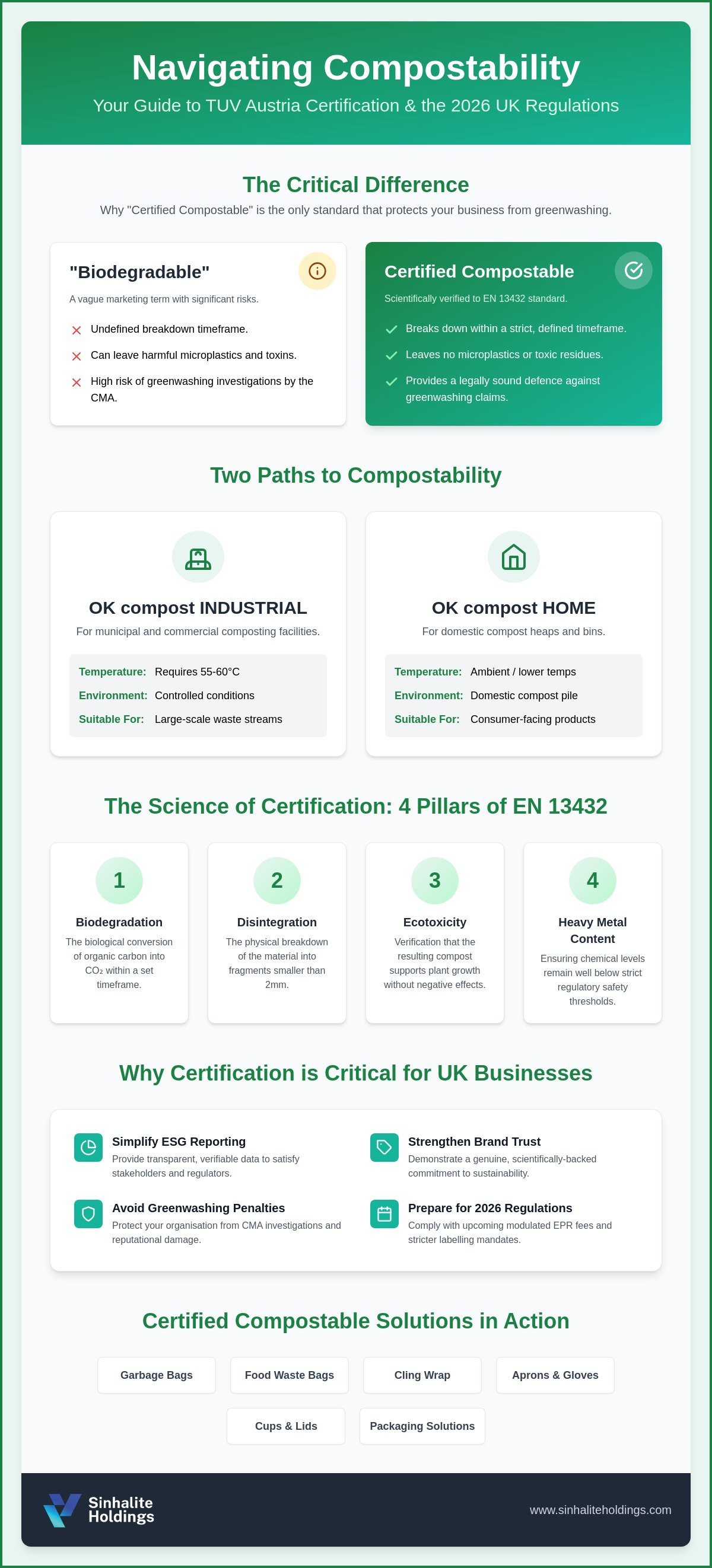
TUV Austria is an independent, globally recognised certification body that provides the essential verification for bioplastics. For UK businesses, this certification is the bridge between a manufacturer’s marketing claim and scientific reality. While "biodegradable" is a broad, often misleading term that simply means a material can break down over an undefined period, certified compostable products must disintegrate within a strict timeframe. TUV Austria certification for compostables confirms that a product leaves no microplastics or toxic residues behind, ensuring your transition to plastic-free operations is genuinely sustainable. Specifically, TUV Austria certification is the formal verification that a product meets the European standard EN 13432 for compostability.
OK compost INDUSTRIAL vs. OK compost HOME
Distinguishing between the two primary TUV labels is vital for effective waste management planning. OK compost INDUSTRIAL products require controlled conditions, typically between 55-60°C, which are found only in municipal composting facilities. Conversely, OK compost HOME products are designed to break down at ambient temperatures in a domestic heap. UK organisations must identify these labels correctly to ensure items like food waste bags or shopping bags reach the correct disposal stream. For a deeper technical breakdown of these requirements, see our OK compost HOME certification explained guide.
The Science of EN 13432 Compliance
TUV certification acts as a visible passport for complex laboratory results. To earn this mark, materials must pass four rigorous pillars of testing:
- Biodegradation: The biological conversion of organic carbon into CO2.
- Disintegration: The physical breakdown of the material into fragments smaller than 2mm.
- Ecotoxicity: Verification that the resulting compost supports plant growth without negative effects.
- Heavy Metal Content: Ensuring chemical levels remain well below strict safety thresholds.
By selecting TUV-certified solutions, such as heavy-duty garbage bags or food roller bags, businesses can be certain their waste becomes high-quality compost rather than a persistent pollutant. This level of transparency is the cornerstone of a functional circular economy.
Why TUV Certification is Critical for UK Business Sustainability
UK organisations are facing unprecedented scrutiny as the 2026 circular economy targets approach. Relying on unverified claims is a significant liability. The Competition and Markets Authority (CMA) has intensified its focus on "greenwashing," making it essential for businesses to provide rigorous evidence for their environmental assertions. Securing TUV Austria certification for compostables provides this evidence. It transforms a vague marketing promise into a legally defensible fact, protecting your brand from potential investigations and reputational damage. For large commercial entities, these certifications are vital for ESG reporting, providing the transparent data required to satisfy stakeholders and regulatory bodies.
Transitioning to verified materials is not merely a compliance exercise; it's a strategic move toward operational resilience. By switching business to sustainable packaging, companies can mitigate the risks associated with volatile plastic supply chains and shifting waste legislation. This proactive approach supports the UK’s broader transition to a circular economy, where products like compostable shopping bags and caddy bags are designed to return value to the earth rather than languishing in landfills.
Navigating the UK Plastic Packaging Tax
The UK Plastic Packaging Tax (PPT) creates a clear financial incentive for material innovation. While the tax applies to plastic packaging with less than 30% recycled content, the regulatory landscape is evolving. TUV-certified compostables are often viewed more favourably in waste strategy assessments than generic "biodegradable" plastics. Without the TUV mark, many materials fail to meet the strict criteria required for future tax exemptions or lower Extended Producer Responsibility (EPR) fees. Partnering with a dedicated supplier of TUV-certified solutions ensures your organisation stays ahead of these shifting fiscal standards.
Strengthening Green Credentials and Consumer Trust
In 2026, transparency is the primary currency of consumer trust. Displaying the TUV logo on items such as food roller bags or heavy-duty garbage bags provides immediate, visual reassurance to your clients. This is particularly critical in the hospitality and retail sectors, where supply chain integrity is a key differentiator. When a business can prove its packaging will safely disintegrate without leaving harmful residues, it builds a lasting bond with an increasingly eco-conscious public. This level of honesty is the only way to secure a competitive advantage in a market that no longer accepts "green" at face value.
Implementing TUV-Certified Solutions: From Clingfilm to Waste Management
Successful implementation of sustainable alternatives requires matching the specific TUV label to your operational needs. For example, compostable clingfilm often benefits most from the OK compost HOME certification. This specific mark provides maximum disposal flexibility, allowing the material to break down in less intensive environments than industrial facilities. In logistics and heavy-duty waste management, durability is equally important. We advocate for the use of puncture resistant compostable garbage bags to ensure that hygiene and safety standards are maintained throughout the collection process. TUV Austria certification for compostables doesn't just verify environmental safety; it confirms that these materials can withstand the rigours of commercial use.
Selecting Certified Clingfilm and Food Roller Bags
Modern plant-based films now match or exceed the performance of traditional PVC. These certified films provide the necessary cling and barrier properties without the environmental cost of persistent plastics. A common question businesses ask is, do compostable bags contain plastic? While they are technically polymers, they are bio-based and designed to disappear. The "OK biobased" label from TUV Austria helps quantify the renewable content, offering a clear metric for your sustainability reports and internal ESG audits.
Integrating Certified Products into Commercial Waste Streams
Transitioning to certified products is only effective if the waste reaches the correct destination. UK organisations should consult with their waste contractors to confirm that TUV-certified bags are accepted in their organic or food waste streams. Clear staff training is the final, vital step. By using colour-coded bins and visible TUV signage, you can prevent the contamination that often undermines circular waste systems. This methodical approach ensures that your investment in high-quality caddy bags and shopping bags results in genuine environmental restoration rather than landfill waste.
Future-Proof Your Business with Certified Compostability
Adopting TUV Austria certification for compostables is no longer a luxury for forward-thinking organisations; it's a fundamental requirement for navigating the 2026 UK regulatory landscape. By moving beyond vague claims and embracing scientifically verified standards, your business can eliminate greenwashing risks while building deep-seated trust with eco-conscious clients. We've explored how distinguishing between industrial and home composting requirements ensures your waste strategy remains effective and transparent. Whether you're integrating high-performance cling wrap or heavy-duty garbage bags, the key to success lies in choosing materials that leave no harmful residues behind.
As a specialist UK supplier, we're dedicated to helping commercial and industrial sectors transition toward a plastic-free future. All our products meet rigorous EN 13432 standards, providing the durability your operations demand with the environmental integrity your stakeholders expect. Our team offers expert guidance to ensure your sustainable packaging transition is seamless and commercially advantageous.
View our range of TUV-certified compostable solutions for UK businesses and take a decisive step toward a cleaner, more resilient tomorrow. The journey to a circular economy is achievable, and we're here to provide the tangible tools you need to reach it.
Frequently Asked Questions
What is the main difference between OK compost HOME and OK compost INDUSTRIAL?
The primary distinction lies in the temperature and environment required for the material to break down completely. OK compost INDUSTRIAL products are engineered for municipal facilities that maintain high temperatures; conversely, OK compost HOME items are designed to disintegrate in domestic heaps at ambient temperatures. This difference ensures that items like caddy bags or food roller bags are processed in a way that truly returns value to the soil.
How can a UK business verify if a supplier’s TUV Austria certificate is valid?
You can verify the authenticity of any claim by entering the unique certificate number into the official TUV Austria online database. Every genuine TUV Austria certification for compostables includes a specific identification code that links to the manufacturer and the certified product range. Checking this database protects your organisation from fraudulent claims and ensures your supply chain remains transparent and legally defensible against greenwashing accusations.
Does TUV certification automatically mean a product is plastic-free?
Not in the traditional sense; these products are often bioplastics or biopolymers derived from renewable sources. While they offer the durability and utility of conventional plastics, they're scientifically formulated to biodegrade into high-quality compost without leaving microplastics. The certification ensures that even if the material feels like plastic, it won't persist in the environment or release toxic residues during the composting process.
Why should my business pay more for TUV-certified compostable bags?
Paying for certification is an investment in regulatory compliance and brand protection. Certified garbage bags and shopping bags provide the rigorous proof required for 2026 UK ESG reporting and help your organisation avoid the significant fines associated with misleading environmental claims. These high-quality alternatives also offer superior performance, such as enhanced puncture resistance, ensuring that your transition to sustainable practices doesn't compromise on operational hygiene or safety.


