
What if the complex chemical name on your compostable packaging isn't a hidden toxin, but the very reason it actually works? As UK businesses face the strict 2026 EPR labelling mandates, many are asking: what is pbat and is it safe for both consumers and the environment? While the "terephthalate" in its name often causes anxiety by sounding similar to harmful phthalates, the reality is a story of responsible innovation. PBAT is a biodegradable polymer that bridges the gap between the durability of traditional plastics and the circularity of nature, providing the flexibility needed for high-performance compostable liners and films.
You've likely felt the frustration of deciphering conflicting claims about "biodegradable" versus "compostable" materials. It's a complex landscape, but we're here to provide the clarity your business needs to make informed, ethical choices. This guide explores the safety of PBAT, its role in meeting the updated EN 13432:2026 standards, and why it's a practical, scalable solution for organisations moving toward a circular economy. We'll look at everything from its chemical structure to the impact of the 2026 EPR modulated fees, giving you the tools to replace single-use plastics with confidence and purpose.
Key Takeaways
- Understand how PBAT provides the essential flexibility for compostable packaging while remaining entirely digestible by soil microbes.
- Gain clarity on what is pbat and is it safe for your organisation by exploring the critical chemical differences between its structure and harmful ortho-phthalates.
- Verify how the latest EN 13432:2026 standards ensure that compostable materials are rigorously tested for non-toxicity to protect plant health and soil ecosystems.
- Learn how adopting PBAT-based solutions helps UK organisations navigate the Plastic Packaging Tax and meet ambitious ESG targets through certified compostable alternatives.
- Discover why this innovative polymer is the key to creating durable, puncture-resistant garbage bags that don't compromise on performance or environmental responsibility.
What is PBAT? Understanding the Chemistry of Compostable Plastic
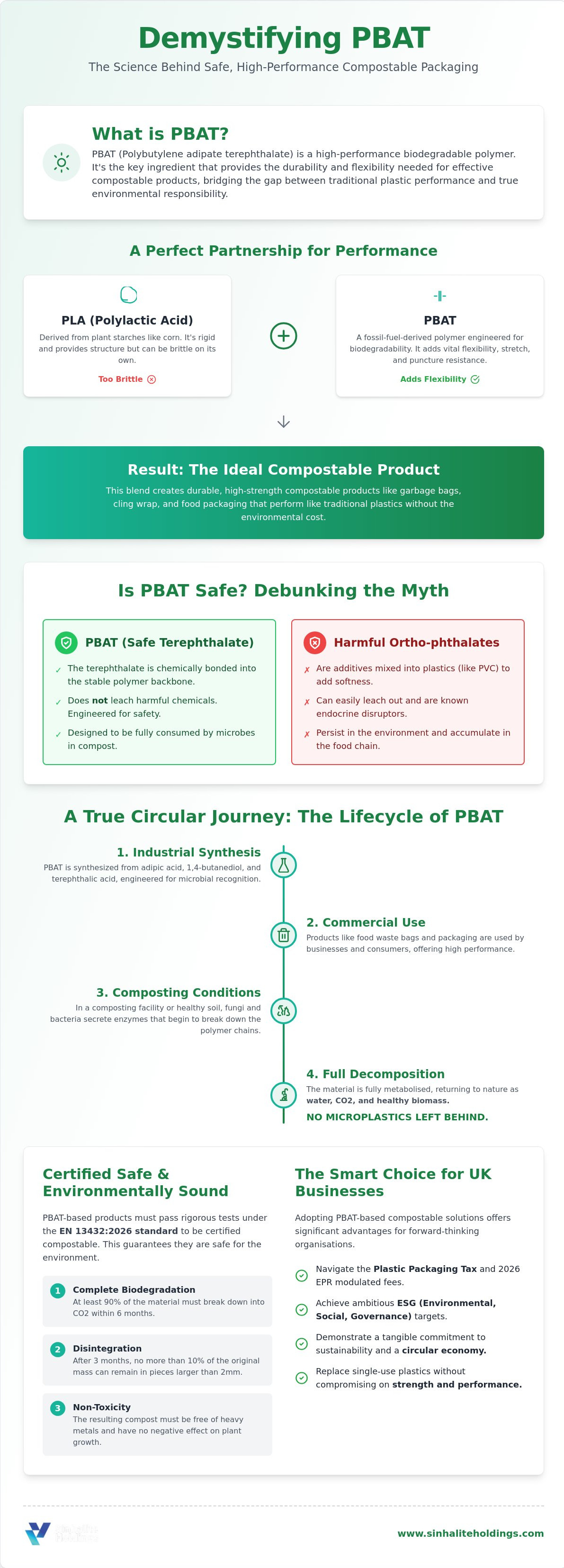
PBAT, or Polybutylene adipate terephthalate, is a biodegradable random copolymer that has become a cornerstone of the sustainable packaging industry. Many organisations investigating sustainable procurement ask, what is pbat and is it safe for widespread commercial use? While the name sounds complex, it's essentially a high-performance material designed to break down completely in composting environments. It presents a unique scientific paradox; although currently synthesised from fossil-fuel sources, its chemical structure allows soil microbes to consume it entirely. Unlike traditional plastics that fragment into permanent microplastics, PBAT's ester bonds are susceptible to enzymatic attack. This leads to a 100% biological decomposition into water, CO2, and biomass, provided the correct composting conditions are met.
PBAT serves as a performance polymer that bridges the gap between industrial durability and certified compostability.
To better understand how these raw materials are processed into functional, eco-friendly products, watch this helpful overview:
PBAT vs. PLA: The Perfect Sustainable Blend
In the UK market, most high-quality products like compostable clingfilm aren't made from a single material. While PLA (polylactic acid) is popular because it's derived from plants like corn starch, it's often too brittle for flexible applications. PBAT provides the vital stretch and cling that plant-based starches lack. By blending these biopolymers, manufacturers create functional bags and wraps that match the performance of polyethylene without the environmental cost. This synergy is particularly important for commercial waste management, where bags must withstand heavy loads without tearing. It's a practical, high-strength choice.
The Lifecycle of PBAT: From Production to Soil
The production of PBAT involves the industrial synthesis of adipic acid, 1,4-butanediol, and terephthalic acid. While the use of terephthalic acid often raises questions about what is pbat and is it safe, this specific formulation is engineered for microbial recognition. Once the material reaches a composting facility or healthy soil, fungi and bacteria secrete enzymes that break the polymer chains into smaller pieces. These fragments are then metabolised by the microorganisms. This process ensures the material returns to the earth rather than accumulating as a pollutant. It's a controlled, reliable end-of-life cycle.
Is PBAT Safe? Addressing Toxicity and Microplastic Concerns
Addressing the question of what is pbat and is it safe requires debunking a common linguistic myth. The "terephthalate" in its name often leads to confusion with harmful ortho-phthalate plasticisers, such as DEHP, which are known endocrine disruptors. However, the chemical composition of PBAT involves a stable aromatic ring that is part of the polymer backbone itself, not an additive that can easily leach out. This fundamental difference means it doesn't pose the same health risks as the chemicals used to soften traditional PVC. It's a purposefully engineered material where safety is built into its molecular structure.
True safety is also measured by what remains after the material breaks down. Unlike traditional plastics that merely fragment into permanent microplastics, certified PBAT is designed to fully mineralise into carbon dioxide, water, and biomass. This process prevents the accumulation of persistent pollutants in our food chain and soil ecosystems. To understand how these materials differ from petroleum-based alternatives in a commercial context, you can read our detailed guide on do compostable bags contain plastic.
Food Contact Safety and Chemical Migration
PBAT is remarkably stable in both household and commercial kitchen environments. It has undergone extensive migration testing to ensure it meets strict UK and EU food contact regulations, including EFSA standards. Whether used as clingfilm for wrapping leftovers or as food roller bags, it doesn't transfer harmful substances to the food it protects. This stability makes it a reliable choice for organisations seeking to maintain high hygiene standards while reducing their plastic footprint. It's a functional solution that doesn't compromise on safety.
Environmental Safety: The Importance of Certification
Relying on the vague label of "biodegradable" is rarely sufficient for responsible procurement. Instead, look for OK compost HOME certification. This standard, verified by TUV Austria, guarantees that the material has passed rigorous toxicity tests. These tests ensure no heavy metals are present and that the resulting compost remains healthy for earthworms and plant growth. Choosing certified compostable solutions ensures your environmental commitments are backed by scientific verification and high-quality manufacturing.
PBAT in the UK: A Practical Solution for a Circular Economy
UK organisations are under increasing pressure to align their operations with the circular economy. Transitioning to PBAT-based products helps businesses meet ambitious ESG targets and navigate the complexities of the Plastic Packaging Tax. Unlike traditional LDPE, which remains a persistent waste issue, PBAT-based alternatives offer a scalable path toward plastic waste reduction. For many procurement leads, the primary concern remains: what is pbat and is it safe for high-volume commercial use? The answer lies in its proven performance. For instance, puncture resistant compostable garbage bags rely on these polymer blends to provide the tensile strength required for commercial waste management without compromising on biological end-of-life. By providing a functional alternative to persistent plastics, PBAT enables the UK's move toward a zero-waste future by 2026.
Why Sinhalite Holdings Prioritises Certified PBAT Blends
At Sinhalite Holdings, we believe that environmental responsibility shouldn't come at the expense of utility. We prioritise certified PBAT blends because they represent the ideal intersection of modern innovation and natural processes. Our range of bags and clingfilm is designed to meet the rigorous demands of industrial settings while maintaining full compostability. This balance ensures that your organisation can transition away from single-use plastics without facing the operational disruptions often associated with lower-quality materials. We act as a dedicated advocate for your sustainability journey, providing tools that are both effective and ethically sound.
Choosing the Right PBAT Products for Your Organisation
When evaluating suppliers, procurement officers should look beyond marketing claims and verify technical standards. High-quality PBAT products must adhere to EN 13432 standards, ensuring they break down completely within specified timeframes. A robust procurement checklist should include:
- Verification of OK compost HOME or Industrial certification.
- Compliance with the latest UK EPR mandatory labelling rules.
- Assessment of material strength for specific applications, such as food waste or heavy-duty disposal.
Taking the next step by switching your business to sustainable packaging is a strategic move that reflects a commitment to long-term impact. Understanding what is pbat and is it safe is the first step toward building a resilient, future-proof supply chain that meets the expectations of the modern, eco-conscious market.
Leading the Transition to a Plastic-Free Future
Embracing PBAT is more than a technical upgrade; it's a commitment to a cleaner, more circular economy. We've explored how this innovative polymer provides the essential durability for commercial waste management while ensuring a completely non-toxic return to the soil. By distinguishing the chemistry of PBAT from harmful phthalates and adhering to the latest safety standards, your organisation can move beyond the fear of greenwashing. Now that you have a clear answer to what is pbat and is it safe, the path toward 2026 regulatory compliance becomes much clearer. High-performance, certified materials are the tangible tools needed to align your operations with modern ethical standards.
Sinhalite Holdings is your trusted partner in this journey, offering specialist UK-wide supply for councils and ESG-driven organisations. Our products, including garbage bags and clingfilm, carry OK compost HOME and TUV Austria certifications to guarantee environmental integrity without sacrificing industrial strength. Explore Sinhalite Holdings' range of certified compostable packaging solutions today to secure a more sustainable future for your organisation. Together, we can build a resilient system where high standards of utility and ecological responsibility go hand in hand.
Frequently Asked Questions
Is PBAT a plastic or a natural material?
PBAT is a biodegradable polymer, often referred to as a bioplastic, that is currently derived from fossil-fuel sources. While it is not a "natural" material like starch or wood, its chemical structure is specifically engineered to be fully digestible by microorganisms. This unique property allows it to function like traditional plastic in terms of strength and flexibility while offering a sustainable end-of-life through biological decomposition.
Does PBAT contain harmful phthalates or BPA?
PBAT does not contain harmful ortho-phthalates or Bisphenol A (BPA). When researching what is pbat and is it safe, it's vital to note that while the name "terephthalate" sounds similar to common plasticisers, it's chemically distinct and does not leach endocrine-disrupting chemicals. High-quality compostable products, such as those provided by Sinhalite Holdings, are rigorously tested to ensure they are free from toxic additives. This makes them a safe choice for organisations concerned about chemical migration.
How long does it take for PBAT to decompose in a home compost bin?
The decomposition time for PBAT depends on its specific certification and the environment of the compost heap. Products with OK compost HOME certification are designed to break down within 12 months in a well-maintained home compost bin. In industrial composting facilities where temperatures are higher and more consistent, this process is significantly faster. These timeframes are strictly monitored by certification bodies to ensure no persistent residues remain in the resulting soil.
Is PBAT safe for direct contact with food?
PBAT is fully approved for direct food contact under both UK and EU regulations, including EFSA standards. It's a stable material that does not migrate into food, making it an ideal choice for items like compostable clingfilm and food roller bags. Its safety profile is confirmed by extensive testing for chemical stability in various kitchen environments. For businesses in the hospitality and food sectors, this provides a reliable and compliant alternative to traditional single-use plastic wraps.
Does PBAT leave microplastics in the soil after it breaks down?
Certified PBAT does not leave persistent microplastics in the soil because it undergoes complete biological mineralisation. Instead of merely fragmenting into smaller pieces of plastic, the polymer chains are entirely consumed by microbes and converted into water, carbon dioxide, and biomass. This process is a key requirement of the EN 13432 standard. It ensures that the material returns to the earth as a nutrient rather than a permanent pollutant, supporting a healthy circular economy.
Can PBAT-based products be recycled with traditional plastics?
PBAT-based products cannot be recycled within traditional plastic streams like LDPE or PET. Mixing compostable materials with recyclable plastics can contaminate the recycling process and reduce the quality of the resulting material. Under the UK's 2026 EPR labelling rules, these items must be clearly marked "Do Not Recycle" to guide users toward the correct disposal route. For organisations asking what is pbat and is it safe for their waste streams, the answer lies in dedicated food waste or composting collections.


