

In 2026, sustainability is no longer just a marketing line; it's a line item on your balance sheet that can either drain your margins or protect them. With the UK Plastic Packaging Tax rising to £228.82 per tonne this April, calculating the ROI of switching to sustainable packaging has moved from a secondary concern straight to the CFO's desk. You likely feel the pressure of these escalating costs and the complexity of new waste regulations, all while trying to avoid the pitfalls of greenwashing. It's a challenging transition, but it's also a significant opportunity to future-proof your operations and lead your industry.
We understand the concern that shifting to compostable solutions might compromise your utility or inflate your overheads. This guide provides a clear financial framework to master this transition by balancing regulatory savings, operational efficiency, and long-term brand equity. We will explore the specific formulas you need to justify the switch to high-quality compostable alternatives, such as food roller bags and caddy liners, while ensuring your business remains compliant and commercially resilient. By the end of this article, you'll have the tools to turn environmental responsibility into a measurable competitive advantage.
Key Takeaways
- Learn how to mitigate the financial impact of the 2026 UK Plastic Packaging Tax by transitioning your procurement to tax-exempt compostable alternatives.
- Master a precise framework for calculating the ROI of switching to sustainable packaging, accounting for regulatory savings, operational efficiencies, and brand equity gains.
- Discover how high-performance materials like compostable cling film and caddy bags can reduce food spoilage and simplify internal waste management workflows.
- Identify the strategic value of enhanced ESG scores and consumer loyalty to build a compelling business case for stakeholders and investors.
The Direct Financial Equation: Regulatory Cost Mitigation
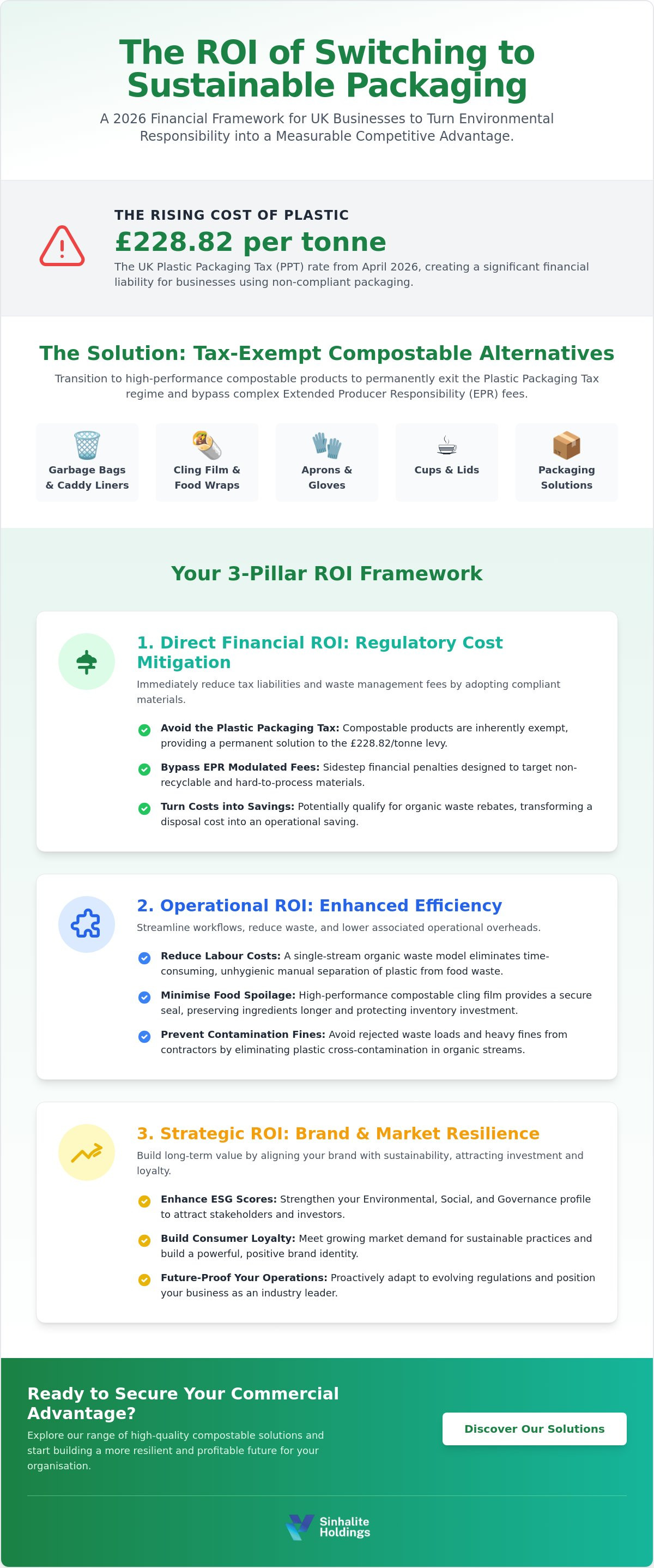
The fiscal reality of 2026 has transformed packaging from a simple procurement commodity into a strategic financial liability. For organisations still relying on traditional polymers, the UK Plastic Packaging Tax (PPT) is no longer a minor levy; it's a significant budgetary drain. As of 1 April 2026, the tax has risen to £228.82 per tonne, making it essential for commercial entities to evaluate their material choices through a rigorous Life-Cycle Assessment (LCA). By identifying the total environmental impact of every garbage bag and shipping wrap, businesses can begin the process of calculating the ROI of switching to sustainable packaging with clinical precision.
To better understand this concept, watch this helpful video:
Avoiding the Plastic Packaging Tax
Traditional plastic packaging must contain at least 30% recycled content to avoid the PPT, but this threshold is becoming increasingly difficult to maintain as global supply chains for high-quality recycled resins tighten. Transitioning to compostable alternatives, such as our compostable shopping bags and food roller bags, offers a permanent exit from this tax regime. These materials are inherently exempt because they're designed for organic recovery rather than traditional plastic recycling streams. If you're looking for a deeper dive into these requirements, you can read our guide on plastic packaging tax explained for small business to ensure your procurement strategy remains compliant.
EPR and the Cost of Non-Compliance
The introduction of modulated fees under Extended Producer Responsibility has created a clear financial penalty for non-recyclable or difficult-to-process materials. We define pEPR as a financial mechanism that penalises non-recyclable materials by 2026, effectively shifting the cost of waste management from the public sector back to the producer. By March 2026, UK businesses must align with DEFRA’s Simpler Recycling standards to avoid escalating waste management levies. Switching to compostable liners and caddy bags allows organisations to bypass these complex fees while potentially qualifying for organic waste rebates. This shift effectively turns a disposal cost into an operational saving, further justifying the methodology for calculating the ROI of switching to sustainable packaging.
Operational ROI: Efficiency in Waste Management
When calculating the ROI of switching to sustainable packaging, businesses often overlook the substantial labour savings found in simplified waste segregation. Labour remains a significant overhead for any commercial kitchen or large organisation. By adopting a single-stream organic waste model, your team can dispose of food scraps, soiled paper, and compostable liners in one motion. This eliminates the need for manual plastic removal from food waste caddies, a task that is both time-consuming and unhygienic. While global standards like the EPA guidelines on sustainable packaging emphasise environmental health, the immediate commercial benefit for UK operators lies in this operational simplicity.
Performance is a critical component of any financial equation. If a material fails to perform, the resulting waste quickly erodes any perceived savings. This is why choosing compostable cling film that actually clings is vital for reducing food spoilage costs. A secure seal preserves ingredients longer, directly protecting your inventory investment. Similarly, using compostable aprons and gloves in commercial kitchens prevents the cross-contamination of recycling streams. When these items are made from traditional plastic, they often end up accidentally mixed with organic waste, leading to rejected loads and heavy contamination fines from waste contractors.
Practical hygiene also plays a role in the bottom line. High-quality compostable sacks create a breathable barrier that reduces moisture buildup, significantly lowering bin cleaning frequency and the associated costs of industrial chemicals. Explore our range of compostable garbage bags and liners to start optimising your waste stream today.
Streamlining Commercial Kitchens and Delis
Efficiency in fast-paced environments requires tools that match the speed of service. Implementing compostable food bags on a roll for delis allows staff to package fresh produce or baked goods quickly while ensuring the entire package remains compatible with organic waste streams. It's a scalable solution that removes the friction of sorting materials during peak hours.
Hygiene and Disposal Savings
Leak-proof compostable garbage bags provide a financial benefit by reducing the risk of splits and spills that attract pests. Maintaining a sanitary environment is essential for avoiding expensive emergency pest control call-outs. Furthermore, understanding how to keep a food waste bin from smelling contributes to a better working environment, which is a key factor in staff retention and overall morale.
Strategic ROI: Brand Equity and Market Resilience
While immediate tax savings and operational speed are compelling, the long-term value of calculating the ROI of switching to sustainable packaging lies in market resilience. In 2026, consumer expectations have shifted from passive approval to active demand. Research indicates that 77% of consumers trust brands more when their packaging is eco-friendly, and 32% are willing to pay between 6% and 10% more for sustainably packaged goods. This shift is a powerful driver for customer retention. Additionally, robust ESG reporting is now a requirement for securing competitive financing. Transitioning to compostable materials directly improves your "Environmental" score, making your organisation a more attractive prospect for investors and lenders who prioritise long-term systemic impact.
Future-proofing your supply chain today prevents the "Planning Paradox," where businesses wait for legislation to catch up and then face inflated costs during a last-minute scramble. Proactively switching business to sustainable packaging protects your operations against future plastic bans and evolving regulatory levies. This visionary approach ensures that your brand remains a leader rather than a laggard in a circular economy.
Capturing the Conscious Consumer
Your packaging is often the most visible representation of your brand's ethics. Using compostable carrier bags for takeaways acts as a mobile billboard, communicating your commitment to environmental stewardship to every passerby. This transparent alignment with modern values fosters deep loyalty, as consumers increasingly seek out brands that don't compromise the planet's future for short-term convenience.
The 5-Step ROI Audit for Sustainable Packaging
To accurately assess your transition, follow this structured audit process:
- Audit Current Spend: Calculate your total annual expenditure on traditional plastics, including tax and disposal fees.
- Identify Quick Wins: Target high-volume items like compostable clingfilm and garbage bags for immediate impact.
- Assess Performance Gains: Factor in reduced food spoilage and labour savings from single-stream waste disposal.
- Quantify Brand Value: Estimate the impact on customer acquisition and retention rates.
- Project Future Compliance: Account for the avoidance of upcoming EPR fees and waste management levies.
Future-Proofing Your Business Through Responsible Innovation
Navigating the fiscal shifts of 2026 requires a transition from reactive procurement to proactive strategy. We have demonstrated how avoiding the £228.82 per tonne Plastic Packaging Tax and streamlining internal waste through single-stream disposal creates immediate budgetary relief. These operational efficiencies, combined with the heightened brand loyalty of conscious consumers, form a powerful commercial argument for change. Calculating the ROI of switching to sustainable packaging must account for these diverse factors, moving beyond simple unit costs to include regulatory savings and long-term market resilience.
Sinhalite Holdings is your dedicated partner in this journey. We specialise in high-performance compostable clingfilm and robust garbage bags, providing the tangible tools needed for a circular economy. With our UK-wide distribution and expert guidance on 2026 UK waste compliance, we ensure your organisation remains competitive and ethically aligned. It's time to replace outdated materials with solutions that protect both your margins and the environment. Calculate your switch to sustainability with Sinhalite Holdings and join the movement toward a more responsible and prosperous future.
Frequently Asked Questions
Is compostable packaging really more expensive than plastic for UK businesses in 2026?
While the initial unit cost of compostable materials can be higher than virgin plastic, the total cost of ownership tells a different story in 2026. When you factor in the UK Plastic Packaging Tax and the escalating fees for non-recyclable waste disposal, the price gap narrows significantly. Many organisations find that the long-term stability of compostable procurement protects them from the volatile price fluctuations often associated with fossil-fuel-based polymers.
How does the Plastic Packaging Tax affect the ROI of compostable alternatives?
The Plastic Packaging Tax acts as a direct financial incentive for sustainable procurement by adding £228.82 per tonne to plastic packaging with less than 30% recycled content. Because compostable alternatives are exempt from this levy, they provide a more predictable cost structure. This exemption is a core component when calculating the ROI of switching to sustainable packaging, as it effectively reduces the financial barrier to adopting cleaner, circular materials.
Can switching to compostable clingfilm actually save my business money?
Yes, switching to high-performance compostable clingfilm can reduce costs by protecting your inventory from premature spoilage. A superior seal preserves fresh produce and ingredients for longer, which directly lowers your food waste expenses. Additionally, using compostable wrap allows for single-stream organic waste disposal. This reduces the labour hours spent on separating plastic contaminants from food waste caddies, allowing your team to focus on high-value tasks instead.
What is the expected payback period for switching to a full compostable packaging suite?
Most commercial entities observe a payback period of between 6 and 18 months, though this depends on total volume and current tax exposure. Initial investments in items like compostable shopping bags and garbage bags are quickly offset by the reduction in waste management levies and the avoidance of plastic taxes. Beyond direct savings, the boost in brand equity and customer retention often accelerates the financial return on your sustainability investment.


